

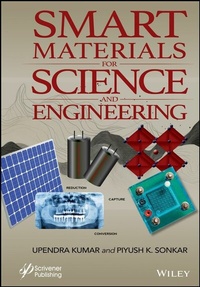
Smart Materials for Science and Engineering
Description

Smart materials, also known as advanced or creative materials, are described as advanced materials that react intuitively to environmental changes or as materials that can return to their original shape in response to certain stimuli. Smart materials are classified as either active or passive based on their characteristics. There are two types of active materials. The first kind cannot change its characteristics when subjected to outside stimuli, for example photochromatic spectacles that only alter their color when exposed to sunlight. The other, which includes piezoelectric materials, can change one sort of energy (thermal, electrical, chemical, mechanical, or optical) into another. When subjected to external pressure, it can generate an electric charge. As an example, optical fibers can transmit electromagnetic waves. In contrast, passive smart materials can transmit a specific sort of energy. They have some amazing qualities that set them apart from other materials, such as transiency, meaning they can react to different kinds of external stimuli immediately, self-actuation or the capacity to change their appearance and shape, selectivity where the response is divided and expected, directness when the response is limited to the activating event, shape-changing where the material can change its shape to external stimuli, their ability to determine their own health, also known as self-diagnosis, and their ability to self-heal.
The ability to synthesize novel materials has substantially progressed thanks to science and technology over the past 20 years. They fall mostly into the following four categories: polymers, ceramics, metals, and smart materials. Among these, smart materials are gaining popularity since they have more uses than conventional materials. Smart materials are unusual substances that have the ability to alter their properties, such as those that can immediately change their phase when placed near a magnet or their shape simply by applying heat. Humanity will be significantly impacted by this new era of smart materials. For instance, some of them can adapt their properties to the environment, some have sensory capabilities, some can repair themselves automatically, and some can degrade themselves. These extraordinary properties of smart materials will have an effect on all facets of civilization. There are many different types of intelligent materials, including magnetorheological materials, electro-rheostat materials, shape memory alloys, piezoelectric materials, and more.
This book describes many forms of smart materials and their possible uses in various fields. A literature survey discusses the different types of smart materials, such as based ceramics, polymers, and organic compounds and their needs, advantages, disadvantages, and applications will be comprehensively discussed. A discussion of well-established smart materials including piezoelectric, magnetostrictive, shape memory alloy, electro-rheological fluid, and magnetorheological fluid materials will be discussed with their present prospects.
More details
Other editions
Additional editions
Persons
Upendra Kumar, PhD has been an assistant professor in the Department of Applied Science at the Indian Institute of Information Technology, Allahabad, Uttar Pradesh, India since 2021. His research has been published in prestigious international Science Citation Index physics and materials science publications and he has received numerous awards in the field. He has also made an impact by attending numerous scientific conferences, seminars, and workshops and serving on a number of national committees and professional bodies and associations.
Piyush K. Sonkar, PhD is an assistant professor in the Department of Chemistry, Banaras Hindu University, Varanasi-India. His research interests include nanomaterials, nanocomposites, fuel cells, electrochemical devices, supercapacitors, bio-sensors, chemical sensors, and new materials. He has published more than 38 international and national research papers in various reputed journals.
Content
Preface xvii
Acknowledgements xix
Scope of the Book xxi
1 Introduction: Historical Overview, Current and Future Perspective 1
Unni kisan, R.R. Awashthi and Sanjeev Kumar Trivedi
1.1 Introduction 1
1.2 Historical Overview of Smart Material 4
1.3 About Smart Materials 6
1.4 Current and Future Perspectives of Smart Materials 11
2 Fabrication and Characterization Tools for Organic Semiconductors as Smart Materials in Optoelectronic Device Applications 17
Minakshi Sharma, Chandra Mohan Singh Negi, Parvez Ahmed Alvi and Saral Kumar Gupta
2.1 Introduction 18
2.2 Overview of Organic Semiconductors 18
2.3 Optoelectronic Properties of Conjugated Polymers 19
2.4 Optoelectronic Devices 19
2.5 Overview of Smart Materials 22
2.6 Methods and Techniques 25
2.7 Methodology 29
2.8 Characterization Techniques 30
2.9 Conclusion and Future Work 34
3 Smart Scaffold Constructs for Regenerative Medicine and Tissue Engineering 39
Princy Choudhary, Ayushi Gupta, Saurabh Kumar Gupta, Shrey Dwivedi and Sangeeta Singh
3.1 Introduction 39
3.2 Applications of Smart Scaffolds in Different Areas 43
3.3 Future Advancements and Techniques to Improve Efficiency of Scaffolds 60
3.4 Conclusion 63
4 Application of Smart Materials in Dental Sciences 75
Ruqaiya Saleem, Amaresh Kumar Sahoo and Shalini Gupta
4.1 Introduction 76
4.2 Clinical Applications of Smart Materials in Various Branches of Dentistry 77
4.3 Conclusion 85
5 Graphene-Related Smart Material (GRSM): Synthesis, Characterization, and Application in Optoelectronics Devices 89
Varsha Yadav, Rahul Bhatnagar and Saral Kumar Gupta
5.1 Introduction 89
5.2 Experimental Methods and Materials 94
5.3 Results and Discussion 96
5.4 Conclusions 100
6 Synthesis and Characterization of Mechanical and Microstructural Properties of Fly-Ash-Reinforced Aluminum-Based Metal Matrix Composite 105
Rahul Bhatnagar and Varsha Yadav
6.1 Introduction 105
6.2 Materials and Methods 109
6.3 Results and Discussion 112
6.4 Conclusion 115
7 Organic Smart Materials: Synthesis, Characterization, and Application 121
Shivaleela B. and S. M. Hanagodimath
7.1 Introduction 121
7.2 Organic Smart Materials 122
7.3 Materials and Experimental Methods 124
7.4 Synthesis of Organic Smart Materials 125
7.5 Results and Discussion 127
7.6 Applications 131
7.7 Conclusions 133
8 Magnetostrictive Material-Based Smart Materials, Synthesis, Properties, and Applications 135
inki Singh and Sonam Perween
8.1 Introduction 136
8.2 Overview of Smart Materials Based on Magnetostrictive Materials 137
8.3 Origin of Magnetostriction 138
8.4 Synthesis of Magnetostrictive Materials 140
8.5 Properties of Magnetostrictive Materials 141
8.6 Methods of Magnetostrictive Property Measurement 144
8.7 Application of the Magnetostrictive Smart Materials 145
8.8 Conclusion 148
9 Materials Development of Supercapacitors--Promising Device for Future Energy Storage Applications 151
Ram Chhavi Sharma
9.1 Introduction 151
9.2 Principle of Operation of Conventional Capacitors and Supercapacitor 154
9.3 Types of Supercapacitors 155
9.4 Development of Advanced Materials for Supercapacitors 160
9.5 Applications of Supercapacitors 164
9.6 Conclusion 166
10 Smart Solid Electrolyte Materials in Energy Storage Devices: Batteries 173
Pawan Kumar, Shalu Rani and Sanjay Kumar
10.1 Introduction 173
10.2 Fundamental Aspects, Different Types of Electrolytes, and the Role of the Electrolyte in Battery Technology 175
10.3 Conductivity Enhancement Approach in Solid Electrolyte Materials 182
10.4 Synthesis Approaches for Solid Electrolytes 184
10.5 Conclusion and Future Perspective 186
11 Smart Materials in Energy Storage Devices: Solar Cells 191
Indu Sharma, Neha Bisht, Parag R. Patil, Pravin S. Pawar, Rahul Kumar Yadav, Yong Tae Kim and Jaeyeong Heo
11.1 Introduction 191
11.2 Types of Solar Cells 194
11.3 Future Trends and Possibilities for Tackling the Challenges in the Improvement of Smart Materials 209
11.4 Summary 212
12 Mixed-Dimensional 2D-3D Perovskite Solar Cells: Origin, Development, and Applications 221
Vani Pawar, Bhumika Sharma and Sushobhan Avasthi
12.1 Introduction 222
12.2 Perovskite Solar Cells (PSCs) 223
12.3 Low-Dimensional (2D or 2D-3D Mixed) Perovskites 229
12.4 Ruddlesden-Popper (RP) Perovskites 231
12.5 Dion-Jacobson (DJ) Perovskites 239
12.6 Alternating Cation Interlayers 244
12.7 Additive Engineering 249
12.8 Compositional Engineering 252
12.9 Functional Perovskite Photovoltaics 254
12.10 Conclusion and Future Outlook 259
13 Advanced Materials in Energy Conversion Devices: Fuel Cells and Biofuel Cells 269
Amit Kumar Verma, Prerna Tripathi, Akhoury Sudhir Kumar Sinha and Shikha Singh
13.1 Introduction 269
13.2 Fuel Cell Types and Advancement in Electrode Materials 273
13.3 Current Application Status 279
13.4 Challenges 279
13.5 Conclusion 280
14 Smart Materials in Energy Storage Devices: Fuel Cells and Biofuel Cells 287
Baliram Gurunath Rathod and Venkata Giridhar Poosarla
14.1 Introduction 287
14.2 Relation of Smart Materials and MFCs 288
14.3 MFCs and Their Mechanism 289
14.4 Classification of MFCs 291
14.5 Microorganisms Involved in MFCs 291
14.6 MFC Systems 293
14.7 Design of MFCs 294
14.8 Functions/Operations of MFCs 296
14.9 Components of MFCs 297
14.10 Energy from MFCs 298
14.11 Recent Developments and Challenges in Smart Materials for Energy Storage Devices 299
14.12 Future Perspectives 299
14.13 Conclusion 300
15 Role of Smart Materials in Environmental Remediation: CO2 Capture and CO2 Reduction 305
Yogendra K. Gautam, Durvesh Gautam, Manohar Singh, Himani, Kavita Sharma, Beer Pal Singh and Anuj Kumar
15.1 Introduction 305
15.2 CO2 Reduction Techniques 307
15.3 Conclusion 318
16 Soft Perovskite Semiconductors for Future Optical Electronics 325
Rashmi Yadav and Bhoopendra Yadav
16.1 Introduction 325
16.2 Perovskite Structure and Characteristics 326
16.3 Composition Engineering Effects 327
16.4 Interface Engineering Effects 328
16.5 Bandgap Engineering Effects 328
16.6 Stability and Degradation Mechanism in Perovskite Solar Cells (PSCs) 330
16.7 Novel Applications 332
16.8 Conclusion 332
17 Band Gap Engineering and Nanopatterning of Muscovite Mica by Low-Energy Ion Beams Applicable for Futuristic Microelectronics 337
Dipak Bhowmik, Joy Mukherjee and Prasanta Karmakar
17.1 Introduction 337
17.2 Experimental Details 338
17.3 Nanopattern Formation on Mica Surface and Its Wettability Property by Low-Energy Ion 340
17.4 Band Gap Engineering of Muscovite Mica by Low-Energy Ion Beam svia Few-Layer and Monolayer Modification 350
17.5 Conclusion 356
Acknowledgments 357
References 357
About the Editors 361
Index 363
1
Introduction: Historical Overview, Current and Future Perspective
Unni kisan*, R.R. Awashthi and Sanjeev Kumar Trivedi
Faculty of Engineering and Technology, KMC Language University, Lucknow, India
Abstract
Human civilization was dependent on the use of materials in the ancient era as it is today. Humans started using stone before progressing to functional nanomaterials; today, humans benefit from using new advanced materials named smart materials. In the present scenario, humans develop different types of smart materials like piezoelectric materials, magnetostrictive materials, dielectrics, thermoelectric materials, nano-medicines, shape-memory alloys, and rheological fluids. These types of smart materials are applicable for sensing devices, data storage, fast commutation, cloud computing, and different engineering as well as medical tools and equipment. Biodegradable and low-cost smart materials will develop due to the synthesis of different amalgamation of materials in the future. The newly developed smart materials may be rapidly used in the engineering, medical, and the information technology sectors.
This book chapter aims to promote awareness on smart materials for the extensive research and knowledge enhancement for new applications in the future. Historical views and modern and future perspectives of smart materials are discussed in this chapter.
Keywords: Historical overview, smart materials, current prospective, future prospective, application of smart materials
1.1 Introduction
In ancient times, humans used different materials for various purposes, due to which there was an enhancement in their living standards. Civilizations were categorized on the basis of their invention of material; the primary age was the Stone Age. Bronze Age was the most radical and was more sustainable. The development of bronze signified the start of a new metallurgical age, which saw the synthesis of numerous materials. Engineering and technology have made significant advancements in the manufacture of novel materials during the last two decades. They could be subdivided primarily into four groups: polymers, ceramics, metals, and smart materials. Because they have more applications than traditional materials, smart materials are among them and are growing in popularity. Smart materials are unique materials with the capability of changing their properties, such as substances that may instantly change their phase when placed near a magnet or their shape by simply reheating. These unexpected abilities of advanced material will have an effect on every aspect of civilization [1].
The terms "smart," "intelligent," and "adaptive" were first used to describe the newly developing field of research that involved incorporating electro-active efficient materials in massive structures as in actuators and in situ sensors in the beginning of the 1980s. Tiny and microstructure transducers and precise mechatronics (mechanical + electrical) controllers constituted the only applications for electro active materials in the past [2].
Mecha, which signifies mechanical, and tronics are terms from the fields of electrical and electronic engineering, etc. Also included is digital engineering. In the other meaning, as produced items and technologies are advanced, it will become gradually difficult to distinguish the electronics between how deeply and naturally they are incorporated into processes. When seen in the context of systems design, the field of mechatronics could be characterized as the intersection of these three main domains rather than just the total of the three. Figure 1.1 [3] depicts mechatronics' multidisciplinary approach. "The effective integration of electronic control, systems thinking, and precision mechanical engineering in the design of goods and industrial processes" [4].
During the 19th century, mechanical engineering as a popular discipline saw a burst in growth as it established the groundwork of successful and quick advancement for the revolution of the industry. Mechanical, electrical, civil, and chemical engineering were the four main engineering disciplines of the 20th century. These disciplines still have their own bodies of knowledge, textbooks, and professional journals since they are thought to have separate intellectual and professional domains. Entrants might evaluate their unique intellectual abilities and select one of the fields as a career. The information revolution is a current scientific and social change that we are currently witnessing, and oddly, engineering expertise appears to be both concentrating and diversifying. The advancement of engineering electronics that has sparked communication and information that revolutionized people is what gave rise to this modern revolution. One of the newest and most fascinating areas of engineering is mechatronics, which incorporates elements of more established disciplines and necessitates a more comprehensive approach to the design of what we can properly refer to as mechatronic systems. So, exactly what is mechatronics? The word "mechatronics" refers to a multidisciplinary subject of engineering that is currently in rapid development. The term "mechatronics" was first used in Japan in the late 1960s; it later gained popularity in Europe and is now widely used in the US. Mechatronic system design primarily draws on the fields of mechanics, semiconductors, controls, and computer engineering.
Figure 1.1 Mechatronics: a multi-disciplinary approach [4].
An engineer of mechatronic systems must be capable of construction and choose digital and analogical circuitry systems, micro-processor-based elements, mechanical components, actuators, and sensors so that the finished result meets the necessary objectives. Smart devices are another name for mechatronic systems. Although a specific definition of the word "smart" is elusive, in the context of engineering, we refer to the incorporation of aspects like computing, logic, and feedback system that are combined in a complex design, which may appear to emulate human thought procedures. The engineering of mechatronic systems requires knowledge from numerous domains, making it difficult to encapsulate within a traditional field of engineering. The designer of mechatronic systems needs to be a generalist who is eager to learn from a variety of sources and apply it to their work. The learner may initially feel intimidated by this, yet it has many advantages for originality and lifelong learning. Nowadays, almost all mechanical machines come equipped with electrical parts and some kind of computer monitoring or control. As a result, a widespread array of system and components fall under the mechatronic systems. Microcontrollers are being included into electromechanical devices increasingly frequently, giving system designers far greater flexibility and control. All the components of an engineering mechatronic system are shown in Figure 1.2. The interface circuit between the input/output and control circuits are controlled by the digital devices [3].
The engineering disciplines that deal with the design of controlled electromechanical systems are currently in a process of evolutionary transformation. A mechanical system that is computer controlled is referred to as mechatronic. Control decisions are frequently made by an embedded computer rather than a general-purpose computer. Yaskawa Electric Company engineers originally used the term "mechatronics" Nowadays, an embedded computer controller is almost built into every electromechanical system. As a result, concerns with computer hardware and software are included in the discipline of mechatronics when applied to the control of electromechanical systems. The field of mechatronics as we know it today would not exist if cheap microcontrollers were not widely available for the mainstream market. The application of computer control in countless consumer products is made possible by the accessibility of embedded microprocessors for the mass market at continually decreasing cost and rising performance. The preceding model [3] is the outdated model for an electromechanical product design team.
Figure 1.2 Mechanical components in mechatronics system.
Figure 1.3 Structronics-A multidiscipline integration.
- Engineers who design a manufacturer's mechanical parts;
- Engineers who create a product's electrical parts, including actuators, sensors, amplifiers, and other devices, as well as the control logic and algorithms;
- Computer hardware and software developers who design the real-time controls for the product.
Adaptive materials or structures, and smart and intelligent materials are generally thought to have the capacity to be sophisticated, trendy, and active. In Figure 1.3, the structronic system is depicted. As a consequence, the objective of this study is to discuss the fundamental properties, design concepts, and real-world uses of the major smart materials listed in Table 1.1, the smart materials that have been studied. Also covered are the specifications for multifield optothermoelectro mechanical systems, which are used to solve various challenging field control problems coupling thermal, magnetic, electric, magnetic, and optical interactions [2].
1.2 Historical Overview of Smart Material
In 1880, quartz crystals were subjected to mechanical forces and the Curie brothers...
