

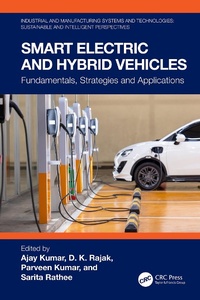
Smart Electric and Hybrid Vehicles
Fundamentals, Strategies and Applications
1st Edition
Published on 14. August 2024
238 pages
978-1-040-09566-9 (ISBN)
Description

This book presents an analysis of the existing surveys in the literature of batteries, chargers, control systems, battery management systems, plugs, sockets, drives, and fuel-cell-based and plug-in smart electric and hybrid vehicles. It provides detailed comparative analysis of parameters of intelligent electric and hybrid vehicles with conventional vehicles and in-depth knowledge of power electronics tools in smart electric and hybrid vehicles. This book compiles the research work and findings in advancements of smart electric and hybrid vehicles from automobile, mechanical, electronic, electrical, computer science, and allied engineering domains and explains how smart electric and hybrid vehicles can be utilized without harmful emissions over the entire lifecycle of a vehicle and how reliance on fossil fuels can be reduced.
Features:
Discusses different types of lightweight and robust materials for the fabrication of smart electric and hybrid vehicles
Presents computational models, emerging technologies, numerical techniques, and environmental and economic benefits applicable to electric vehicles
Highlights the applications of smart and hybrid vehicles in diverse sectors including aerospace, agriculture, defense, and medical
Covers electromechanical drives, storage systems, wireless charging, and component design for smart electric and hybrid vehicles
Showcases a detailed comparative analysis of parameters of intelligent electric and hybrid vehicles with conventional vehicles
It is primarily written for senior undergraduates, graduate students, and academic researchers in the fields of electrical engineering, electrical and electronics engineering, computer engineering, and automotive engineering.
Features:
Discusses different types of lightweight and robust materials for the fabrication of smart electric and hybrid vehicles
Presents computational models, emerging technologies, numerical techniques, and environmental and economic benefits applicable to electric vehicles
Highlights the applications of smart and hybrid vehicles in diverse sectors including aerospace, agriculture, defense, and medical
Covers electromechanical drives, storage systems, wireless charging, and component design for smart electric and hybrid vehicles
Showcases a detailed comparative analysis of parameters of intelligent electric and hybrid vehicles with conventional vehicles
It is primarily written for senior undergraduates, graduate students, and academic researchers in the fields of electrical engineering, electrical and electronics engineering, computer engineering, and automotive engineering.
More details
Series
Edition
1. Auflage
Language
English
Place of publication
London
United Kingdom
Publishing group
Taylor & Francis Ltd
Target group
College/higher education
Professional and scholarly
Illustrations
45 Tables, black and white; 43 Line drawings, black and white; 18 Halftones, black and white; 61 Illustrations, black and white
ISBN-13
978-1-040-09566-9 (9781040095669)
Copyright in bibliographic data and cover images is held by Nielsen Book Services Limited or by the publishers or by their respective licensors: all rights reserved.
Schweitzer Classification
Other editions
Additional editions
Ajay Kumar | D. K. Rajak | Parveen Kumar
Smart Electric and Hybrid Vehicles
Fundamentals, Strategies and Applications
Book
approx. 07/2026
1st Edition
CRC Press
€66.00
Not yet published
Ajay Kumar | D. K. Rajak | Parveen Kumar
Smart Electric and Hybrid Vehicles
Fundamentals, Strategies and Applications
Book
08/2024
1st Edition
CRC Press
€145.60
Shipment within 10-20 days

Ajay Kumar | D. K. Rajak | Parveen Kumar
Smart Electric and Hybrid Vehicles
Book
07/2024
CRC Press
Unfortunately, price unknown
Article exhausted; check different version
Persons
Ajay Kumar is currently serving as an Associate Professor in Mechanical Engineering Department, School of Engineering and Technology, JECRC University, Jaipur, Rajasthan, India. He received his Ph.D. in the field of Advanced Manufacturing from Guru Jambheshwar University of Science & Technology, Hisar, India after B.Tech. (Hons.) and M. Tech. (Distinction) from Maharshi Dayanand University, Rohtak, India. His areas of research include Artificial Intelligence, Intelligent Manufacturing, Incremental Sheet Forming, Additive Manufacturing, Intelligent vehicles, advanced manufacturing, Industry 4.0, Waste management, and optimization techniques.
D. K. Rajak is a doctorate in material and design engineering from Indian Institute of Technology (ISM) Dhanbad, Jharkhand-India. The academic achievements are manifested in his original research contributions through over 120 papers published in refereed international journal, including 18-patents, 02-designs, 12-book chapters, and 02-books. These contributions are well reckoned as shown through numerous citations to his papers more than 1900.
Parveen Kumar is currently serving as an Assistant Professor and Head in Department of Mechanical Engineering at Rawal Institute of Engineering and Technology, Faridabad, Haryana, India. Currently, he is pursuing Ph.D. from National Institute of Technology, Kurukshetra, Haryana, India. He completed his B.Tech. (Hons.) from Kurukshetra University, Kurukshetra, India and M. Tech. (Distinction) in Manufacturing and Automation from Maharshi Dayanand University, Rohtak, India. His areas of research include Intelligent Manufacturing Systems, Materials; Die less Forming, Design of Automotive systems, Additive Manufacturing, CAD/CAM and artificial Intelligence, machine learning and Internet of Things in manufacturing, multi objective optimization techniques.
Sarita Rathee is currently serving as an Assistant Professor in Department of Electrical and Electronics Engineering, School of Engineering and Technology, JECRC University, Jaipur, Rajasthan, India. She received her M. Tech (Distinction) in the field of Electrical and Electronics Engineering from Maharshi Dayanand University, Rohtak, India after B.Tech. (Hons.) in electrical engineering. Her areas of research include Artificial Intelligence, IOT, cloud computing, Industry 4.0, Waste management, and optimization techniques.
D. K. Rajak is a doctorate in material and design engineering from Indian Institute of Technology (ISM) Dhanbad, Jharkhand-India. The academic achievements are manifested in his original research contributions through over 120 papers published in refereed international journal, including 18-patents, 02-designs, 12-book chapters, and 02-books. These contributions are well reckoned as shown through numerous citations to his papers more than 1900.
Parveen Kumar is currently serving as an Assistant Professor and Head in Department of Mechanical Engineering at Rawal Institute of Engineering and Technology, Faridabad, Haryana, India. Currently, he is pursuing Ph.D. from National Institute of Technology, Kurukshetra, Haryana, India. He completed his B.Tech. (Hons.) from Kurukshetra University, Kurukshetra, India and M. Tech. (Distinction) in Manufacturing and Automation from Maharshi Dayanand University, Rohtak, India. His areas of research include Intelligent Manufacturing Systems, Materials; Die less Forming, Design of Automotive systems, Additive Manufacturing, CAD/CAM and artificial Intelligence, machine learning and Internet of Things in manufacturing, multi objective optimization techniques.
Sarita Rathee is currently serving as an Assistant Professor in Department of Electrical and Electronics Engineering, School of Engineering and Technology, JECRC University, Jaipur, Rajasthan, India. She received her M. Tech (Distinction) in the field of Electrical and Electronics Engineering from Maharshi Dayanand University, Rohtak, India after B.Tech. (Hons.) in electrical engineering. Her areas of research include Artificial Intelligence, IOT, cloud computing, Industry 4.0, Waste management, and optimization techniques.
Content
1. An Overview on Electric Vehicles: Technologies, Emissions, and Challenges. 2. A Comprehensive Review on Rechargeable Batteries: Technologies, Advancements, and Comparative Analysis. 3. Fabrication of Test Rig to Analyze the Effects of Variable Belt Tension in a CVT System. 4. An analysis of start stop system for energy efficient micro hybrid two-wheeler. 5. Optimization of Electric Vehicle Lithium-ion battery parameter by using. 6. Energizing the Future: Electric Vehicle Charging infrastructure, Integration, and Policy Perspectives. 7. Modeling of Electronic - Waste Recycling Intentions among Generation Z. 8. Vision-Based Target Tracking for UAVs using Yolov2 Deep Algorithms. 9. Flight Delay Prediction: A Comprehensive Review of Models, Methods, and Trends. 10. Selection of Electric Car using Multi-Attribute Decision-Making Methods. 11. People's perception of Electric Vehicles in developing countries: A case study of Jaipur city. 12. Significance of AI in Automobiles.
