

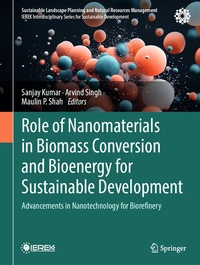
Role of Nanomaterials in Biomass Conversion and Bioenergy for Sustainable Development
Description

This book provides an extensive discussion of the most current techniques and applications of nanomaterials in processes that produce bioenergy. In view of the necessity of protecting the environment and rising global energy requirements, bioenergy has gained enormous and escalating attention as an eco-friendly substitute for conventional fuels. Biomass typically yields biogas, bio-oil, biodiesel, bio-alcohol, biohydrogen, biofuel, and several other bioenergy outputs. The generation of these biofuels relies on catalysts, in addition to other factors and components. Researchers have made exceptional efforts to develop catalysts, particularly nano-catalysts and support materials, in order to enhance reaction performance, expedite the production process, or provide an environmentally benign approach. Nanoparticles are used in biochemical processes to immobilize enzymes, increasing their effectiveness. Researchers are also employing nanocatalysts in the transesterification process to produce biodiesel and enhance yields. Furthermore, upgrading biomass-derived products is now a major area of research. Thermochemical conversion of biomass in bioenergy generation is the oldest technology, now effectively utilizing nanoparticles to get rid of CO2 emissions and maximize output in the form of energy. Nanotechnology has also the potential to significantly contribute to biofuel production by lowering processing costs and improving efficiency. This study focuses on the strategic use of nanomaterials such as metallic nanoparticles, nanocomposites, carbon-based nanomaterials, and nanobiochar in all areas of the bio-derived energy generation process. This book enhances the bioenergy experience for readers by offering a comprehensive and comparative perspective. It provides a concise framework for researchers in the domains of chemistry, renewable, the environment, and process engineering. The book also focuses specifically on how bioenergy processes integrated with nanotechnology could improve and scale up.
More details
Other editions
Additional editions
Persons
Sanjay Kumar is a dynamic researcher in the field of wastewater treatment and energy generation area for 5 years. He has achieved best research award for his doctoral dissertation. His research interest includes Electrochemical Wastewater Treatment, Phytoremediation Process Using Aquatic Plants, Energy Generation (Battery, Fuel cells), and Electrochemical Modelling. He published more than 13 publications in reputed international journals and along with 10 book chapters and one book in Springer Nature.
Arvind Singh mainly focuses his research on the development of materials for energy applications and processes for the bioremediation of pollutants. Other areas of interest included the development of catalysts and their characterization for hydrogen production, and the findings have appeared in journals of international repute. His current research revolves around the convergence of biotechnology and chemical engineering in addressing the needs of the country in terms of expected energy concerns and water pollution. He published more than 16 publications in reputed international journals and along with 3 book chapters.
Maulin P Shah is an active researcher and scientific writer in his field for over 20 years. His research interests include Biological Wastewater Treatment, Environmental Microbiology, Biodegradation, Bioremediation, and Phytoremediation of Environmental Pollutants from Industrial Wastewaters. He has published more than 350 research papers in national and international journals of repute on various aspects of microbial biodegradation and bioremediation of environmental pollutants.
Content
Nanomaterial for bio-oil production from biomass.- Role of nanomaterial in bio-gas production.- Nanomaterial Incorporation as nanocatalyst in microalgae cultivation and algal- refinery.- Nanomaterial-derived electrode in microbial fuel cell.- Carbon-based Material in Biofuel Generation.- Nanomaterial in bio-hydrogen production.- Use of nanomaterial in biomass gasification.- Nanosized Metal oxide in up-gradation of bio-oil.- Nanotechnology in Enzyme immobilization for biofuel production.- Advances in nanotechnology in upgrading biomass to biofuels.- Application of Nano-material in catalytic pyrolysis of biomass.- Nanostructured material for Furfural to alcohols conversion process.- Potential of nanomaterial in Transesterification of Bio-oil.- Advancement in synthesis process in preparation of nano-composite for bio- energy generations.- Role of support material in synthesis of nano-composite for bio-energy generations.- Advanced Nanomaterials Synthesis during Bioenergy Production.
