

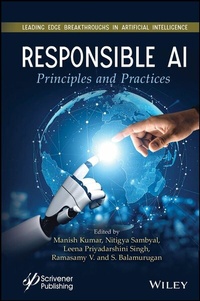
Responsible AI
Description

Bridge the gap between groundbreaking AI innovation and ethical responsibility with this comprehensive guide to the expert-led frameworks needed to navigate the complex legal, social, and moral landscapes of our digital future.
Artificial Intelligence (AI) has emerged as a transformative force with the ability to bring new innovations to reshape economies, industries, and our daily lives. From advanced medical diagnostics to autonomous vehicles, AI systems are driving incomparable innovations in every sector. These advancements promise unmatched benefits and provide the potential to solve some of humanity's most pressing challenges. However, there are many potential challenges and significant risks that come alongside the benefits provided by AI.
This book offers a multidisciplinary viewpoint on how to develop and use AI systems responsibly by offering a deep dive into the ethical, legal, and societal ramifications of artificial intelligence. It explores important subjects such as algorithmic fairness, transparency, accountability, and governance through contributions from notable academics, engineers, and policy specialists. It highlights how crucial it is to match AI development with democratic norms and human values, offering both theoretical frameworks and workable implementation solutions for a range of industries. This comprehensive guide is an essential resource for scholars, professionals, and legislators dedicated to making sure that AI technology is created and applied in ways that are moral, inclusive, and advantageous to society.
The reader will find the volume:
- Provides a multidisciplinary exploration of the ethical, legal, and social dimensions of AI;
- Bridges the gap between AI theory and real-world applications through practical frameworks;
- Covers key topics such as fairness, transparency, accountability, and governance;
- Serves as a valuable resource for researchers, practitioners, and policymakers aiming to build trustworthy AI systems.
Audience
AI practitioners, data scientists, developers, business leaders, and executives actively engaged in the development and implementation of AI systems.
More details
Other editions
Additional editions
Persons
Manish Kumar, PhD is an Assistant Professor at the Thapar Institute of Engineering and Technology, India, with more than eight years of teaching experience. He has authored several scientific articles in international journals and conferences, as well as internationally published books and book chapters. His research interests include soft computing applications for bioinformatics problems and computational intelligence.
Nitigya Sambyal, PhD is an Assistant Professor in the Department of Computer Science and Engineering at the Thapar Institute of Engineering and Technology, India. She is also a postdoctoral fellow in the Department of Information Technology at Uppsala University, Sweden. Her research interests include machine learning, deep learning, medical image analysis, and computer vision.
Leena Priyadarshini Singh, PhD is an Assistant Professor in Organizational Behavior and Industrial Relations with more than 14 years of experience. She has published more than 30 research papers in refereed international journals and several chapters in edited books. Her research interests include quality of work life, work-life balance, strategic leadership, corporate governance, and corporate social responsibility.
Ramasamy V., PhD is an Associate Professor in the Dr. Sagunthala Research and Development Institute of Science and Technology, Vel Tech Rangarajan, India. He is the author of several scholarly research papers in national and international journals and conferences and editor of several books. His areas of interest include mobile cloud computing, IoT, data science, artificial intelligence, and data mining.
S. Balamurugan, PhD is the Director of Research at iRCS, an Indian Technological Research and Consulting firm with more than 20 years of experience. He has published more than 100 books, 300 papers in international journals and conferences, and 300 patents. He specializes in technology forecasting and decision-making for leading companies and startups.
Content
1
AI for Social Good
R. Srivats, Kalyanasundaram V., Abhiram Sharma, Deepika Roselind J.* and Logeswari G.
School of Computer Science and Engineering, Vellore Institute of Technology, Chennai, Tamil Nadu, India
Abstract
Considered a great enabler of innovation, artificial intelligence (AI) is also becoming an essential tool to address some of the biggest challenges in the world. This chapter examines in a wide range of examples of the application of AI in sectors from health and education to disaster relief and cultural creation, and the centrality of ethical regulation for its use. It starts by emphasizing AI's increasing relevance for the promotion of social welfare and the positive impact that it can have on issues of global significance. The conversation refers to important ethical principles including fairness, transparency, and accountability in order to encourage responsible uptake. The importance of governmental and private cooperation is also highlighted, which demonstrates how such strategic partnerships can enhance the societal contributions of AI. To this regard, in medical industry, AI is able to support risk prediction and early disease detection and diagnosis which makes early interventions possible. This subsection, additionally, delves into how smart systems can address educational inequality, especially among minority populations. "Leveraging data-driven insights, AI can contribute to reduce barriers to equitable and quality education, paving the way to more inclusive and effective learning environments. The application of AI for disaster management is explored through predictive analytics with the aim to improve preparedness and response. This chapter discusses how intelligent technology can be used to determine the optimal allocation of crucial resources and to organize support measures efficiently, resulting in life-saving interventions, and minimized effects of crisis. Integrating AI and actual data can help with the communication and allocation of resources during crises, ultimately enhancing the power of answers. In Culture, the report on AI demonstrates how AI enhances cultural preservation, arts and creativity, and how it runs responsible intercultural activities. Cultural institutions could generate unique experience by AI, in which various collectives participate in evaluating the culture. The chapter ends by summarizing the key contributions made by work in social aspects in AI. This clarifies the limitations in the future development of AI in this domain, and further attends to the ethical obligations of responsible governments and stakeholders. Through powerful technology solutions, stakeholders can enhance healthcare, create more educational opportunities, enhance disaster response, and encourage more effective solutions with cultural context. But responsible deployment of these technologies should be a priority. Looking at the future, AI's future direction in social wells is extremely promising. Through prioritizing only goals and promoting objectives and inclusiveness to promote human well-being, AI systems can use their overall capabilities to make wise changes and create a more equitable future for all.
Keywords: Artificial intelligence (AI), social good, ethical AI, healthcare, education, disaster management, predictive analytics, AI governance
1.1 Introduction to AI for Social Good
1.1.1 Social Good and the Role of AI
Artificial Intelligence (AI) has emerged as a leading transformative technology with the ability to address sophisticated societal challenges. Applications of AI are widespread across various domains as healthcare, education, disaster management and cultural preservation (Figure 1.1), where it holds the responsibility to uplift human capabilities and deliver innovative solutions. The ability of AI to process and analyze vast amounts of data, automate redundant tasks and predict with high accuracy has placed it as a key driver of change to address pressing issues globally. The deployment of AI for social good requires a multi-faceted approach. While its technological potential is undeniable, ethical considerations, effective collaboration between stakeholders and strategies to overcome systemic challenges must be prioritized.
Figure 1.1 The application of AI used in various sectors such as cultural preservation, education, disaster management and healthcare.
Artificial intelligence brings transformations in key domains, especially healthcare. Medical imaging based machine learning models have shown remarkable performance in detecting diseases like cancer and cardio vascular diseases. A study by Rajpurkar et al. showed that AI technologies can identify pneumonia in chest X-ray images as well as radiologist experts [1]. These advancements are leading to earlier diagnosis and more timely interventions, resulting in ultimately better patient care and less burden placed on healthcare. AI is likely to be applied in underserved spots through the filling of the accessibility gap. Natural language processing (NLP) and predictive analytics tools have started allowing for remote consultations with continuous health monitoring and treatment recommendations, which has the potential to increase access to quality care for underprivileged persons and those in isolated communities.
In education, AI is transforming learning with customization. It is used to evaluate performance of students, and customize content according to individual learning requirements. This personalization enables students to learn at their own speeds and to focus on specific problems better. Language-learning apps like Duolingo, say, rely on AI to customize drills to a learner's current skill level, creating an effective and immersive experience. Additionally, smart systems have potential to not only reduce educational system barriers through providing high quality digital education material to students in different socio-economical environments and areas of limited accessibility, but also decreasing the equilibrium of opportunities of academic growth among the students.
Disaster response is an important field for artificial intelligence improvements. AI systems can predict natural events including hurricanes, floods and earthquakes with pin-point accuracy through their analysis and prediction capabilities. These predictions allow governments and aid organizations to prepare, collectively respond to emergency needs and to start evacuations with an aim to reduce loss of life and minimize economic disruption. For instance, Rolph et al. demonstrated that the inclusion of meteorological and geospatial information with advanced models can be very useful in early forecasting of cyclones, which will support in timely announcement of emergency and allocation of resources [4]. This shows the life-saving and life-diminishing capabilities of AI in times of crisis. AI is also making a valuable contribution not only to the functional applications, but also to the preservation and promotion of the cultural heritage. It provides a variety of services including digital preservation of artifacts, online virtual exhibition creation and immersive storytelling experiences for cultural heritage. Projects like Google Arts & Culture illustrate the potential of AI to help people around the world share and experience a diversity of cultural narratives, leading to greater empathy and understanding. Applied ethically, AI also helps cultural institutions and organizations sustain heritage in the past while fostering artistic innovation and creativity in the future.
1.1.2 Ethical Frameworks and Considerations in the Implementation of AI
As AI increasingly transforms vital aspects of modern life, there should be a strong ethical framework to guide the development and application of AI to ensure that these technologies serve us all. A pervasive issue is bias which may be present in AI systems, typically due to unbalanced or non-representative training data. One highly publicized case is the facial recognition technology, which faced criticism due to greater error rates for minorities [2]. Such divergences may also help reinforce social injustice and emphasize the urgency for inclusive data collection and effective validation methods.
Another requirement for ethical AI is accountability. Many black boxes provide little transparency into how decisions are reached, making it difficult for users to assess or challenge results. Explainable AI (XAI) is the computer science discipline that is trying to overcome this challenge by making algorithmic decision-making transparent and comprehensible. Adadi and Berrada highlighted that this interpretability is especially crucial for sensitive areas such as healthcare and criminal justice for which AI-based decisions may result in grave impacts [3]. Making AI output more interpretable increases trust and also allows a stakeholder to assess the underlying reasoning behind automated recommendations.
Privacy is also a major issue, especially in healthcare and education - two sectors where AI uses personal (often highly sensitive) data to operate. Federated learning has been proposed as a practical solution, where model training can be performed among decentralized data sites without transporting the data. Such an approach can help in protecting privacy and also ensuring the integrity and accuracy of AI models. The use of such privacy-preserving techniques can help build public trust and enable broader deployment of AI.
1.1.3 Consensus Between Public and Private Sectors
The successful application of...
