

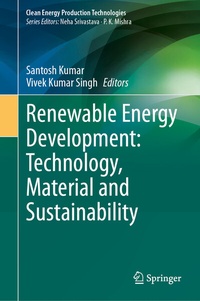
Renewable Energy Development: Technology, Material and Sustainability
Description

This edited volume is a comprehensive guide to understanding and harnessing the power of renewable energy for a sustainable future. In a world dealing with the urgent need to combat climate change and reduce our dependence on fossil fuels, this book provides a new perspective on renewable energy. It is filled with cutting-edge research and practical insights, exploring the technologies, advanced materials, and sustainability practices driving the renewable energy revolution.
Renewable energy resources are developing the latest advancements in solar, wind, hydro, geothermal, biomass, tidal, and wave energy technologies. This book is unique and opens a new window on classic renewable energy sources as well as new developments in technology, advanced material innovation, and sustainability aspects leading with various factors such as energy storage, transmission, institutional and economic factors, renewable energy application in smart cities, building and other solar thermal applications, environmental aspects, electrical energy generation, and climate change mitigation potential to achieve net-zero targets.
This book is of interest to teachers, researchers, climate change scientists, capacity builders, and policymakers. Additionally, the book serves as an additional reading material for undergraduate and graduate students of sustainable energy, engineering, material science, and environmental sciences. National and international energy, sustainable and material scientists, managers, and policymakers will also find this to be a useful read.
More details
Other editions
Additional editions
Persons
Dr. Santosh Kumar is currently working as an Associate Professor, Department of Chemistry, Harcourt Butler Technical University, Nawabganj Kanpur, Uttar Pradesh India. He also served as Research Professor in Department of Organic and Nano System Engineering, Division of Chemical Engineering, Konkuk University, Seoul, South Korea. Dr. Kumar received his B.Sc, M.Sc. and D. Phil. in Chemistry from University of Allahabad. He worked as a Research Associate (CSIR) at MNNIT Allahabad. He was awarded CAS-TWAS Postdoctoral fellowship in 2008 and worked in Changchun Institute of Applied Chemistry, Chinese Academy of Sciences, Changchun, China. Later, he joined as a KU Brain Pool Professor and researcher at the KU, Seoul, South Korea (2010-2013). He was awarded FCT Postdoctoral Fellowship 2012 and later worked at University of Coimbra, Coimbra, Portugal (2013-2017). Dr. Kumar has published more than 111 publications in reputed journals and books along with 19 book chapters and 3 edited books. Current research interest is chitosan biopolymer, nanotechnology, biomedical, food packaging, energy and environmental chemistry.
Dr. Vivek Kumar Singh is the Founding Director of Emerald Gears Initiative Foundation (EGIF) Global, located in Greater Noida, Uttar Pradesh, India. His tenure expanses as a researcher in the Energy for Sustainability Initiative at the University of Coimbra in Coimbra, Portugal, and a post-doctoral researcher at the Institute for Systems Engineering and Computers in Coimbra (INESC Coimbra). Dr. Singh has worked with prominent organizations such as The Energy and Resources Institute (TERI), the Center for Study of Science, Technology and Policy (CSTEP), and the United Nations Development Program (UNDP) in New Delhi. Dr. Singh earned his Doctoral degree with distinction in Sustainable Energy Systems from the University of Coimbra as part of the Massachusetts Institute of Technology, USA -Portugal sandwich program. He holds a MTech degree in Energy & Environmental Engineering from VIT University, Vellore, Tamil Nadu, India. With a robust academic background, he has published over 53 articles in reputed journals and contributed to 4 book chapters. His research interests are in policy research in renewable energy, energy and climate economics modelling, sustainability, and many more. Dr. Singh has accumulated 18 years of experience in industry consultancy, academia, and research across Asia and Europe.
Content
1. Renewable Energy Development Sources and Technology: Overview.- 2. Renewable Energy Insights: Sources and Technological Advancements.- 3. Solar Energy and Environmental Application.- 4. Role of Solar Energy for Sustainable Environment.- 5. Solar energy and Smart cities: A holistic approach for sustainable development.- 6. Solar Energy and its Utilization in Smart Cities.- 7. Integration of Renewable Energy in Buildings.- 8. Sustainable Electricity Generation Through Solar Energy Technologies.- 9. Biomass energy conversion technologies to produce electrical power, green hydrogen, bio-oil and biochar through biomass gasification and pyrolysis.- 10. Hydrogen Energy: Innovation in Production, Storage, and Diverse Applications.- 11. Hydrogen Horizons: Advancements, Applications, and Global Initiatives.- 12. Porous Organic Polymers for Renewable Energy Development.- 13. Advanced biobased materials for renewable energy development.- 14. Achieving net-zero emission: A sustainable future with renewable energy.- 15. Renewable Energy in Focus: Development Trends, Challenges, and Policy Responses.- 16. Environmental Aspects and Electrical Energy Generation.- 17. Environmental Aspects in Electrical Energy Generation: A Comprehensive Review.
