

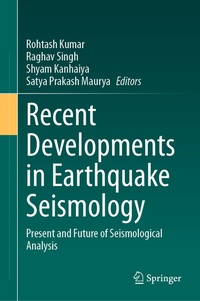
Recent Developments in Earthquake Seismology
Description

More details
Other editions
Additional editions
Persons
Dr Rohtash Kumar is presently working as an Assistant Professor in the Department of Geophysics, Institute of Science Banaras Hindu University, Varanasi, Utter Pradesh, India. He did PhD from the Department of Earthquake Engineering, Indian Institute of Technology, Roorkee, Uttarakhand, India in 2016. Dr Kumar area of research is the earthquake source dynamics, wave propagation, moment tensor analysis and waveform inversion. He has published more than ten research papers in well reputed international journals. He is supervising six PhD students working on various aspects of seismology. He also supervises more than twelve postgraduate students in their research work. He has also engaged in various administrative works apart from teaching and research. Dr Kumar has more than 10-year experience in the field of earthquake seismology.
Mr. Raghav Singh is presently working as an Assistant Professor in the Department of Geophysics, Institute of Science Banaras HinduUniversity, Varanasi, Utter Pradesh, India. He did his MSc from the Department of Earth Science, Indian Institute of Technology, Bombay, Mumbai, India in 2013. Mr. Singh is also doing his PhD in the field of earthquake seismology. His area of interest is joint inversion, moment tensor analysis, and full waveform inversion. He has published four research papers in well-reputed international journals. He supervises more than 40 postgraduate students for their dissertation projects.
Dr. Shyam Kanhaiya is presently working as an Assistant Professor and Head, in the Department of Earth and Planetary Science, Rajju Bhaiya Institute of Physical Sciences for Study and Research, Veer Bahadur Singh Purvanchal University, Jaunpur, U.P., India. Dr. Singh did his PhD from the Department of Geology, Institute of Science, Banaras Hindu University, Varanasi, U.P., India. His area of interest is Geochemistry of earth surface processes: river processes geochemistry, chemical weathering of rocks, sediment geochemistry, paleoclimatology, and provenance studies besides fluvial sedimentology of the Ganga plain. He has published more than 15 research papers in well-reputed international journals. He is supervising four PhD students working on various aspects of geology. He has also engaged in various administrative works apart from teaching and research.
Dr. Satya Prakash Maurya is presently working as an Assistant Professor in the Department of Geophysics, Institute of Science, Banaras Hindu University, Varanasi, Utter Pradesh, India. He did his PhD from the Department of Earth Sciences, Indian Institute of Technology, Bombay, Mumbai, India in 2016. Dr. Maurya's area of research is Exploration Geophysics, Seismic inversion, Well log analysis, Petrophysics, Reservoir Characterization, Seismic acquisition, Processing, and Interpretation, CO2 Sequestration in Geological Formation, Optimization, Machine Learning and Geomechanics behavior of reservoir. He has published more than 25 research papers in well-reputed international journals. He has supervised one Ph.D. student and currently supervising six Ph.D. students working on various aspects of seismic methods. He also supervises more than 15 postgraduate students in their research work. Dr. Maurya has more than 10 years of research experience.