

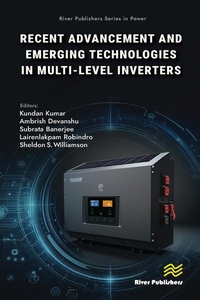
Recent Advancements and Emerging Technologies in Multi-level Inverters
1st Edition
Published on 14. October 2025
376 pages
978-1-040-43737-7 (ISBN)
Description

Recent Advances and Emerging Technologies in Multi-Level Inverters provides a
comprehensive exploration of the latest innovations and trends in multi-level inverter
technology. This book delves into cutting-edge designs, control strategies, and
applications of multi-level inverters in renewable energy systems, electric vehicles,
and industrial automation. It combines theoretical foundations with practical insights,
offering readers a holistic understanding of inverter operation and performance
optimization. Designed for researchers, students, and industry professionals, the
book highlights advancements in power electronics and their role in addressing
modern energy challenges. With detailed analyses and real-world case studies, this
is an essential resource for anyone interested in the future of energy conversion and
sustainable technologies.
comprehensive exploration of the latest innovations and trends in multi-level inverter
technology. This book delves into cutting-edge designs, control strategies, and
applications of multi-level inverters in renewable energy systems, electric vehicles,
and industrial automation. It combines theoretical foundations with practical insights,
offering readers a holistic understanding of inverter operation and performance
optimization. Designed for researchers, students, and industry professionals, the
book highlights advancements in power electronics and their role in addressing
modern energy challenges. With detailed analyses and real-world case studies, this
is an essential resource for anyone interested in the future of energy conversion and
sustainable technologies.
More details
Series
Edition
1. Auflage
Language
English
Place of publication
London
United Kingdom
Target group
College/higher education
Professional and scholarly
Illustrations
40 Tables, black and white; 129 Line drawings, color; 112 Line drawings, black and white; 7 Halftones, color; 136 Illustrations, color; 112 Illustrations, black and white
File size
47,54 MB
ISBN-13
978-1-040-43737-7 (9781040437377)
Copyright in bibliographic data and cover images is held by Nielsen Book Services Limited or by the publishers or by their respective licensors: all rights reserved.
Schweitzer Classification
Other editions
Additional editions
Kundan Kumar | Ambrish Devanshu | Subrata Banerjee
Recent Advancements and Emerging Technologies in Multi-level Inverters
Book
10/2025
1st Edition
River Publishers
€178.30
Article not available for order
Persons
Dr. Kundan Kumar (M' 2013, SM' 2021 IEEE USA) is presently working as an Assistant Professor in the Department of Electrical Engineering at NIT Jamshedpur. He completed his B. Tech. from the IET MJP Rohilkhand University, Bareilly, in 2008. He received an M. Tech. degree from NIT Jamshedpur, Jamshedpur, India, and a Ph.D. degree from the University of Padova, Padova, Italy, both in Electrical Engineering, in 2010 and 2016, respectively. He has previously worked as an Assistant Professor at NIT Manipur and at School of Electrical Engineering, Kalinga Institute of Industrial Technology, deemed to be a university, in Bhubaneswar, India. He was also awarded a University Fellowship for a Ph. D. course at the University of Padova, Italy, the Best Presentation Recognition award at IECON, held in Japan in 2015, and the Best Paper award in IEEE STPEC-2021 at Bilaspur, India. He has published more than 50 research articles in reputed international journals and conference proceedings, 7 book chapters, and 5 Indian Patents. He is a senior member of the IEEE (USA) and a Life member of the Institution of Engineers (IE), India. He is a reviewer of IEEE journals and transactions such as TIE, TPEL, and JESTPE. His research interests include electric vehicles and their charging infrastructures, wireless power transfer systems, dynamic wireless charging systems, propulsion drive systems for EVs, application of wide bandgap semiconductor devices, high-efficiency power converters, soft switching, multi-port converters, single-active bridge (SAB), dual active bridge (DAB) converters, and offshore wind energy systems.
Dr. Ambrish Devanshu earned his B.Tech. in Electrical and Electronics Engineering from Cochin University of Science and Technology, completing his major project at ISRO's Vikram Sarabhai Space Centre in 2011. He worked as a Project Engineer at Wipro Technologies from 2011 to 2014 before pursuing his Ph.D. at Delhi Technological University, which he completed in 2019. He is currently an Assistant Professor at the National Institute of Technology (NIT) Silchar and has previously served at NIT Patna. Dr. Devanshu has an extensive research portfolio, including numerous journal, conference and book chapter publications, authored books, and patents. He is actively engaged in academic and professional activities, having delivered talks at various institutes of national importance in India and contributed to IEEE conferences as a technical chair, session chair, publicity chair, and program chair. In addition to organizing national-level workshops and technical programs, Dr. Devanshu serves as a reviewer for several reputed national and international journals, including prestigious IEEE Transactions, underscoring his commitment to advancing the field of electrical engineering.
Dr. Subrata Banerjee is working as Professor with the Department of Electrical Engineering, National Institute of Technology, Durgapur, India. His research interests include modeling and control of switch-mode converters and inverters, multilevel inverters and different modulation techniques, electromagnetic levitation, active magnetic bearing, controller design, intelligent control, etc. He has authored about 240 research papers in national/international journals and conference records. He has filed three Indian patents and one copyright out of which three have been granted. He has written one book (published in Springer) and nine book chapters. He is a Fellow of the Institution of Engineers (India), the Institution of Electronics and Telecommunication Engineers (India), and the Institution of Engineering and Technology (UK), and a Senior Member of IEEE (USA). He has acted as associate editor and on the editorial board of IEEE Access (USA), IET Power Electronics (UK)/IEEE Transportation Electrification Community eNewsletter (USA). Professor Banerjee has attended and chaired sessions in different IEEE IES/IAS conferences and acted as a member of the technical committee of many national and international conferences. He has visited ten countries for different academic assignments. He was listed among the top 2% scientists in the world in 2020, 2021, 2022, 2023, and 2024 by a survey conducted by a team of scientists at Stanford University
Dr. Robindro is a Scientist in the areas of e-mobility and energy sector. He obtained a B.E. degree with distinction in Electrical & Electronics Engineering from Madurai Kamaraj University in 2000, and holds a Ph.D. in Electronics & Electrical Engineering from IIT Guwahati. He has more than 22+ years of research experience in EV powertrain system performance and energy studies, E-vehicle system integration, EV driving and charging energy studies, RE hybrid power systems for power-to-X, energy system integration and management, and vehicle dynamics tests. Before joining CSIR-IIP in 2006, he worked for 4 years in M/s. OEM Tech. Instruments (Delhi) for two German companies and their vehicle test instruments for vehicle dynamic tests such as brake, acceleration test, lane change test, etc. During the year 2002-2006, he had opportunities to work with the R&D teams of Maruti Suzuki, Yamaha Motors, Tata Motors, TVS Motors, TVS Tires, Kalyani Brakes, and ARAI. He recently developed and evaluated prototype EV kits for M1 category passenger vehicles and a prototype EV charging system powered by renewable hybrid energy sources. He has published several research papers and reviewed many journal & conference papers and has delivered 20+ invited talks on different national and international platforms. He is a committee member of TED-26, TED-27 committees of BIS (Bureau of Indian Standards) and Automotive Industry Standards (AIS) for EVs and HEVs.
Sheldon S. Williamson received a Ph.D. degree (Hons.) in electrical engineering from the Illinois Institute of Technology, Chicago, IL, USA in 2006. He is currently a Professor with the Department of Electrical, Computer and Software Engineering, and the Director of the Smart Transportation Electrification and Energy Research (STEER) Group within the Faculty of Engineering and Applied Sciences, at Ontario Tech University in Oshawa, Ontario, Canada. His current research interests include advanced power electronics, electric energy storage systems, and motor drives for transportation electrification and autonomous e-mobility. Prof. Williamson is also an NSERC Canada Research Chair (CRC) in electric energy storage systems for transportation electrification and is a Fellow of the IEEE.
Dr. Ambrish Devanshu earned his B.Tech. in Electrical and Electronics Engineering from Cochin University of Science and Technology, completing his major project at ISRO's Vikram Sarabhai Space Centre in 2011. He worked as a Project Engineer at Wipro Technologies from 2011 to 2014 before pursuing his Ph.D. at Delhi Technological University, which he completed in 2019. He is currently an Assistant Professor at the National Institute of Technology (NIT) Silchar and has previously served at NIT Patna. Dr. Devanshu has an extensive research portfolio, including numerous journal, conference and book chapter publications, authored books, and patents. He is actively engaged in academic and professional activities, having delivered talks at various institutes of national importance in India and contributed to IEEE conferences as a technical chair, session chair, publicity chair, and program chair. In addition to organizing national-level workshops and technical programs, Dr. Devanshu serves as a reviewer for several reputed national and international journals, including prestigious IEEE Transactions, underscoring his commitment to advancing the field of electrical engineering.
Dr. Subrata Banerjee is working as Professor with the Department of Electrical Engineering, National Institute of Technology, Durgapur, India. His research interests include modeling and control of switch-mode converters and inverters, multilevel inverters and different modulation techniques, electromagnetic levitation, active magnetic bearing, controller design, intelligent control, etc. He has authored about 240 research papers in national/international journals and conference records. He has filed three Indian patents and one copyright out of which three have been granted. He has written one book (published in Springer) and nine book chapters. He is a Fellow of the Institution of Engineers (India), the Institution of Electronics and Telecommunication Engineers (India), and the Institution of Engineering and Technology (UK), and a Senior Member of IEEE (USA). He has acted as associate editor and on the editorial board of IEEE Access (USA), IET Power Electronics (UK)/IEEE Transportation Electrification Community eNewsletter (USA). Professor Banerjee has attended and chaired sessions in different IEEE IES/IAS conferences and acted as a member of the technical committee of many national and international conferences. He has visited ten countries for different academic assignments. He was listed among the top 2% scientists in the world in 2020, 2021, 2022, 2023, and 2024 by a survey conducted by a team of scientists at Stanford University
Dr. Robindro is a Scientist in the areas of e-mobility and energy sector. He obtained a B.E. degree with distinction in Electrical & Electronics Engineering from Madurai Kamaraj University in 2000, and holds a Ph.D. in Electronics & Electrical Engineering from IIT Guwahati. He has more than 22+ years of research experience in EV powertrain system performance and energy studies, E-vehicle system integration, EV driving and charging energy studies, RE hybrid power systems for power-to-X, energy system integration and management, and vehicle dynamics tests. Before joining CSIR-IIP in 2006, he worked for 4 years in M/s. OEM Tech. Instruments (Delhi) for two German companies and their vehicle test instruments for vehicle dynamic tests such as brake, acceleration test, lane change test, etc. During the year 2002-2006, he had opportunities to work with the R&D teams of Maruti Suzuki, Yamaha Motors, Tata Motors, TVS Motors, TVS Tires, Kalyani Brakes, and ARAI. He recently developed and evaluated prototype EV kits for M1 category passenger vehicles and a prototype EV charging system powered by renewable hybrid energy sources. He has published several research papers and reviewed many journal & conference papers and has delivered 20+ invited talks on different national and international platforms. He is a committee member of TED-26, TED-27 committees of BIS (Bureau of Indian Standards) and Automotive Industry Standards (AIS) for EVs and HEVs.
Sheldon S. Williamson received a Ph.D. degree (Hons.) in electrical engineering from the Illinois Institute of Technology, Chicago, IL, USA in 2006. He is currently a Professor with the Department of Electrical, Computer and Software Engineering, and the Director of the Smart Transportation Electrification and Energy Research (STEER) Group within the Faculty of Engineering and Applied Sciences, at Ontario Tech University in Oshawa, Ontario, Canada. His current research interests include advanced power electronics, electric energy storage systems, and motor drives for transportation electrification and autonomous e-mobility. Prof. Williamson is also an NSERC Canada Research Chair (CRC) in electric energy storage systems for transportation electrification and is a Fellow of the IEEE.
Content
1. Recent Developments, Challenges, and Applications of Multilevel Inverters. 2. Recent Advancement in Switched Capacitor-based Multilevel Inverters. 3. Reduced Switch Count Multilevel Inverters and Their Applications. 4. Modular Multilevel Converter. 5. Mathematical Modeling and Development of Current Estimator for Multilevel Architectures. 6. Switching Strategy Optimization in Transformer-integrated Cascaded Multilevel Inverters. 7. Z-Source-based Multilevel Inverter Topologies for Photovoltaic Applications. 8. A Comparative Analysis of Multicarrier PWM Techniques in a Seven-level Asymmetrical Multilevel Inverter. 9. Cascaded H-Bridge and Modular Multilevel Converters: A Review. 10. Low-frequency Analysis of an Asymmetric Inverter. 11. Multilevel Converters for Renewable Energy Systems. 12. Aspects of MLI Integration in EV Powertrain and Performance Evaluation Using Drive Cycle Analysis.
