

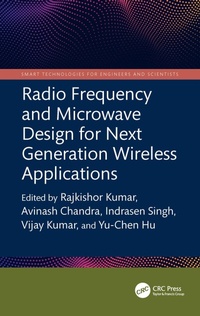
Radio Frequency and Microwave Design for Next Generation Wireless Applications
1st Edition
Published on 31. December 2025
370 pages
978-1-040-80125-3 (ISBN)
Description

This book covers both transmitters and receivers of modern microwave devices designed for a wide range of practical applications. It focuses on different types of antennas, filters, amplifiers, and oscillators and their optimization techniques for the design of networks, which are most useful in modern communication systems such as the Internet of Things, remote sensing, and space applications.
Key Features:
* Focuses on specific applications of microwave device design, such as wearable, implantable, body-centric networks, wearable, implantable, and Internet of Medical Things.
* Covers the design and implementation of the defense networks and discusses the application of RADAR optimization algorithms.
* Presents advanced topics such as the integration of machine learning, and artificial intelligence for designing microwave devices.
* Examines modern microwave devices for next-generation communication systems, such as 5G and beyond, satellites, and RADAR applications.
* Explains the implementation and challenges for unmanned aerial vehicles, ground-penetrating radar, and remote sensing applications on aerial platforms.
This book is primarily written for senior undergraduates, graduate students, and academic researchers in the fields of electrical engineering, electronics and communication engineering, computer science and engineering, and telecommunications.
Key Features:
* Focuses on specific applications of microwave device design, such as wearable, implantable, body-centric networks, wearable, implantable, and Internet of Medical Things.
* Covers the design and implementation of the defense networks and discusses the application of RADAR optimization algorithms.
* Presents advanced topics such as the integration of machine learning, and artificial intelligence for designing microwave devices.
* Examines modern microwave devices for next-generation communication systems, such as 5G and beyond, satellites, and RADAR applications.
* Explains the implementation and challenges for unmanned aerial vehicles, ground-penetrating radar, and remote sensing applications on aerial platforms.
This book is primarily written for senior undergraduates, graduate students, and academic researchers in the fields of electrical engineering, electronics and communication engineering, computer science and engineering, and telecommunications.
More details
Series
Edition
1. Auflage
Language
English
Place of publication
London
United Kingdom
Publishing group
Taylor & Francis Ltd
Target group
College/higher education
Professional and scholarly
Illustrations
38 Tables, black and white; 67 Line drawings, color; 149 Line drawings, black and white; 20 Halftones, color; 28 Halftones, black and white; 87 Illustrations, color; 177 Illustrations, black and white
File size
27,97 MB
ISBN-13
978-1-040-80125-3 (9781040801253)
Copyright in bibliographic data and cover images is held by Nielsen Book Services Limited or by the publishers or by their respective licensors: all rights reserved.
Schweitzer Classification
Other editions
Additional editions

Rajkishor Kumar | Avinash Chandra | Indrasen Singh
Radio Frequency and Microwave Design for Next Generation Wireless Applications
Book
approx. 12/2025
1st Edition
CRC Press
€184.50
Not yet published
Persons
Rajkishor Kumar is an assistant professor at the School of Electronics Engineering, Vellore Institute of Technology, India. He has authored/co-authored more than 45 research papers in journals, and conferences of national and international repute. His current research interests include radio frequency (RF) and microwave antennas, microwave filters, RF energy harvesting and transfer systems, antennas in biomedical applications, artificial intelligence, and machine learning approaches in antennas as well as Internet of Things-based smart antennas.
Avinash Chandra is an associate professor at the School of Electronics Engineering, Vellore Institute of Technology, India. He has published over 35 papers in leading journals and conferences. His current research areas include waveguides, reconfigurable arrays, and antennas for 6G applications.
Indrasen Singh is an assistant professor at the School of Electronics Engineering, Vellore Institute of Technology, India. He has published more than 20 research papers in national and international journals and conferences. His research interests are in the areas of cooperative communication, stochastic geometry, modeling of wireless networks, heterogeneous networks, millimeter wave communications, device-to-device communication, and 5G, and 6G communication.
Vijay Kumar is a professor at the School of Electronics Engineering, Vellore Institute of Technology, India. He has worked as a research associate at the Indian Institute of Bombay, India, and focused on SAR interferometry and polarimetry. His research focus is on microwave radar imaging, SAR imaging system development, RF front-end development for communication applications about earth observation, and reconnaissance from spaceborne, airborne, and unmanned aerial vehicle platforms. He has published research papers in journals and conferences of national and international repute.
Yu-Chen Hu is a professor in the Department of Computer Science at Tunghai University, Taiwan. He is a senior member of IEEE. He is also a member of the Chinese Cryptology and Information Security Association, Computer Science and Information Management, and Phi Tau Phi Society of the Republic of China. His research interests include digital forensics, information hiding, image and signal processing, data compression, information security, computer networks, deep learning, and bioinformatics. He has published research papers in national and international journals and conferences.
Avinash Chandra is an associate professor at the School of Electronics Engineering, Vellore Institute of Technology, India. He has published over 35 papers in leading journals and conferences. His current research areas include waveguides, reconfigurable arrays, and antennas for 6G applications.
Indrasen Singh is an assistant professor at the School of Electronics Engineering, Vellore Institute of Technology, India. He has published more than 20 research papers in national and international journals and conferences. His research interests are in the areas of cooperative communication, stochastic geometry, modeling of wireless networks, heterogeneous networks, millimeter wave communications, device-to-device communication, and 5G, and 6G communication.
Vijay Kumar is a professor at the School of Electronics Engineering, Vellore Institute of Technology, India. He has worked as a research associate at the Indian Institute of Bombay, India, and focused on SAR interferometry and polarimetry. His research focus is on microwave radar imaging, SAR imaging system development, RF front-end development for communication applications about earth observation, and reconnaissance from spaceborne, airborne, and unmanned aerial vehicle platforms. He has published research papers in journals and conferences of national and international repute.
Yu-Chen Hu is a professor in the Department of Computer Science at Tunghai University, Taiwan. He is a senior member of IEEE. He is also a member of the Chinese Cryptology and Information Security Association, Computer Science and Information Management, and Phi Tau Phi Society of the Republic of China. His research interests include digital forensics, information hiding, image and signal processing, data compression, information security, computer networks, deep learning, and bioinformatics. He has published research papers in national and international journals and conferences.
Content
1. Different Feeding Networks to Generate Wideband Circular Polarization Waves in Different Shapes of Dielectric Resonators. 2. Development and Analysis of Symmetric Circular Rings Incorporated Modified Circular Patch Antenna for Numerous Wireless Applications. 3. On the Behavior of Multiband, High Gain Fractal Curves based Microstrip Patch Antenna. 4. MIMO Antenna Systems for 5G and Beyond Wireless Communication. 5. Design and Performance Analysis of Metamaterials Incorporated Microstrip Antennas for 5G and Beyond Wireless Applications. 6. Flexible Antennas for Wireless Body Area Network Applications. 7. Metamaterial Based Antennas for Biomedical Applications. 8. A gm/Id based Low Power High Gain CMOS Folded Cascode OTA for Biomedical. 9. Design and Investigations on Conformal Vivaldi Antenna for Wireless Capsule Endoscopic System. 10. The Practical Implementations of Microwave Devices for IoMT, Wearable, Sensors and Healthcare Applications. 11. 5G Beam Steering Techniques. 12. Design Principles and Numerical Analysis of Ultrathin Polarization-Insensitive Hybrid FSS: Dual Wide-Stopband and Triple Passband Characteristics Exploration. 13. RF Energy Harvesting, IOT, Flexible and Implanted Microwave Device. 14. Machine Learning Methods in Drone Detection: A Comprehensive Survey.
