

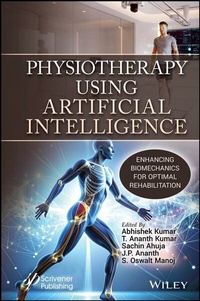
Physiotherapy Using Artificial Intelligence
Description

Empower your practice with this definitive resource that bridges the gap between artificial intelligence and biomechanics, providing the essential tools and knowledge to optimize assessments, personalize treatment plans, and predict recovery outcomes in the rapidly evolving landscape of modern physiotherapy.
The integration of artificial intelligence (AI) with biomechanics in physiotherapy represents a transformative shift in the healthcare landscape, driven by rapid technological advancement and an increasing emphasis on personalized, data-driven care. Over the past decade, AI has progressed from theoretical exploration to practical clinical application, enabling enhanced decision-making and improved patient outcomes. This book examines the intersection of artificial intelligence and physiotherapy with a focused emphasis on biomechanics, exploring how AI can optimize biomechanical assessments, support individualized treatment planning, and predict patient progress in clinical settings. As demand grows for AI-driven innovation in rehabilitation, this volume serves as an essential resource for physiotherapists, clinicians, and researchers seeking to understand and adopt these emerging technologies to advance practice and improve rehabilitation outcomes.
More details
Other editions
Additional editions
Persons
T. Ananth Kumar, PhD is an Associate Professor and Head of Computer Science and Engineering at IFET College of Engineering, India. He has edited six books, published numerous book chapters and patents, and presented research at national and international conferences. His research interests include networks on chips, computer architecture, and application-specific integrated circuit design. He has edited and authored 12 books and has written many book chapters.
Sachin Ahuja, PhD is a Professor and Executive Director in the Department of Computer Science at the School of Engineering and Technology, Chitkara University. He has led multiple funded research projects in artificial intelligence, machine learning, and data mining and has contributed to numerous academic books. He has also served as a guest editor for special issues in reputed international journals.
J.P. Ananth, PhD is a Professor and Director of the Internal Quality Assurance Cell, Dayananda Sagar University, Bangalore. His research has been published widely in peer-reviewed journals, and he serves as a reviewer for several international journals and conferences. His research interests include computer vision, pattern recognition, artificial intelligence, and data analytics.
S. Oswalt Manoj, PhD is a committed academician and researcher, currently serving as a Professor in the Department of Computer Science and Engineering at Alliance University, Bengaluru. With rich experience in teaching, research, mentoring, and academic leadership, he has guided several Ph.D. scholars and contributed extensively to doctoral committees under Anna University, Chennai. He holds a Ph.D. in Information and Communication Engineering from Anna University, Chennai, with his research focused on Deep Learning-based Rainfall Prediction for Agricultural Applications. He also holds undergraduate and postgraduate degrees in Computer Science and Engineering from Anna University and its affiliated institutions. His areas of academic interest include Machine Learning, Deep Learning, Big Data Analytics, Cloud Computing, and Quantum Computing.
Content
Preface xxix
1 Advancements in Physiotherapy: A Holistic Approach to Rehabilitation and Pain Management 1
Radhika Chintamani, G Varadharajulu and G Himashree
1.1 Introduction 2
1.2 Classification of Forces 18
1.3 Conclusion 26
2 Physiotherapy and Its Role in Neurodegenerative Disease Management: A Focus on Alzheimer's Disease 31
Shraddha Mohite and Salim Chavan
2.1 Introduction 32
2.2 Alzheimer's Disease: Pathophysiology and Clinical Profile 36
2.3 Role of Physiotherapy in Alzheimer's Disease Management 40
2.4 Physiotherapy Interventions in Alzheimer's Disease 41
2.5 Evidence-Based Benefits of Physiotherapy in Alzheimer's Disease 43
2.6 Challenges in Implementing Physiotherapy for AD 46
2.7 Innovations and Future Directions 47
2.8 Conclusion 50
3 Integrating Herbal Treatments in Physiotherapy for Enhanced Rehabilitation 55
S Anandh and Sachin Purushottam Untawale
3.1 Introduction 56
3.2 Historical Context and Rationale 59
3.3 Pharmacological Actions of Medicinal Herbs in Rehabilitation 62
3.4 Clinical Applications and Evidence Base 63
3.5 Methods of Integration in Physiotherapy Practice 64
3.6 Safety, Standardization, and Contraindications 67
3.7 Case Studies and Best Practices 68
3.8 Ethical Considerations and Patient Education 68
3.9 Future Directions and Research Gaps 69
3.10 Conclusion 69
4 Physiotherapy and Herbal Compositions: A Holistic Approach to Scalp Health and Rehabilitation 73
Mandar Malawade, Shrushti P Jachak and Sanjay L Badjate
4.1 Introduction 74
4.2 Anatomy and Physiology of the Scalp 78
4.3 Role of Physiotherapy in Scalp Rehabilitation 81
4.4 Herbal Compositions in Scalp Treatment 86
4.5 Integrative Protocols for Scalp Health 87
4.6 Clinical Evidence and Case Studies 88
4.7 Safety, Limitations, and Future Directions 88
4.8 Conclusion 89
5 Advancements in Physiotherapy: Enhancing Mobility and Quality of Life 95
G Himashree, G Varadharajulu and Radhika Chintamani
5.1 Introduction 96
5.2 The Foundation of Artificial Intelligence 99
5.3 Algorithm Aversion 104
5.4 Conclusion 106
6 The Role of Physiotherapy in Fall Prevention and Rehabilitation among Older Adults 109
Namrata Kadam and Piyush Ashokrao Dalke
6.1 Introduction 110
6.2 Epidemiology and Risk Factors of Falls among Older Adults 111
6.3 Physiotherapy Assessment Tools for Fall Risk 114
6.4 Physiotherapy in Fall Rehabilitation 118
6.5 Technology in Fall Prevention and Rehabilitation 120
6.6 Special Considerations 120
6.7 Multidisciplinary Collaboration 121
6.8 Case Studies 122
6.9 Evidence and Guidelines 123
6.10 Challenges and Barriers 123
6.11 Recommendations 124
6.12 Conclusion 124
7 The Role of Precision and Controlled Methods in Physiotherapy 129
Chandrakant Patil, Dhirajkumar Mane and Kalpana Malpe
7.1 Introduction 130
7.2 Theoretical Foundations of Precision and Control in Physiotherapy 133
7.3 Clinical Assessment: The First Step Toward Precision 136
7.4 Controlled Delivery of Therapeutic Interventions 137
7.5 Case Applications of Precision and Control in Physiotherapy 138
7.6 Benefits 140
7.7 Facilitation of Research and Quality Improvement 140
7.8 Emerging Trends and Innovations 140
7.9 Ethical and Regulatory Considerations 141
7.10 Future Directions 142
7.11 Conclusion 143
8 Optimizing Adjustable Armchairs for Physiotherapy: A Case Study on Desklet Modifications 149
Poonam Patil, Neeraja Aswale and Dhirajkumar Mane
8.1 Introduction 150
8.2 Literature Review 153
8.3 Methodology 156
8.4 Results 160
8.5 Discussion 161
8.6 Recommendations 162
8.7 Conclusion 164
9 Physiotherapy in Modern Healthcare: Innovations, Applications, and Future Prospects 169
G Varadharajulu, Radhika Chintamani and G Himashree
9.1 Introduction 170
9.2 Layers of AI That Represent Development of a Prototype 171
9.3 AI in a Brief 177
9.4 Current Scenario of Artificial Intelligence in Healthcare 194
9.5 Current Scenario of Artificial Intelligence in Physical Therapy 199
9.6 Future Outcomes 203
9.7 Conclusion 204
10 Assessing Discomfort Metrics and Seating Design in Physiotherapy 211
Suraj Kanase and Rasika Manapure
10.1 Introduction 212
10.2 Literature Review 215
10.3 Discomfort Metrics: Methods and Applications 218
10.4 Seating Design Considerations in Physiotherapy 221
10.5 Clinical Implications of Seating Discomfort 223
10.6 Special Populations and Seating Requirements 223
10.7 Innovations in Seating Technology 224
10.8 Research and Case Studies 225
10.9 Conclusion 225
11 Synergizing Postural Support, Pain Assessment, and Skin Health in Physiotherapy 231
Trupti Yadav and Vibha Vyas
11.1 Introduction 232
11.2 Literature Review 234
11.3 Methodology 236
11.4 Skin Health: A Critical But Overlooked Component 240
11.5 The Rationale for a Synergistic Approach 241
11.6 Clinical Implementation Strategies 242
11.7 Case Studies 243
11.8 Challenges and Limitations 243
11.9 Future Directions 245
11.10 Conclusion 248
12 Innovative Sanitization Strategies for Enhanced Safety in Physiotherapy 253
Pragati Salunkhe and Prashant S Jadhav
12.1 Introduction 254
12.2 Traditional Sanitization Methods and Their Limitations 256
12.3 Ultraviolet-C (UV-C) Disinfection 260
12.4 Antimicrobial and Self-Disinfecting Surfaces 264
12.5 Electrostatic Spraying and Fogging Systems 264
12.6 AI and IoT in Sanitization Monitoring 265
12.7 Ozone and Hydrogen Peroxide Vapor (HPV) Systems 265
12.8 Sustainable and Green Sanitization Solutions 266
12.9 Training and Behavior Modification 266
12.10 Policy Guidelines and Regulatory Framework 267
12.11 Case Studies 267
12.12 Economic Analysis of Innovative Strategies 268
12.13 Future Directions 268
12.14 Conclusion 269
13 The Role of Physiotherapy in Rehabilitation: Advances, Applications, and Future Directions 273
Radhika Chintamani, G Himashree and G Varadharajulu
13.1 The Skeleton 274
13.2 Composition and Structure of Natural Bone 277
13.3 Hardness and Strength of Bones 279
13.4 Load-Deformation Curve of Bone 282
13.5 Trabecular Bone Pattern 285
13.6 Forces of Compression 287
13.7 Shear Forces 290
13.8 Post Fracture Biomechanics of Bone 290
13.9 Bone Biomechanics in Implantology 291
13.10 Conclusion 294
14 Exploring Sustained-Release Topical Applications in Physiotherapy: A Study on Terminalia Bellirica 299
Mayiri Burungale and Shamla Mantri
14.1 Introduction 300
14.2 Background 302
14.3 Discussion 306
14.4 Limitations 307
14.5 Future Directions 309
14.6 Conclusion 310
15 AI and Motion Analysis: Revolutionizing Physiotherapy with Biomechanical Insights 315
Omkar Somade, Nitin K Chaudhary and Mahendra Alate
15.1 Introduction 316
15.2 Understanding Motion Analysis in Physiotherapy 319
15.3 AI in Motion Analysis: Core Technologies 321
15.4 Applications in Physiotherapy 324
15.5 Key Benefits of AI-Powered Motion Analysis 325
15.6 Case Studies and Clinical Trials 328
15.7 Ethical and Technical Challenges 328
15.8 Future Directions 329
15.9 Conclusion 330
16 The Future of Physiotherapy: AI-Driven Biomechanical Rehabilitation Techniques 335
S Anandh and Vivek Parhate
16.1 Introduction 336
16.2 AI in Biomechanical Assessment 338
16.3 Personalized Rehabilitation with AI 341
16.4 Remote Monitoring and Tele-Rehabilitation 343
16.5 Robotic-Assisted Rehabilitation 345
16.6 Gamification and Patient Engagement 346
16.7 Challenges and Ethical Considerations 346
16.8 Future Directions 346
16.9 Conclusion 346
17 Advancements and Efficacy of Physiotherapy in Rehabilitation and Pain Management 353
G Varadharajulu, G Himashree and Radhika Chintamani
17.1 Introduction 354
17.2 Muscles Proteins 354
17.3 Striated Muscle 356
17.4 Cross-Bridge Cycle 357
17.5 Types of Muscle Fibers 361
17.6 Types of Contraction 362
17.7 Passive and Active Elastic Component 370
17.8 Length-Tension Relationship 372
17.9 Force Velocity Relationship 373
17.10 Conclusion 375
18 AI-Enhanced Biomechanics: Personalizing Physiotherapy for Optimal Recovery 379
Namrata Kadam and Vivek Deshpande
18.1 Introduction 380
18.2 Background 382
18.3 Biomechanical Data Acquisition for AI Analysis 384
18.4 AI Techniques for Biomechanical Data Interpretation 386
18.5 Clinical Applications of AI-Enhanced Biomechanics in Physiotherapy 387
18.6 Case Studies and Recent Advances 390
18.7 Challenges and Limitations 391
18.8 Future Directions 393
18.9 Conclusion 394
19 Smart Rehabilitation: AI-Driven Biomechanical Solutions for Physiotherapy 399
S Anandh and Manoj Vairalkar
19.1 Introduction 400
19.2 The Role of Biomechanics in Physiotherapy 403
19.3 Artificial Intelligence in Biomechanical Analysis 406
19.4 Smart Rehabilitation Systems 409
19.5 Clinical Applications 412
19.6 Remote Physiotherapy and Telerehabilitation 412
19.7 Case Studies and Evidence-Based Research 413
19.8 Challenges and Limitations 413
19.9 Future Directions 414
19.10 Conclusion 414
20 Biomechanics Meets AI: Transforming Physiotherapy through Smart Technology 421
Ankita Durgawale and Vivek Deshpande
20.1 Introduction 422
20.2 Foundations of Biomechanics in Physiotherapy 425
20.3 AI Technologies Transforming Physiotherapy 426
20.4 Applications of AI and Biomechanics in Physiotherapy 428
20.5 Discussion 430
20.6 Future Directions 432
20.7 Conclusion 434
21 The Role of Physiotherapy in Rehabilitation: Enhancing Mobility, Function, and Quality of Life 439
G Himashree, Radhika Chintamani and G Varadharajulu
21.1 Introduction 440
21.2 Classification 441
21.3 Muscle and Fascia Relation 445
21.4 Force Transmission 452
21.5 Biomechanical Simulations and Data Integration 452
21.6 Biotensegrity 453
21.7 Fascia and Joint Mobility 456
21.8 Conditions Affecting Fascia in Physiotherapy 459
21.9 Fascia Diagnostics 460
21.10 Limitations of Existing Diagnostic Methods 462
21.11 Conclusion 464
References 464
About the Editors 469
Index 471
1
Advancements in Physiotherapy: A Holistic Approach to Rehabilitation and Pain Management
Radhika Chintamani1*, G. Varadharajulu2 and G. Himashree3
1Department of Manual Therapy, Krishna College of Physiotherapy, Krishna Vishwa Vidyapeeth, (Deemed to be University), Karad, Maharashtra, India
2Dept. of Neurosciences, Krishna College of Physiotherapy, Krishna Vishwa Vidyapeeth, (Deemed to be University), Karad, Maharashtra, India
3Department of Physiology, Krishna Vishwa Vidyapeeth, (Deemed to be University), Karad, Maharashtra, India
Abstract
Physiotherapy is a vital healthcare discipline focused on restoring movement, function, and overall well-being in individuals affected by injuries, disabilities, or chronic conditions. This study examines the latest advancements in physiotherapy, highlighting innovative techniques and evidence-based practices that enhance patient recovery. Key areas explored include manual therapy, exercise prescription, electrotherapy, and rehabilitation programs, all of which play a significant role in improving mobility and lessening pain. Additionally, the integration of modern technologies such as virtual reality, artificial intelligence, and robotics has revolutionized physiotherapy interventions, making treatments more precise and personalized. A review of recent literature and clinical case studies underscores the significance of patient-centered approaches and multidisciplinary collaboration in achieving optimal therapeutic outcomes. The findings suggest that physiotherapy not only increases physical recovery but also improves mental and emotional well-being by promoting active participation in treatment plans. Moreover, advancements in remote physiotherapy and digital health solutions have expanded access to care, allowing for continuous monitoring and support. As the field of physiotherapy continues to evolve, the adoption of innovative methodologies and personalized treatment strategies will be essential to meet the diverse needs of patients. Future research should focus on optimizing these advancements, ensuring their effectiveness, and making physiotherapy more accessible to a broader population. Ultimately, physiotherapy is not only about rehabilitation but also about strengthening its vital position in contemporary healthcare by enabling people to restore their freedom and enhance their general quality of life.
Keywords: Artificial intelligence in rehabilitation, electrotherapy, exercisextherapy, manual therapy, mobility improvement, pain management, patient-centered care, physiotherapy
1.1 Introduction
1.1.1 Definition
Kinesiology means a scientific study of human movement, its evaluation and characteristics. Historically, kinesiology course has been studied under the heading of movement science programs. The first focus of kinesiology was on the anatomical perspective of joint muscle actions during simple and complicated movements in the context of movement efficiency in musculoskeletal sciences [1]. Biomechanics is the application of physical or more precisely mechanical laws to human body movements in order to study, analyze and evaluate them. Biomechanics is usually covered under the heading of kinesiology, but both definitely differ from each other [2]. Biomechanics as defined in the book by Hamill J is "the study of structure and function of biological systems by means of the methods of mechanics" [2].
1.1.2 Movement Analysis
The way the human body interacts with its surroundings is through posture and movement. A human being can be either in static or dynamic position. For humans to adapt to different environmental situations, the position must change from dynamic to static or back to dynamic. This becomes necessary for smooth interaction between human being and the environment [2].
Posture and movement become necessary for physiotherapist to study in detail and document the same. The quantitative and qualitative assessment of the movements thus becomes vital for detailed knowledge about the human posture and movements.
Movement analysis clusters into two basic types
- Kinetics: basic Physics definition describes kinetics as "Push or pull between two objects that may or may not result in its motion"1. According the biomechanists, kinetics is defined as the study of force causing movement.
- Kinematics: It is the study of motion irrespective of the force causing it. The motion can be in any of the three anatomical planes of human body.
- Movement analysis traditionally includes both kinetic and kinematic analysis in both qualitative and quantitative modes [3].
- Quantitative analysis: describes the numerical assessment of movement, Example: range of motion in degree or millimeters.
- Qualitative analysis: describes the non-numerical assessment of movement, Example: symmetricity or asymmetricity of the movements when compared with the ideal normal movement or contra-lateral side.
1.1.3 Types of Movement Analysis
- Kinetic4:
- Linear: Force
- Angular: Torque
- Kinematics4:
- Linear: Position, velocity and Acceleration
- Angular: Position, velocity and Acceleration
Before understanding the movement analysis occurring during kinetic and kinematic studies, let us understand the linear and angular movements.
1.1.3.1 Linear Movement and Its Kinetic and Kinematic Analysis
Commonly termed as straight line or curved movement occurring in a translational pattern without changing its direction [4].
Examples: a trajectory baseball movement, walking, running.
Linear movements, are easily understood and analyzed as well by mere observation, video clipping and even high-profile photography's. The image above demonstrates the observed difference between walking, running and how different they are [3].
The human body movements are never purely linear; they have some added component of angular as well [4].
For example: though a person looks that he is walking on a horizontal surface in a straight direction, the detailed COG kinematic analysis reveals that, the COG moves in Sinusoidal curve which is a component of angular motion. The image below represents the same [5].
The center of the body or object is analyzed during linear movement analysis. The center of the human body is located anterior to S2, which moves in a sinusoidal curve in both vertical and horizontal directions, thus maintaining the human body in balance and control during dynamic activity or movements like walking or running [6].
1.1.3.2 Angular Movement and Its Kinetic and Kinematic Analysis
Movement occurring around certain point having a curvilinear direction are called so. This type of movement frequently changes the direction and its plane where the movement occurs [4].
Examples: the following image describes the human body examples of angular movements [5].
1.1.4 Axis of Rotation
The angular movement occurs about a certain imaginary axis called as, the axis of rotation. Each movement described in the above image, occurs, through a certain axis passing through the joint at a specific angle. If the axis is disrupted due to some injury of the bony segments forming the joint, the muscle causing movement or the ligaments and fascia stabilizing the joint during movement, the movement may not be pure and efficient. Thus, simply summarizing, only when the joints move and the range of movement is taken into account irrespective of the stability force provided by the ligament and the muscular contraction force (the one causing the movement) is termed as kinematic analysis. And the study in which the elaboration of stability and contractile forces are taken into consideration along with the movements caused by them at a particular joint is termed as kinetic analysis [4].
1.1.5 Reference System
It is a system that is used to explain a motion or determine whether a motion has happened, offers a certain position for a body, a portion of the human body, or an object. Before learning about the reference frames, we need to understand the meaning of segmental angle.
A segment's orientation in space is indicated by its segmental angle, which is measured from the right horizontal axis [1]. Two reference frames are frequently discussed:
- Absolute: the segment's movement is described in relation to the joint where the axes connect with the joint's center.
- Relative: in this case, a segment's movement is explained in relation to its neighboring segment.
The image below illustrates the classification of the reference frames.
The left most image demonstrates that the relative reference frame in the rightmost image measures the relative angle B created by the two segments (tibia and femur), while the absolute frame measures the segment angle A with regard to the distal joint.
The reference frame consists of an imaginary line (axis) and the area (planes) where the movement occurs [1].
1.1.6 Kinematic Analysis of Joint Motion
1.1.6.1 Axis
It is an Imaginary Line Around Which the Movement...
