

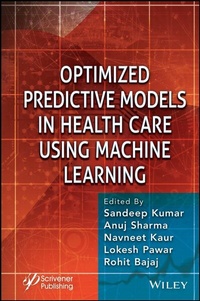
Optimized Predictive Models in Health Care Using Machine Learning
Description

This book is a comprehensive guide to developing and implementing optimized predictive models in healthcare using machine learning and is a required resource for researchers, healthcare professionals, and students who wish to know more about real-time applications.
The book focuses on how humans and computers interact to ever-increasing levels of complexity and simplicity and provides content on the theory of optimized predictive model design, evaluation, and user diversity. Predictive modeling, a field of machine learning, has emerged as a powerful tool in healthcare for identifying high-risk patients, predicting disease progression, and optimizing treatment plans. By leveraging data from various sources, predictive models can help healthcare providers make informed decisions, resulting in better patient outcomes and reduced costs.
Other essential features of the book include:
* provides detailed guidance on data collection and preprocessing, emphasizing the importance of collecting accurate and reliable data;
* explains how to transform raw data into meaningful features that can be used to improve the accuracy of predictive models;
* gives a detailed overview of machine learning algorithms for predictive modeling in healthcare, discussing the pros and cons of different algorithms and how to choose the best one for a specific application;
* emphasizes validating and evaluating predictive models;
* provides a comprehensive overview of validation and evaluation techniques and how to evaluate the performance of predictive models using a range of metrics;
* discusses the challenges and limitations of predictive modeling in healthcare;
* highlights the ethical and legal considerations that must be considered when developing predictive models and the potential biases that can arise in those models.
Audience
The book will be read by a wide range of professionals who are involved in healthcare, data science, and machine learning.
More details
Other editions
Additional editions
Persons
Sandeep Kumar, PhD, is a professor in the Department of Computer Science and Engineering, K L Deemed to be University, Vijayawada, Andhra Pradesh, India. He has been granted six patents and successfully filed another ten. He has published more than 100 research papers in various national and international journals and proceedings of reputed national and international conferences.
Anuj Sharma, PhD, is a professor at Maharshi Dayanand University, Rohtak, India. He has 19 years of teaching and administrative experience and has published more than 50 journal articles.
Navneet Kaur, PhD, is a professor in the Department of Computer Science & Engineering, Chandigarh University, India. She is the awardee of the Best Engineering College Teacher Award for Punjab State for the year 2019 and has published more than 35 research articles in reputed SCI journals and conferences.
Lokesh Pawar, PhD, is an assistant professor at Chandigarh University, India. He has filed two patents and has published multiple research articles in many SCI journals.
Rohit Bajaj, PhD, is an associate professor in the Department of Computer Science & Engineering, Chandigarh University, India. He has 12 years of teaching research experience and has published 60 papers in refereed journals and conferences.
Content
Preface xv
1 Impact of Technology on Daily Food Habits and Their Effects on Health 1
Neha Tanwar, Sandeep Kumar and Shilpa Choudhary
1.1 Introduction 2
1.2 Technologies, Foodies, and Consciousness 4
1.3 Government Programs to Encourage Healthy Choices 7
1.4 Technology's Impact on Our Food Consumption 7
1.5 Customized Food is the Future of Food 8
1.6 Impact of Food Technology and Innovation on Nutrition and Health 9
1.7 Top Prominent and Emerging Food Technology Trends 10
1.8 Discussion 18
1.9 Conclusions 18
2 Issues in Healthcare and the Role of Machine Learning in Healthcare 21
Nidhika Chauhan, Navneet Kaur, Kamaljit Singh Saini and Manjot Kaur
2.1 Introduction 22
2.2 Issues in Healthcare 23
2.3 Factors Affecting the Health 30
2.4 Machine Learning in Healthcare 30
2.5 Conclusion 32
3 Improving Accuracy in Predicting Stress Levels of Working Women Using Convolutional Neural Networks 39
Purude Vaishali Narayanro, Regula Srilakshmi, M. Deepika and P. Lalitha Surya Kumari
3.1 Introduction 39
3.2 Literature Survey 41
3.3 Proposed Methodology 45
3.4 Result and Discussion 50
3.5 Conclusion and Future Scope 54
4 Analysis of Smart Technologies in Healthcare 57
Shikha Jain, Navneet Kaur, Manisha Malhotra and Manjot Kaur
4.1 Introduction 57
4.2 Emerging Technologies in Healthcare 58
4.3 Literature Review 62
4.4 Risks and Challenges 65
4.5 Conclusion 68
5 Enhanced Neural Network Ensemble Classification for the Diagnosis of Lung Cancer Disease 73
Thaventhiran Chandrasekar, Praveen Kumar Karunanithi, K.R. Sekar and Arka Ghosh
5.1 Introduction 74
5.2 Algorithm for Classification of Proposed Weight-Optimized Neural Network Ensembles 75
5.3 Experimental Work and Results 81
5.4 Conclusion 84
6 Feature Selection for Breast Cancer Detection 89
Kishan Sharda, Mandeep Singh Ramdev, Deepak Rawat and Pawan Bishnoi
6.1 Introduction 90
6.2 Literature Review 92
6.3 Design and Implementation 94
6.4 Conclusion 100
7 An Optimized Feature-Based Prediction Model for Grouping the Liver Patients 103
Bhupender Yadav and Rohit Bajaj
7.1 Introduction 104
7.2 Literature Review 106
7.3 Proposed Methodology 108
7.4 Results and Discussions 108
7.5 Conclusion 113
8 A Robust Machine Learning Model for Breast Cancer Prediction 117
Rachna, Chahil Choudhary and Jatin Thakur
8.1 Introduction 118
8.2 Literature Review 119
8.3 Proposed Mythology 126
8.4 Result and Discussion 127
8.5 Concluding Remarks and Future Scope 132
9 Revolutionizing Pneumonia Diagnosis and Prediction Through Deep Neural Networks 135
Abhishek Bhola and Monali Gulhane
9.1 Introduction 135
9.2 Literature Work 138
9.3 Proposed Section 139
9.4 Result Analysis 142
9.5 Conclusion and Future Scope 146
10 Optimizing Prediction of Liver Disease Using Machine Learning Algorithms 151
Rachna, Tanish Jain, Deepak Shandilya and Shivangi Gagneja
10.1 Introduction 151
10.2 Related Works 153
10.3 Proposed Methodology 166
10.4 Result and Discussions 166
10.5 Conclusion 170
11 Optimized Ensembled Model to Predict Diabetes Using Machine Learning 173
Kamal, AnujKumar Sharma and Dinesh Kumar
11.1 Introduction 173
11.2 Literature Review 175
11.3 Proposed Methodology 177
11.4 Results and Discussion 184
11.5 Concluding Remarks and Future Scope 187
12 Wearable Gait Authentication: A Framework for Secure User Identification in Healthcare 195
Swathi A., Swathi V., Shilpa Choudhary and Munish Kumar
12.1 Introduction 195
12.2 Literature Survey 197
12.3 Proposed System 199
12.4 Results and Discussion 203
12.5 Conclusion and Future Scope 211
13 NLP-Based Speech Analysis Using K-Neighbor Classifier 215
Renuka Arora and Rishu Bhatia
13.1 Introduction 215
13.2 Supervised Machine Learning for NLP and Text Analytics 216
13.3 Unsupervised Machine Learning for NLP and Text Analytics 219
13.4 Experiments and Results 222
13.5 Conclusion 225
14 Fusion of Various Machine Learning Algorithms for Early Heart Attack Prediction 229
Monali Gulhane and Sandeep Kumar
14.1 Introduction 230
14.2 Literature Review 231
14.3 Materials and Methods 233
14.4 Result Analysis 239
14.5 Conclusion 242
15 Machine Learning-Based Approaches for Improving Healthcare Services and Quality of Life (QoL): Opportunities, Issues and Challenges 245
Pankaj Rahi, Rohit Bajaj, Sanjay P. Sood, Monika Dandotiyan and A. Anushya
15.1 Introduction 246
15.2 Core Areas of Deep Learning and ML-Modeling in Medical Healthcare 248
15.3 Use Cases of Machine Learning Modelling in Healthcare Informatics 250
15.4 Improving the Quality of Services During the Diagnosing and Treatment Processes of Chronicle Diseases 259
15.5 Limitations and Challenges of ML, DL Modelling in Healthcare Systems 261
15.6 Conclusion 264
16 Developing a Cognitive Learning and Intelligent Data Analysis-Based Framework for Early Disease Detection and Prevention in Younger Adults with Fatigue 273
Harish Padmanaban P. C. and Yogesh Kumar Sharma
16.1 Introduction 274
16.2 Proposed Framework "Cognitive-Intelligent Fatigue Detection and Prevention Framework (CIFDPF)" 275
16.3 Potential Impact 286
16.4 Discussion and Limitations 292
16.5 Future Work 293
16.6 Conclusion 294
17 Machine Learning Approach to Predicting Reliability in Healthcare Using Knowledge Engineering 299
Kialakun N. Galgal, Kamalakanta Muduli and Ashish Kumar Luhach
17.1 Introduction 300
17.2 Literature Review 302
17.3 Proposed Methodology 305
17.4 Implications 310
17.5 Conclusion 312
17.6 Limitations and Scope of Future Work 313
18 TPLSTM-Based Deep ANN with Feature Matching Prediction of Lung Cancer 317
Thaventhiran Chandrasekar, Praveen Kumar Karunanithi, A. Emily Jenifer and Inti Dhiraj
18.1 Introduction 318
18.2 Proposed TP-LSTM-Based Neural Network with Feature Matching for Prediction of Lung Cancer 320
18.3 Experimental Work and Comparison Analysis 325
18.4 Conclusion 326
19 Analysis of Business Intelligence in Healthcare Using Machine Learning 329
Vipin Kumar, Chelsi Sen, Arpit Jain, Abhishek Jain and Anu Sharma
19.1 Introduction 329
19.2 Data Gathering 331
19.3 Literature Review 333
19.4 Research Methodology 334
19.5 Implementation 335
19.6 Eligibility Criteria 337
19.7 Results 337
19.8 Conclusion and Future Scope 338
20 StressDetect: ML for Mental Stress Prediction 341
Himanshu Verma, Nimish Kumar, Yogesh Kumar Sharma and Pankaj Vyas
20.1 Introduction 342
20.2 Related Work 344
20.3 Materials and Methods 348
20.4 Results 352
20.5 Discussion & Conclusions 353
References 355
Index 359
1
Impact of Technology on Daily Food Habits and Their Effects on Health
Neha Tanwar1, Sandeep Kumar2* and Shilpa Choudhary3
1Department of Food Technology, Guru Jambheshwar University of Science and Technology, Hisar, India
2Department of Computer Science and Engineering, Koneru Lakshmaiah Educational Foundation, Vijayawada, India
3Department of Computer Science and Engineering, Neil Gogte Institute of Technology, Hyderabad, India
Abstract
In this modern and busy lifestyle, we all look for ready-to-eat food. Food industries turn toward full automation to provide ready food nowadays. Prepared and packed food has an impact on health in the modern lifestyle with eating habits consumers seeking the technology viz. food diets application, online food delivery systems, and robotic food making machines. In this chapter, we have discussed the impacts of technology on daily food habits. The importance of technology in the food industry and its problems are highlighted in this chapter, with a focus on artificial intelligence, bioinformatics, 3D printing, sustainable applications of functional and nutraceutical food, and the need for a coordinated regulatory framework. The natural nutrients included in food, including carbs, proteins, vitamins, fats, antioxidants, and minerals, are necessary for the body parts to work normally physiologically. Achieving good health from sustainable food systems for the people is one of the most significant issues facing our world today. This chapter also focuses on different processed foods and their health impacts.
Keywords: Technology, food habits, artificial intelligence, digitization, emerging technologies
1.1 Introduction
We truly are what we eat, as the phrase goes. In other words, nutrition is essential to our health. Food provides information to our bodies, which also require ingredients to function properly. Our metabolic processes become disrupted and our health degrades if our body doesn't receive the proper signals [1]. If we give our bodies non-healthy foods, our bodies get the wrong information, and we have to suffer many diseases. Several exciting pieces of evidence show that dietary factor plays a vital role in maintaining the systems and mechanisms of mental function. The relative abundance or scarcity of specific nutrients can affect cognitive processes. Cognitive ability is influenced by several gut hormones which can enter the brain, and these hormones function depending on the type of food intake. Although there are definite patterns, such as the need for nutrition balancing, there is no universally accepted definition of a healthy diet. Also, this relies on the features of every person and their surroundings [2]. -Gregorio Varela, Chairman of the Spanish Nutrition Association
Our food is different from what it was 20 years ago. The soil nutrients have been depleted, and chemicals are increasingly used to get more yield. Because of the growing quantity and variety of available food products, food choices are complex and vary over a short period, influenced by many factors like social, cultural, biological, psychological, and economic factors [3]. We have a lot of food variety and approx. Seventeen thousand new products are introduced each year. So we are heavily dependent on processed foods. The examples of food tech businesses include robotics, 3D food printing, alternative proteins, and individualised nutrition. Although these technologies have a tremendous positive impact on the food business, they merely touch the surface. These technological advancements and the internet era promote new food products that give fulfillment in less time.
1.1.1 Impacts of Food on Health
Food is central to our health. The food we have gives information and materials to our bodies that we need for the proper functioning of our bodies, as shown in Figure 1.1. This information can be right and wrong, depending on our food. To sustain, prevent, and treat disease, food serves as medication. The nutrients in food give all the necessary nourishing things and information by which our cells enable them to perform their functions. The metabolic processes slow down or occasionally even cease when the amount of nutrients consumed is not appropriate for the demands of the cell's activity [4]. A healthy and balanced diet gives us plenty of energy to work, enjoy ourselves, and keep our immune systems healthy. The both science and art concerned with maintaining health and the prevention, relief, or cure of sickness, according to Webster. Nutrients come in a wide variety of forms, and we classify them into two groups: macronutrients and micronutrients, as shown in Figure 1.2.
Figure 1.1 Role of food habits on our mental health.
Figure 1.2 Macronutrients and micronutrients.
- Macro (big) Nutrients
We need large amounts of carbohydrates, sugars, and dietary fiber from pieces of bread, beans, cereals and grains, pasta, fruits, and non-starchy vegetables. We obtain fats, fatty acids, and cholesterol from red palm oil, coconuts, groundnuts, soybeans, oily fish, avocados, butter, ghee, lard/cooking fat, whole milk, and cheese. We also obtain fats from meats and meat products (such as sausages) and fowl. There are many various types of proteins; some examples include those found in animal-based meals like meat, chicken, fish, eggs, and dairy products as well as those found in plant-based foods like pulses, fruits, and vegetables [5]. - Micro (minor) Nutrients
Minerals like iron, iodine, and zinc are among the micronutrients, or minor nutrients, which humans need in very small amounts yet are most often inadequate in our diets. Beef, liver, and other organ meats, poultry, fish, breast milk, as well as seaweed, legumes, almonds, and other foods provide us with these nutrients, vitamins, such as folate, vitamin B-group vitamins (which also contain vitamin A), and vitamin C [6].
1.1.2 Impact of Technology on Our Eating Habits
Technology changes every aspect of people's lives and their communication, lifestyle, thinking, learning, and food habits. Food habits are changed with the rise of Internet of Things (IoT) and Artificial Intelligence (AI). Sharing food pictures on social media like WhatsApp, Facebook, Twitter, Instagram, etc., has grown globally [7]. Many people have even made their careers as food bloggers out of employing this trend on their feeds as shown in Figure 1.3. From every aspect, technology is changing our way of food habits. According to the Choosi Modern Food Trends Study, 50% of consumers get ideas for meals from others' internet food photos. 39% of those surveyed stated that social media influenced their current eating habits.
Now, the question arises: How does technology affect our eating habits, and how will this change in the future?
1.2 Technologies, Foodies, and Consciousness
Technological influence may have both positive and negative effects. Figure 1.4 demonstrates that food is more than simply a necessity for survival.
Figure 1.3 Technological innovations in food sector.
Figure 1.4 Food on social media.
From one perspective, it increases our awareness of what we eat and current dietary trends, which develops better eating habits, at the same time, problematic internet users, uncontrollable craving habits, and eating disorders such as loss of control eating, binge eating disorders, etc. are increasing by the higher rate [8]. Problematic Internet Use (PIU) comprises passive behaviour brought on by excessive technology use as well as adverse social comparisons that may arise from exposure to and self-comparison with anything on their home feed. When it comes to teenagers, it becomes more distracting because of their undeveloped skills and the constant pressure they face through the internet world. It is important to understand online marketing and how it can be deceptive, as people can't touch, feel or smell what's advertised. Technology has improved accessibility-find, grab, and get. This on-demand culture has naturally shifted our food habits as well. Technology gives a faster way to get your food. Everybody likes ready to eat, ready to drink, and mull meal bars because it takes just a few minutes to prepare without effort. Technology does not affect our food habits as well as it affects the food industries [9].
According to the latest available statistics from the Australian Institute of Health and Welfare, which covered the years 2017 to 2018, 7.7% of adults and 17% of children were obese. As a result, one in four kids are at an elevated risk for physical health problems as well as greater mortality and sickness risks as adults. In order to prevent these tendencies from developing later in life, it is important to foster a positive link between food and technology from early childhood and adolescence on.
Technology has positive impacts also; like presently, so many intelligent appliances make cooking more accessible and less time-consuming, like smart cookers, electric inductions, ovens, etc. New technologies change everything from what we eat to how it to made by minimizing waste and environmental impacts. New automation raises high-skill jobs in the food sector and puts manual workers' livelihoods at risk. So, the effect of technology is much more complicated...
