

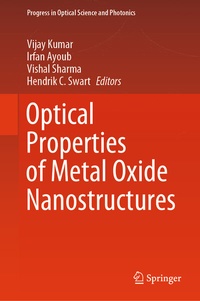
Optical Properties of Metal Oxide Nanostructures
Description

This book highlights the optical properties of metal oxides at both the fundamental and applied level and their use in various applications. The book offers a basic understanding of the optical properties and related spectroscopic techniques essential for anyone interested in learning about metal oxide nanostructures. This is partly due to the fact that optical properties are closely associated with other properties and functionalities (e.g., electronic, magnetic, and thermal), which are of essential significance to many technological applications, such as optical data communications, imaging, lighting, and displays, life sciences, health care, security, and safety. The book also highlights the fundamentals and systematic developments in various optical techniques to achieve better characterization, cost-effective, user-friendly approaches, and most importantly, state-of-the-art developing methodologies for various scientific and technological applications. It provides an adequate understanding of the imposed limitations and highlights the prospects and challenges associated with optical analytical methods to achieve the desired performance in targeted applications.
More details
Other editions
Additional editions
Persons
Dr. Vijay Kumar is presently working as an assistant professor in the Department of Physics at the National Institute of Technology Srinagar (J&K), India. His research experience, as well as research interests, lie in the synthesis, processing, and characterization of functional materials, solid-state luminescent materials, bio-based/biodegradable polymers and composites, drug delivery devices, wastewater treatment, polymer nanocomposites, and ion-solid interaction.
Irfan Ayoub is a senior research fellow in the Department of Physics, National Institute of Technology Srinagar. He is pursuing his Ph.D. in luminescence and optical properties of metal oxides.
Dr. Vishal Sharma is presently working as an Assistant Professor (Physical Sciences) at the Institute of Forensic Science and Criminology (IFSC), Faculty of Science, Panjab University, Chandigarh (India). He is currently chairing the Institute at Panjab University. He obtained his Ph.D. in Physics from Kurukshetra University, Kurukshetra, India, and Inter University Accelerator Centre (IUAC-an autonomous center of UGC, Govt. of India), New Delhi (India). His research interests are in the field of material science (synthesis of smart materials for different applications, nanophosphors, hydrogels), sensors (drug and finger-mark sensing), molecular spectroscopy, forensic science, analytical chemistry, and chemometrics.
Hendrik C Swart is an internationally acclaimed researcher and is currently a senior professor in the Department of Physics at the University of the Free State, South Africa. He has led research in the area of degradation of phosphors for field emission displays, as well as developing materials for nanosolid-state lighting. He has been key in the development of processes to synthesize and deposit thin films of various types of semiconductor nanoparticles that enhance the color, luminescent intensity, and lifetime of such displays. His research led to the establishment of astrong group working on luminescent materials, as well as the establishment of several smaller groups all over South Africa.