

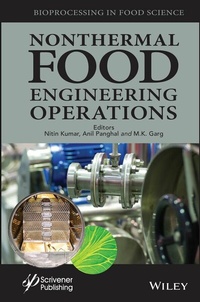
Nonthermal Food Engineering Operations
1st Edition
Published on 21. May 2024
526 pages
978-1-119-77645-1 (ISBN)
Description

NONTHERMAL FOOD ENGINEERING OPERATIONS
Presenting cutting-edge information on new and emerging food engineering processes, Nonthermal Food Engineering Operations, the latest volume in the series, "Bioprocessing in Food Science," is an essential reference on the modeling, quality, safety, and technologies associated with food processing operations today.
"Bioprocessing in Food Science" is a series of volumes covering the entirety of unit operations in food processing. This latest volume covers nonthermal food engineering operations, focusing on packaging techniques, artificial intelligence and other emerging technologies and their use and relevance within food engineering, fluid extraction, nanotechnology, and many other topics.
As the demand for healthy food is increasing in the current global scenario, manufacturers are searching for new possibilities for occupying a greater share in the rapidly changing food market. Compiled reports and updated knowledge on thermal processing of food products are imperative for commercial enterprises and manufacturing units. In the current scenario, academia, researchers, and food industries are working in a scattered manner and different technologies developed at each level are not compiled to implement for the benefits of different stakeholders. However, advancements in bioprocesses are required at all levels for the betterment of food industries and consumers. This series of groundbreaking edited volumes will be a comprehensive compilation of all the research that has been carried out so far, their practical applications, and the future scope of research and development in the food bioprocessing industry.
During the last decade, there have been major developments in novel technologies for food processing. This series will cover all the novel technologies employed for processing different types of foods, encompassing the background, principles, classification, applications, equipment, effect on foods, legislative issue, technology implementation, constraints, and food and human safety concerns.
Presenting cutting-edge information on new and emerging food engineering processes, Nonthermal Food Engineering Operations, the latest volume in the series, "Bioprocessing in Food Science," is an essential reference on the modeling, quality, safety, and technologies associated with food processing operations today.
"Bioprocessing in Food Science" is a series of volumes covering the entirety of unit operations in food processing. This latest volume covers nonthermal food engineering operations, focusing on packaging techniques, artificial intelligence and other emerging technologies and their use and relevance within food engineering, fluid extraction, nanotechnology, and many other topics.
As the demand for healthy food is increasing in the current global scenario, manufacturers are searching for new possibilities for occupying a greater share in the rapidly changing food market. Compiled reports and updated knowledge on thermal processing of food products are imperative for commercial enterprises and manufacturing units. In the current scenario, academia, researchers, and food industries are working in a scattered manner and different technologies developed at each level are not compiled to implement for the benefits of different stakeholders. However, advancements in bioprocesses are required at all levels for the betterment of food industries and consumers. This series of groundbreaking edited volumes will be a comprehensive compilation of all the research that has been carried out so far, their practical applications, and the future scope of research and development in the food bioprocessing industry.
During the last decade, there have been major developments in novel technologies for food processing. This series will cover all the novel technologies employed for processing different types of foods, encompassing the background, principles, classification, applications, equipment, effect on foods, legislative issue, technology implementation, constraints, and food and human safety concerns.
More details
Other editions
Additional editions
Nitin Kumar | Anil Panghal | M. K. Garg
Non-thermal Food Engineering Operations
Book
05/2024
1st Edition
Wiley-Scrivener
€229.50
Shipment within 15-20 days
Content
- Cover
- Series Page
- Title Page
- Copyright Page
- Preface
- Chapter 1 Artificial Intelligence (AI) in Food Processing
- 1.1 Introduction
- 1.2 Evolution of Artificial Intelligence
- 1.3 Artificial Intelligence in Food Processing
- 1.4 Artificial Neural Network (ANN)
- 1.4.1 Fats & Oils Quality Evaluation
- 1.4.2 Fruits Quality Evaluation
- 1.4.3 Dairy Products Quality Evaluation
- 1.4.4 Solvent Extraction
- 1.4.5 Microwave Assisted Extraction (MAE)
- 1.4.6 Ultrasound-Assisted Extraction (UAE)
- 1.4.7 Microwave Drying
- 1.4.8 Tray Drying
- 1.4.9 Osmotic Dehydration
- 1.4.10 Other Drying Process
- 1.4.11 Extrusion Process
- 1.4.12 Baking
- 1.4.13 Storage of Food Grains
- 1.5 Fuzzy Logic System
- 1.5.1 Fuzzy Logic Systems in Liquid Foods Processing
- 1.5.2 Fuzzy Logic Systems in Solid Foods Processing
- 1.5.3 Semisolid Products
- 1.5.4 Drying Process
- 1.5.5 Baking Process
- 1.5.6 Dairy Process
- 1.5.7 Thermal Process
- 1.5.8 Fermentation
- 1.6 Knowledge.Based Expert System (ES)
- 1.6.1 Applications of ES in the Food Processing Sector
- 1.7 Machine Learning System (ML)
- 1.7.1 Detection of Defects and Mechanical Damage in Fruits
- 1.7.2 ML in Foreign Material Detection
- 1.7.3 ML in Food Quality Evaluation
- 1.8 Conclusion
- References
- Chapter 2 Advances in Ultrasound in Food Industry
- 2.1 Introduction
- 2.2 Background of Ultrasound
- 2.3 Ultrasonic Waves
- 2.4 Applications of Ultrasonics in the Food Industry
- 2.4.1 Food Preservation
- 2.4.2 Food Processing
- 2.5 Detection of Fruit Quality
- 2.6 Ultrasound in Dairy Sector
- 2.7 Conclusion
- References
- Chapter 3 Biosensors in Food Quality and Safety
- 3.1 Introduction
- 3.2 What is a Biosensor?
- 3.2.1 Components of a Biosensor Diagnostic Technique
- 3.2.1.1 Biological Element
- 3.2.1.2 Physicochemical Transducer
- 3.2.1.3 Detector/Recognition of Signal
- 3.2.2 Basic Working Mechanism of Biosensors
- 3.2.3 Important Characteristics of Biosensors
- 3.3 Categorization of Biosensors
- 3.3.1 Calorimetric Biosensors
- 3.3.2 Electrochemical Biosensors
- 3.3.2.1 Amperometric Biosensors
- 3.3.2.2 Potentiometric Biosensors
- 3.3.2.3 Conductometric Biosensors
- 3.3.3 Optical Biosensors
- 3.3.4 Microbial-Based Biosensors
- 3.3.4.1 Electrochemical Microbial Biosensors
- 3.3.4.2 Optical Microbial Biosensors
- 3.3.5 Affinity Biosensors
- 3.3.6 Plant Tissue Biosensors
- 3.3.7 Surface Plasmon Resonance (SPR) Biosensors
- 3.3.8 Acoustic Sensors
- 3.3.9 Aptamers
- 3.3.10 Molecularly Imprinted Polymers
- 3.3.11 Immunosensors
- 3.4 Application of Biosensors
- 3.4.1 Scenario of Available Biosensors for the Detection of Various Compounds Present in Food Products
- 3.4.2 Electrochemical Biosensors for Food Products
- 3.4.3 Optical Biosensor
- 3.4.4 Microbial Biosensors
- 3.4.5 Plant Tissue Biosensors
- 3.5 Future Prospects
- References
- Chapter 4 Cold Plasma: Principles and Applications
- 4.1 Introduction
- 4.2 Physics of Plasma
- 4.3 Methods of Generation
- 4.3.1 Dielectric Barrier Discharge (DBD)
- 4.3.2 Glow Discharge
- 4.3.3 Plasma Jet
- 4.3.4 Corona Discharge
- 4.3.5 High Voltage Pulse Discharge
- 4.4 Principles of Cold Plasma Decontamination
- 4.5 Plasma Species?f Role in Microbial Inactivation
- 4.5.1 Reactive Oxygen and Reactive Nitrogen Species
- 4.6 Cold Plasma Affecting Microbial Cells
- 4.6.1 Effect on Cell Morphology
- 4.6.2 Impact on the Cell Membrane
- 4.6.3 Effect on Nucleic Acids
- 4.6.4 Impact on Enzyme and Proteins Activity
- 4.7 Limitations
- 4.8 Conclusion and Future Prospects
- References
- Chapter 5 Food Extrusion: An Approach to Wholesome Product
- 5.1 Introduction
- 5.2 Principle and Components of Extrusion Equipment
- 5.3 Types of Extruders
- 5.3.1 Single Screw Extruders
- 5.3.2 Twin Screw Extruders
- 5.4 Food Product Based on Extrusion Technology
- 5.5 Effect of Extrusion Cooking on Nutritional Aspects of Food
- 5.6 New Research Area of Byproduct Waste Utilization
- 5.7 Conclusion
- References
- Chapter 6 Image Processing Technology, Imaging Techniques, and Their Application in the Food Processing Sector
- 6.1 Introduction
- 6.2 Image Processing Technology
- 6.2.1 Image Acquisition
- 6.2.2 Image Pre-Processing
- 6.2.3 Image Segmentation
- 6.2.4 Feature Extraction
- 6.2.5 Classification
- 6.3 Machine Learning Algorithms
- 6.4 Industrial Applications
- 6.5 Novel Imaging Techniques and Their Applications
- 6.5.1 Near Infrared Imaging
- 6.5.2 Multispectral and Hyperspectral Imaging
- 6.5.3 Raman Imaging
- 6.5.4 Laser Light Backscattering Imaging
- 6.5.5 Structured-Illumination Reflectance Imaging
- 6.5.6 Optical Coherence Tomography
- 6.6 Challenges and Opportunities
- References
- Chapter 7 Active and Passive Modified Atmosphere Packaging: Recent Advances
- 7.1 Introduction
- 7.2 Modified Atmosphere Packaging
- 7.2.1 Passive MAP
- 7.2.1.1 Gases Utilised in Modified Atmosphere Packaging
- 7.2.2 Active MAP
- 7.2.2.1 Active Ingredients
- 7.2.2.2 Dynamics of MAP
- 7.2.2.3 Design of Modified Atmosphere Packaging
- 7.2.2.4 Packaging Materials Used in MAP
- 7.2.3 MAP Combined with Other Preservative Techniques
- 7.2.3.1 Heat Treatment
- 7.2.3.2 Irradiation
- 7.2.3.3 UV Light Radiation
- 7.2.3.4 Ozone Gas
- 7.2.3.5 Edible or Wax Coatings
- 7.2.4 Effect of MAP on Quality of Fresh Produce
- 7.3 Final Remarks
- References
- Chapter 8 Membrane Processing Techniques in Food Engineering
- 8.1 Introduction
- 8.2 Overview of Membranes
- 8.3 Types of Membrane Separation Processes
- 8.3.1 Pressure-Driven Processes
- 8.3.2 Filtration Spectrum
- 8.4 Filtration Modes
- 8.4.1 Dead-End Filtration
- 8.4.2 Crossflow Filtration
- 8.4.3 Hybrid-Flow Filtration
- 8.5 Membrane Structure
- 8.6 Important Terms Related to Membrane Processes
- 8.7 Operational Requirements of Membranes
- 8.8 Theoretical Models for Membrane Processes
- 8.9 Factors Affecting the Separation Processes
- 8.10 Major Advantages of Membranes
- 8.11 Microfiltration
- 8.11.1 Microfiltration Applications by Industry
- 8.12 Ultrafiltration
- 8.12.1 UF Applications
- 8.13 Nanofiltration
- 8.13.1 Applications of Nanofiltration
- 8.14 Application of Membrane Separation in Food Industry
- 8.15 Conclusion
- References
- Chapter 9 Nano Technology in Food Packaging
- 9.1 Introduction
- 9.2 Nanomaterials
- 9.2.1 Silver Nanomaterial (AgNPs)
- 9.2.2 Titanium Dioxide (TiO2)
- 9.2.3 Montmorillonite Clay (Nanoclay)
- 9.2.4 Nano Zinc Oxide
- 9.2.5 Nano Silica
- 9.2.6 Carbon Nanotubes (CNTs)
- 9.2.7 Nano Starch
- 9.2.8 Nanocellulose
- 9.3 Use of Nanotechnology in Improved Packaging
- 9.3.1 Improving the Mechanical Strength and Permeability Properties
- 9.3.2 Improving Thermal Stability
- 9.3.3 Accelerating the Biodegradation Process
- 9.4 Use of Nanotechnology in Active Packaging
- 9.4.1 Antimicrobial Packaging
- 9.4.2 Nanoemulsion
- 9.4.3 Oxygen Scavengers
- 9.4.4 Immobilization of Enzymes
- 9.5 Use of Nanotechnology in Smart Packaging
- 9.5.1 Oxygen Sensors
- 9.5.2 Nanosensors for Detection of Pathogens
- 9.5.3 Freshness Indicators
- 9.5.4 Time Temperature Indicators
- 9.6 Toxicological Aspects, Safety Consideration, and Migration of Nanoparticles
- 9.7 Future Outlook and Conclusion
- References
- Chapter 10 Polysaccharide-Based Bionanocomposites for Food Packaging
- 10.1 Introduction
- 10.2 Classification of Polysaccharides
- 10.2.1 Plant-Based Polysaccharides
- 10.2.1.1 Starch
- 10.2.1.2 Cellulose
- 10.2.1.3 Galactomannans
- 10.2.2 Animal-Based Polysaccharides
- 10.2.2.1 Chitosan
- 10.2.2.2 Carrageenan
- 10.2.3 Microorganism-Based Polysaccharides
- 10.2.3.1 Xanthan Gum
- 10.2.3.2 Gellan Gum
- 10.2.3.3 Pullulan
- 10.2.3.4 FucoPol
- 10.3 Extraction and Purification of Polysaccharides
- 10.3.1 Extraction of Polysaccharides
- 10.3.1.1 Hot Water Extraction
- 10.3.1.2 Sequential Extraction Method
- 10.3.1.3 Dilute Alkali-Water Extraction
- 10.3.1.4 Microwave-Assisted Extraction
- 10.3.1.5 Ultrasound-Assisted Extraction
- 10.3.1.6 Enzyme-Assisted Extraction
- 10.3.1.7 Subcritical Water Extraction
- 10.3.2 Purification Techniques
- 10.3.2.1 Fractional Precipitation
- 10.3.2.2 Chromatographic Techniques
- 10.4 Polysaccharide-Based Bionanocomposite Fabrication Techniques
- 10.4.1 Solution Intercalation
- 10.4.2 In Situ Intercalative Polymerization
- 10.4.3 Melt Intercalation
- 10.4.4 Extrusion
- 10.4.5 Electrospinning Technique
- 10.4.6 Freeze-Drying Technique
- 10.5 Polysaccharide-Based Nanocomposites: Classification and Food Applications
- 10.5.1 Polysaccharide-Based Nanocomposites with Graphene/Carbon Nanotubes
- 10.5.2 Polysaccharide-Based Nanocomposites with Metal Oxides
- 10.5.2.1 Silver-Based Nanoparticles
- 10.5.2.2 Zinc Oxide Nanoparticles
- 10.5.2.3 Copper Oxide Nanoparticles
- 10.5.2.4 Titanium Dioxide Nanoparticles
- 10.5.3 Polysaccharides-Based Nanocomposites with Other Reinforcement Materials
- 10.5.3.1 Bionanocomposites Based on Starch
- 10.5.3.2 Bionanocomposites Based on Chitosan
- 10.5.3.3 Bionanocomposites Based on Cellulose
- 10.6 Conclusions
- References
- Chapter 11 Smart, Intelligent, and Active Packaging Systems for Shelf-Life Extension of Foods
- 11.1 Introduction
- 11.2 Novel Types of Food Packaging
- 11.3 Regulatory Framework
- 11.4 Novel Smart Packaging Proposals
- 11.4.1 Meat Preservation
- 11.4.2 Nanotechnologies
- 11.5 Considerations
- 11.6 Conclusions
- References
- Chapter 12 Supercritical and Subcritical Fluid Extraction Systems
- 12.1 Introduction
- 12.2 Supercritical Fluids
- 12.3 Super Critical Fluid Extraction
- 12.4 Factors Affecting Supercritical Fluid Extraction
- 12.4.1 Feed Pre-Treatment
- 12.4.2 Feed Matrix
- 12.4.3 Extraction Temperature and Pressure
- 12.4.4 Flow Rate
- 12.4.5 Solvent-to-Feed Ratio
- 12.5 Applications of Supercritical Fluid Extraction
- 12.5.1 Spices
- 12.5.2 Milk and Milk-Based Products
- 12.5.3 Cocoa and Coffee Products
- 12.5.4 Plants, Herbs, and Natural Colours
- 12.5.4.1 Herbs
- 12.6 Sub-Critical Fluid Extraction
- 12.7 Factors Affecting Subcritical Fluid Extraction
- 12.7.1 Temperature and Pressure
- 12.7.2 Solvent Flow Rate
- 12.7.3 Particle Size
- 12.8 Application of Subcritical Fluid Extraction
- 12.8.1 Extraction of Bioactive Compounds
- 12.9 Conclusion and Future Trends
- References
- Chapter 13 Ultraviolet Rays in Food Processing
- 13.1 Introduction
- 13.2 Types of UV Radiation
- 13.3 Principles of Ultraviolet Radiation
- 13.4 Types of Ultraviolet Sources
- 13.4.1 Low-Pressure Amalgam (LPA) Lamps
- 13.4.2 Low-Pressure Mercury (LPM) Lamps
- 13.4.3 Medium Pressure Mercury (MPM) Lamps
- 13.4.4 Excimer Lamps
- 13.4.5 Microwave UV Lamps
- 13.4.6 Pulsed UV Radiation
- 13.4.7 UV LED
- 13.5 Types of Influencing Factors of UV Processing
- 13.6 Effect of UV Processing on Vegetable Crops
- 13.6.1 Effects of UV Radiation on Physical Properties of Vegetable Crops
- 13.6.2 Effect of UV Radiation on Biochemical Properties of Vegetable Crops
- 13.6.3 Effect of UV Radiation on Microorganisms and Post-Harvest Diseases of Vegetables
- 13.7 Effect of UV Processing on Fruits Crops
- 13.7.1 Effects of UV Processing on Physical Properties of Fruit Crops
- 13.7.2 Effects of UV Processing on Biochemical Properties of Fruit Crops
- 13.7.3 Effects of UV Processing on Microbial Properties of Fruit Crops
- 13.8 Effect of UV Processing on Miscellaneous Foods
- 13.9 Conclusion
- References
- Index
- Also of Interest
- EULA
