

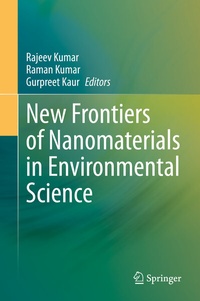
New Frontiers of Nanomaterials in Environmental Science
Description

This book provides the detail information about nanoparticles, their types, characterization techniques such as TEM, FESEM, AFM, XRD etc. nanogenotoxicity, metal and metal oxide nanoparticle's toxicity, physical and chemical characterization of nanomaterials, entry routes, cell-nano interaction studies, possible impacts to the human kind, and on the methods of evaluating the toxicity. It puts together comprehensive and up-to-date information about sustainable approaches in making an eco-friendly environment using advanced nanotechnologies. It educated readers about the new frontiers and scope of employing various state-of-art nano-technologies to clean-up and save our environment. This book will be of interest to teachers, researchers, environmental biotechnologists, capacity builders and policymakers. Also the book serves as additional reading material for undergraduate and graduate students of agriculture, environmental sciences, environmental engineering and biotechnology.
More details
Other editions
Additional editions
Persons
Dr. Raman Kumar is working as Associate Professor in Department of Biotechnology, Maharishi Markendeshwar University, Mullana (Ambala), Haryana, India Since 2011. He has also worked as Senior Research Fellow, Division of Soil and Crop Management, Central Soil Salinity Research Institute, Karnal, India from 2007 to 2010. He has experience of about 13 years in the field of Teaching and Research in the area of Microbial and Environmental Biotechnology. He has published more than 40 publications and 02 books in Various National and International Peer Reviewed Journals. He developed many bacterial and fungal strains for removal of heavy metals from wastewater. His current research areas are Bioremediation and Biodegradation of toxic pollutants, Pesticides and azo dyes using microbial consortium from the industrial Effluents, Mechanism involved in the heavy metal bioremediation.
Dr. Gurpreet Kaur is currently working as an Assistant Professor in Department of Chemistry, Panjab University. She did her B.Sc. (Hons school), M.Sc. (Hons school) and Ph.D. from the same department. Dr. Kaur is one of the recipients of DST Inspire Faculty Award. She is a physical chemist and works in the field of colloidal Chemistry. Her area of research deals with fabrication of metal functionalized surfactants for wide spectrum application including formation of bioactive materials and their interaction with biomolecules (DNA, proteins, etc), antimicrobial surfactants, microbial corrosion inhibitors, and electrocatalyst. She has more than 50 publications including review articles, 5 book chapters, 3 Indian Patents; one granted and two filed (and one applied for).
