

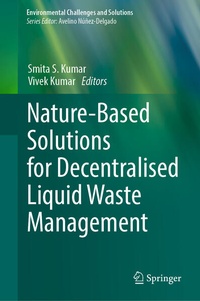
Nature-Based Solutions for Decentralised Liquid Waste Management
Description

When water is used once and is no longer fit for human consumption or any other use, it is considered liquid waste. Proper disposal, treatment and reuse of wastewater wherever possible will help in combating diseases as well as meeting water scarcity. The selection and adoption of appropriate technologies plays a very important role in this whole exercise and has far-reaching implications on the success in achieving a circular water economy. The selection of technologies is even more important. New concepts are continuously being added to achieve a sustainable society, focusing on the new tool of circular economy. Various reuse options of waste; either water or solids (e.g., agricultural irrigation, industrial process recycling, resource recovery, biogas production etc.) as part of a circular economy, are being identified and tested.
This book caters to the role of nature-based solutions in a circular water economy and includes chapters on how to tackle wastewater treatment with the help of sustainable bio-based technologies. This may include Bio-based technologies for the treatment of domestic/municipal/industrial/agro-industrial wastewater/sludges including but not limited to:
- Leach pit, Soak pit, Magic Pits, Kitchen Garden, and Community Soak pits etc.
- Waste Stabilization Ponds
- Duck Weed Pond system
- Constructed Wetlands
- Soil Bio Technology
- DEWATS
- Reed bed System
- Anaerobic Baffled Reactor (ABR)
- Moving Bed Bio-Film Reactor (MBBR)
- Urine treatment technologies
The book covers increased efficiency of treatment for example by using process modification, integration of technologies or selectively enriched biota. Investigation of pollutant removal processes/transformations, to better understand and optimize the design and improve the performance of these wastewater treatment systems are also included.
More details
Other editions
Additional editions
Persons
Dr. Smita S. Kumar is an Assistant Professor at the Central University of Haryana, Jant-Pali, Mahendergarh, and formerly held the same position at JC Bose University of Science and Technology, YMCA Faridabad. Her Ph.D. focused on using Microbial Fuel Cell Technology for the bioelectrochemical stabilization of landfill leachate, followed by post-doctoral research at CRDT, IIT Delhi. Her research interests include bio-energy, environmental pollution assessment, and nature-based solutions to environmental pollution. She has published over 90 edited books, peer-reviewed articles, and book chapters, with 7,600+ citations, an H-index of 39, and an i10-index of 60.
Prof. Vivek Kumar is a Professor at the Centre for Rural Development and Technology, IIT Delhi. He holds a B.E. in Pulp & Paper Engineering, an M.E. in Chemical Engineering (Industrial Pollution Abatement), and a Ph.D. from IIT Delhi (2000) on waste management in small-scale pulp and paper industries. He completed post-doctoral research in Germany and has over 20 years of academic and R&D experience, including roles at IIT Roorkee and as Visiting Research Professor at the University of Toronto. He has led numerous research projects on industrial waste treatment and currently leads an Indo-UK project on waste valorization in sugarcane industries. His research interests span industrial wastewater treatment, decentralized waste management, groundwater and river pollution assessment, emerging pollutants, biomass valorization, and sustainability policy. He has received multiple honors, including a Shastri Indo-Canadian SRF Grant, and served as International Director of the Bio-Forest Product Division, AIChE (2014-2017).
Content
Part I. Introduction .- Chapter 1. Nature-Based Solutions for Decentralized Liquid Waste Management.- Part II. Decentralized Technologies for Wastewater Treatment .- Chapter 2. Constructed Wetland as a Sustainable Option to Decentralized System for Industrial Waste Water Treatment.- Chapter 3. Waste Stabilization Ponds for Decentralized Wastewater Treatment.- Chapter 4. Access to Clean Water: Sustainable Biochar-based Water Treatment.- Chapter 5. Recent Advances in Anaerobic Baffled Reactor Technology for Decentralized Wastewater Management.- Chapter 6. Prospects and Advances in Soil Biotechnology as a Sustainable Strategy for Decentralized Liquid Waste Management.- Chapter 7. Treatment of Emerging Contaminants Using Constructed Wetlands.- Chapter 8. Landfill Leachate Treatment Using Sustainable Technology: Current Practices and Perspectives.- Chapter 9. Microbial Technologies for Degradation of Microplastics in Wastewater.- Chapter 10. Innovative Nature-Based Solutions for Hazardous Effluent Treatment.- Chapter 11. Application of Constructed Wetlands for the Removal of Contaminants from Wastewater.- Chapter 12. Macrophytes as a Potential Sustainable Strategy for Decentralized Wastewater Treatment.- Chapter 13. Circularity and Nature Based Solutions: A New Paradigm for Sustainability.- Part III. Case Studies .- Chapter 14. A Low-Cost Appropriate Sanitation Technology for Rural India: A Case Study of Vadgaon Maval, India.- Chapter 15. Application of Phytoremediation Technology as a Cost-Effective Solution for Treatment of Municipal and Industrial Wastewater: A Few Case Studies.- Chapter 16. Environmentally Sound Wastewater Treatment Options in Hebbal-Nagavara Valley, Bengaluru.- Chapter 17. Performance Evaluation of Raw Rubber Treatment of Wastewater in Water Lettuce (Pistia stratiotes) Macrophyte Pond.- Chapter 18. Performance Assessment of a Field-Scale Constructed Wetland: A Case Study of Tepla Village, Ambala, Haryana.
