

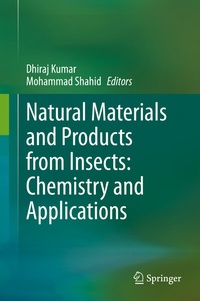
Natural Materials and Products from Insects: Chemistry and Applications
Description

This book reviews the latest research on bioproducts from various economically important insects, such as silkworms, honey bees, lac and drosophila, and termites, and discusses their general, biomedical and industrial applications in detail. It includes chapters focusing on insects as a food source, probiotics, silk-based biomaterials, insect pheromones, insects as biomedicine source, pupa oil chemistry, non-protein compounds from Lepidopteran insects, insect chitin and chitosan, polyphenols and flavonoids.
Model insects like Bombyx mori or bees were domesticated in Asian countries thousands of years ago. Over time, natural products from these animals became industrialized and today they attracting increasing attention thanks to their sustainability and their manifold applications in agriculture and biomedicine.The book is intended for entomologists, material scientists, natural product researchers and biotechnologists.
More details
Other editions
Additional editions
Persons
Dr. Dhiraj Kumar holds a doctorate in Animal Science from B.B. Ambedkar University, India and a post-doctorate from Soochow University, China. Currently, he is working as a Dr. D.S. Kothari fellow at Jiwaji University, India. He also served as an Assistant Professor at the Department of Zoology, Guru Ghasidas Vishwavidyalaya, India. Dr. Kumar has published 29 research papers in leading international journals, two books (10000+ downloads), five book chapters, three international proceedings and one patent (2 filed). He is also a reviewer for numerous SCI journals. Dr. Kumar has received several national & international awards for his contributions in biological science. Dr. Kumar's current research focus is metagenomics, natural products, novel wound healing patches and biomedicines.
Dr. Mohammad Shahid received his Ph.D. in Organic Chemistry from the Jamia Millia Islamia, New Delhi (India). He has contributed to 34 publications,including two books and three book chapters. His publications have attracted more than 1500 citations to date. He also coordinated the publication of a special issue of the Research Journal of Textile and Apparel. Dr. Shahid has been the recipient of several prestigious fellowships for his doctoral and postdoctoral research, such as the UGC Central University Ph.D. fellowship, China postdoctoral fellowship (Soochow University, China), Marie Curie individual fellowship (University of Glasgow, UK) and Dr. D S Kothari postdoctoral fellowship. He is currently involved in a project focusing on superhydrophobic finishing of nanocolored textiles at the Department of Fibers and Textile Processing Technology, Institute of Chemical Technology, Matunga, Mumbai. His research interests include natural dyes and dyeing, the chemistry of textile dyeing and functional finishing, functional coatings, and analytical methods for historical dye analysis.
