

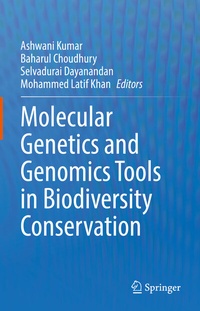
Molecular Genetics and Genomics Tools in Biodiversity Conservation
Description

More details
Other editions
Additional editions
Persons
Ashwani Kumar is presently an Assistant Professor in the Department of Botany at Dr. Harisingh Gour Vishwavidyalaya (Central University), Sagar, India (since 2013). Plant-microbe interactions, metagenomics, lignocellulosic biofuels, and bioremediation are among his scientific interests. He earned his Ph.D. in bioenergy from IIT Delhi and served as a postdoctoral scholar (2011-2013) at Durban University of Technology and Rhodes University in Grahamstown, South Africa. He earned numerous awards, including the GSEP Fellowship at the University of Saskatchewan in Canada (2009-2010), the Claude Leon Fellowship (2012-2014), and the NRF Fellowship (2012-2014) at Rhodes University in Grahamstown, South Africa. In 2019, he was awarded the GIAN Program, MHRD, Government of India, Shastri Indo-Canada Mobility Program Fellowship at Concordia University in Montreal, Canada. He is a life member of the BRSI, the NIE, and the ISEB in India, and he was recently chosen as a Fellow of the International Society of Environmental Botanists and the National Institute of Ecology.
Baharul Choudhury is a trained biologist with several years of research experience in ecology, evolution, conservation biology, population genetics and genomics. He obtained Ph.D. from Assam University, Silchar (India), and moved to Canada to pursue a second Ph.D. at Concordia University. Baharul was able to secure several fellowships including the prestigious FRQNT Merit Scholarship from Quebec Government. Following that, Baharul started working as a Postdoctoral Fellow at Concordia University, to study the rewiring in gene regulatory mechanism in Ascomycetes fungi during evolution. He then moved to the University of Toronto for another Postdoctoral Fellowship and studied genomic evolution sex chromosomes in the plant genus Rumex. Baharul recently started a new instructor position at Queen's University, Canada and active in teaching and learning, especially biology curriculum development. He is a lifemember of the Indian Science Congress Association and the Canadian Society for Ecology and Evolution.Dr. Selvadurai Dayanandan is a Professor and Head of the Biology Department, and a member of the Senate and Board of Governors of Concordia University in Montreal, Quebec, Canada. He received a PhD degree in Biology from Boston University and postdoctoral training at the University of Massachusetts and as a Killam Postdoctoral Fellow at the University of Alberta. He is an Associate Editor of Botany (formerly, Canadian Journal of Botany), Subject Editor of Biotropica and a council member of the Shastri India-Canada Institute. He is a member of the Quebec Centre for Biodiversity Sciences, Global Forest Biodiversity Initiative and a fellow of the Society for Science and Climate Change and Sustainable Environment, New Delhi, India. He was a Vice-President and member of the Board of Directors of the Canadian Botanical Association. His research program is focused on microbiomics, evolutionary genomics, and conservation of biological diversity in forest and agricultural landscapes.
Dr. Mohammed Latif Khan is a Professor of Botany at Dr. Harisingh Gour Vishwavidyalaya (Central University), Sagar, India. By training, he is a plant ecologist and conservation biologist. With over 200 peer-reviewed publications, Dr. Khan is a leading researcher in his field. Dr. Khan is a recipient of the Nanda Memorial Young Scientist Medal (1995) and also a recipient of DST-BOYSCAST (1995-96), DBT-Overseas (2005 & 2008), and SICI (2018) fellowships in the thrust area 'Biodiversity Conservation' and worked as visiting faculty at the University of Massachusetts, Boston, USA, and Concordia University, Montreal, Canada respectively. He is the Fellow of the National Academy of Agricultural Sciences (NAAS), National Environmental Science Academy (NESA), National Institute of Ecology (NIE), ISTE, ISEB, SSCE, and Rangeland Management Society of India. He has been Vice President of the National Institute of Ecology.
