

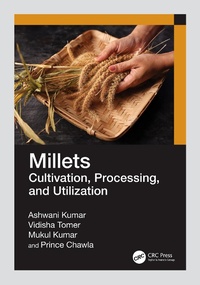
Millets
Cultivation, Processing, and Utilization
1st Edition
Published on 29. January 2024
321 pages
978-1-003-84825-7 (ISBN)
Description

Millets are diverse small-seeded crops which are resilient to climatic stress, pests, and diseases. These can be grown in rainfed conditions with minimal agricultural inputs. These are considered nutritionally superior to other major cereals like rice, wheat, and maize as they contain a significant amount of protein, dietary fibre, and minerals. Today, millets are recognized and considered as integral components of a sustainable food system. Millets have low glycaemic index and are beneficial for diabetics. Millet protein is devoid of gluten, making them a better option than wheat for patients with gluten sensitivity.
Millets: Cultivation, Processing, and Utilization covers information on taxonomy, morphology, germplasm accessions, cultivation practices, harvesting methods, threshing, cleaning, storage, milling, structural and engineering properties, nutritional and anti-nutritional values, health benefits, food applications, by-products, non-food applications, quality standards, and prospects in millet processing. This book's sixteen in-depth chapters give readers complete information on all facets of millet cultivation, processing, and use. It is a unique compilation of information on millets from farm to fork and beyond. This book will be useful for students, researchers, farmers, and entrepreneurs in understanding millets and their applications. It has been compiled by experts in the field and can serve as a guidance document for the stakeholders.
Millets: Cultivation, Processing, and Utilization covers information on taxonomy, morphology, germplasm accessions, cultivation practices, harvesting methods, threshing, cleaning, storage, milling, structural and engineering properties, nutritional and anti-nutritional values, health benefits, food applications, by-products, non-food applications, quality standards, and prospects in millet processing. This book's sixteen in-depth chapters give readers complete information on all facets of millet cultivation, processing, and use. It is a unique compilation of information on millets from farm to fork and beyond. This book will be useful for students, researchers, farmers, and entrepreneurs in understanding millets and their applications. It has been compiled by experts in the field and can serve as a guidance document for the stakeholders.
More details
Edition
1. Auflage
Language
English
Place of publication
London
United Kingdom
Publishing group
Taylor & Francis Ebooks
Target group
Professional and scholarly
Product notice
Reflowable
Illustrations
33 Tables, black and white; 20 Line drawings, black and white; 11 Halftones, black and white; 31 Illustrations, black and white
ISBN-13
978-1-003-84825-7 (9781003848257)
Copyright in bibliographic data and cover images is held by Nielsen Book Services Limited or by the publishers or by their respective licensors: all rights reserved.
Schweitzer Classification
Other editions
Additional editions
Book
01/2024
1st Edition
CRC Press
€163.50
Shipment within 15-20 days
Book
01/2024
1st Edition
CRC Press
€355.60
Shipment within 15-20 days
Persons
Dr. Ashwani Kumar is a Ph.D. in Food Technology from Punjab Agricultural University, Ludhiana, Punjab, India. He has done his Master's in Food Technology from Dr. Y. S. Parmar University of Horticulture and Forestry, Nauni, Solan, Himachal Pradesh, and his Bachelor in Food Science and Technology (honours) from D.A.V. College Jalandhar. Presently he is working as Teaching-cum-Research Associate, Postharvest Technology at Rani Lakshmi Bai Central Agricultural University, Jhansi, Uttar Pradesh, India since 3rd January 2022. He also has 4.5 years of experience working as an Assistant Professor of Food Technology and Nutrition at Lovely Professional University, Phagwara, India. He received the prestigious Dryland Cereals Scholarship from the Asia Pacific Associations of Agricultural Research Institutions, Bangkok, Thailand; INSPIRE Fellowship from the Department of Science and Technology, New Delhi, India, and the University Merit Scholarship from Punjab Agricultural University, Ludhiana, India (for Ph.D.) and Dr. Y. S. Parmar University of Horticulture and Forestry, Solan, India (for M.Sc.). He has also qualified National Teaching Eligibility Test in Food Technology conducted by the Indian Council of Agricultural Research. His research area is focused on the development of millet-based value-added products. He has also presented his work at national and international conferences. He has 43 research publications and 6 book chapters in indexed journals and books. He is also a reviewer of many esteemed journals.
Vidisha Tomer, Ph.D. is currently working as an Assistant Professor in the Department of Horticulture and Food Science, VIT School of Agricultural Innovations and Advanced Learning, Vellore Institute of Technology, Vellore, Tamil Nadu India, and has over seven years of experience in teaching and research. She has a Master's degree in Food Science and Technology with a certificate of merit with distinction (Vishishta Yogyata) for her outstanding academic performance. She completed her Ph.D. in Food and Nutrition from Punjab Agricultural University (PAU), Ludhiana. She was awarded INSPIRE Fellowship by the Department of Science and Technology, New Delhi, India, and the University Merit Scholarship by PAU, Ludhiana. She has also qualified National Eligibility Test and Senior Research Fellowship exam conducted by the Indian Council of Agricultural Research. She has authored 40 publications and 4 book chapters and is also an active reviewer of reputed journals. She is currently an active member of scientific societies including the Nutrition Society of India and Indian Dietetic Association and the American Society of Nutrition. She can be reached at vidisha.tomer@vit.ac.in and vidishatomer@gmail.com.
Mukul Kumar, Ph.D., is presently working as an Assistant Professor in the Department of Food Technology and Nutrition, School of Agriculture, Lovely Professional University, Phagwara, Punjab, India. He also served at the School of Bioengineering and Food Technology, Shoolini University, Solan, for about 3 years. He has seven years of experience in teaching and research. He is an alumnus of the Shoolini University, Solan, Himachal Pradesh, India, and an eminent researcher whose chief interests lie in herbal formulations to cure health problems, bioactive compounds utilizations, waste valorization, extruded products, beverage technology, in-vitro digestion, and packaging. He has authored 20 research publications, 6 book chapters, 13 patents, and 2 copyrights. He is guiding 4 Ph.D. Scholars and guided 20 MSc students.
Dr. Prince Chawla joined Lovely Professional University, Phagwara, Punjab as an Assistant professor in Department of Food Technology and Nutrition (School of Agriculture). He is an alumnus of Chaudhary Devi Lal University, Sirsa, and Shoolini University, Solan. He has a chief interest in plant based polysaccharides, mineral fortification, functional foods, protein modifications, food safety, and the detection of toxicants from foods using nanotechnology. He has worked on 'Department of Biotechnology' and 'Department of Science and Technology' funded research projects at National Dairy Research Institute, Karnal, Haryana, and has 8 years of research experience. He has 3 patents, 5 books, 82 international research articles, 12 international book chapters. Dr. Chawla is guiding 4 Ph.D. students and guided 22 MSc students. He is a life-time member of the Association of Food Scientists & Technologists (India). He is also the lead editor of a special issue of Foods and Food Quality. He is a recognized reviewer of more than 30 international journals and reviewed several research and review articles.
Vidisha Tomer, Ph.D. is currently working as an Assistant Professor in the Department of Horticulture and Food Science, VIT School of Agricultural Innovations and Advanced Learning, Vellore Institute of Technology, Vellore, Tamil Nadu India, and has over seven years of experience in teaching and research. She has a Master's degree in Food Science and Technology with a certificate of merit with distinction (Vishishta Yogyata) for her outstanding academic performance. She completed her Ph.D. in Food and Nutrition from Punjab Agricultural University (PAU), Ludhiana. She was awarded INSPIRE Fellowship by the Department of Science and Technology, New Delhi, India, and the University Merit Scholarship by PAU, Ludhiana. She has also qualified National Eligibility Test and Senior Research Fellowship exam conducted by the Indian Council of Agricultural Research. She has authored 40 publications and 4 book chapters and is also an active reviewer of reputed journals. She is currently an active member of scientific societies including the Nutrition Society of India and Indian Dietetic Association and the American Society of Nutrition. She can be reached at vidisha.tomer@vit.ac.in and vidishatomer@gmail.com.
Mukul Kumar, Ph.D., is presently working as an Assistant Professor in the Department of Food Technology and Nutrition, School of Agriculture, Lovely Professional University, Phagwara, Punjab, India. He also served at the School of Bioengineering and Food Technology, Shoolini University, Solan, for about 3 years. He has seven years of experience in teaching and research. He is an alumnus of the Shoolini University, Solan, Himachal Pradesh, India, and an eminent researcher whose chief interests lie in herbal formulations to cure health problems, bioactive compounds utilizations, waste valorization, extruded products, beverage technology, in-vitro digestion, and packaging. He has authored 20 research publications, 6 book chapters, 13 patents, and 2 copyrights. He is guiding 4 Ph.D. Scholars and guided 20 MSc students.
Dr. Prince Chawla joined Lovely Professional University, Phagwara, Punjab as an Assistant professor in Department of Food Technology and Nutrition (School of Agriculture). He is an alumnus of Chaudhary Devi Lal University, Sirsa, and Shoolini University, Solan. He has a chief interest in plant based polysaccharides, mineral fortification, functional foods, protein modifications, food safety, and the detection of toxicants from foods using nanotechnology. He has worked on 'Department of Biotechnology' and 'Department of Science and Technology' funded research projects at National Dairy Research Institute, Karnal, Haryana, and has 8 years of research experience. He has 3 patents, 5 books, 82 international research articles, 12 international book chapters. Dr. Chawla is guiding 4 Ph.D. students and guided 22 MSc students. He is a life-time member of the Association of Food Scientists & Technologists (India). He is also the lead editor of a special issue of Foods and Food Quality. He is a recognized reviewer of more than 30 international journals and reviewed several research and review articles.
Content
1. Origin, Taxonomy, Botanical description, Biodiversity, Cultivation, Agrarian requirements, and Production of Millets
2. Harvesting, Threshing, and Storage of Millets
3. Milling and Secondary Processing of Millets
4. Machines for Processing Millets
5. Structural Composition and Engineering Properties of Millets
6. Nutritional and Functional Composition of Millets
7. Phytochemicals in Millets and Related Health Benefits
8. Anti-Nutritional Factors and Methods to Improve Nutritional Value of Millets
9. Role of Millets in Disease Management
10. Chemistry and Application of Millet-Derived Starch
11. Chemistry and Application of Millet-derived Proteins
12. Mineral Bioavailability and Impact of Processing
13. Millet-Based Traditional Foods
14. Millets-based Processed Foods
15. Millet By-products and their Food and Non-food Applications
16. Prospects in the Production, Processing and Utilization of Millets
2. Harvesting, Threshing, and Storage of Millets
3. Milling and Secondary Processing of Millets
4. Machines for Processing Millets
5. Structural Composition and Engineering Properties of Millets
6. Nutritional and Functional Composition of Millets
7. Phytochemicals in Millets and Related Health Benefits
8. Anti-Nutritional Factors and Methods to Improve Nutritional Value of Millets
9. Role of Millets in Disease Management
10. Chemistry and Application of Millet-Derived Starch
11. Chemistry and Application of Millet-derived Proteins
12. Mineral Bioavailability and Impact of Processing
13. Millet-Based Traditional Foods
14. Millets-based Processed Foods
15. Millet By-products and their Food and Non-food Applications
16. Prospects in the Production, Processing and Utilization of Millets
