

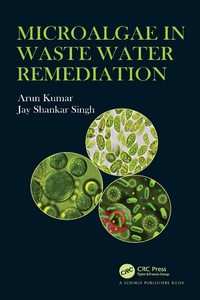
Microalgae in Waste Water Remediation
1st Edition
Published on 30. June 2021
252 pages
978-1-000-34769-2 (ISBN)
Description

Microalgae in Waste Water Remediation aims to point out trends and current topics concerning the use of microalgae in wastewater treatment and to identify potential paths for future research regarding microalgaebased bioremediation. To achieve this goal, the book also assessing and analyzes the topics that attract attention among the scientific community and their evolution through time. This book will be useful to the students, scientists and policy makers concerned with the microalgae mediated management of wastewater effluents and its applications in overall future sustainable development.
Reviews / Votes
"Kumar and Singh begin by examining microalgae origins, distribution, morphology, and nutritional needs. They subsequently examine their usefulness in remediating wastewater associated with several industry-specific waste streams. The various categories are presented in particular chapters examining, e.g., the impacts of temperature, salinity, and pH on each system. Chemical contaminants requiring remediation vary by wastewater stream category. In general, they include the widely recognized persistent organic pollutants (POPs) and heavy metals, e.g., arsenic, cadmium, chromium, barium, lead, mercury, nickel, zinc. Discussions cover volatile organic compounds (VOCs), e.g., styrene, phenol, biphenyls, mercaptans, and ammonia-based products. Biochemical oxygen demand (BOD), chemical oxygen demand (COD), and turbidity are also described. Results of chemical analysis are summarized in well-labeled tables. Some figures are presented in color, and diagrams are well drawn and easy to understand."- A. S. Casparian, Community College of Rhode Island, Choice, November 2022
More details
Edition
1. Auflage
Language
English
Place of publication
London
United Kingdom
Publishing group
Taylor & Francis Ltd
Target group
College/higher education
Product notice
Reflowable
Illustrations
31 Tables, black and white; 6 Line drawings, color; 13 Line drawings, black and white; 6 Illustrations, color; 13 Illustrations, black and white
ISBN-13
978-1-000-34769-2 (9781000347692)
Copyright in bibliographic data and cover images is held by Nielsen Book Services Limited or by the publishers or by their respective licensors: all rights reserved.
Schweitzer Classification
Other editions
Additional editions
Arun Kumar | Jay Shankar Singh
Microalgae in Waste Water Remediation
Book
07/2023
1st Edition
CRC Press
€114.60
Shipment within 15-20 days
Arun Kumar | Jay Shankar Singh
Microalgae in Waste Water Remediation
Book
07/2021
1st Edition
CRC Press
€270.80
Shipment within 15-20 days
Persons
Dr. Arun Kumar is currently working in the field of Microalgal ecology and their applications in bioremediation and sustainable environment. Dr. Kumar has published various research and review papers in reputed journals like Frontier in Microbiology, Frontiers in Biosciences (Landmark) and Environment and Sustainability Indicators (Elsevier); in the area of microalgal bioremediation, biofuels and bioproducts production from microalgae. He obtained his doctoral degree in Environmental Microbiology from Babasaheb Bhimrao Ambedkar University, Lucknow, India. In his doctoral work, Dr. Kumar successfully metabolized a widely used and hazardous insecticide Chlorpyrifos by cyanobacterial strain Oscillatoria sp. CYA8 CPF isolated from paddy fields; which could be useful to decontaminate the pesticide residue from paddy fields and also provide a means to fix the atmospheric nitrogen.
Dr. Jay Shankar Singh is faculty member at Department of Environmental Microbiology, Babasaheb Bhimrao Ambedkar University, India. Dr. Singh has contributed significantly to the subject of land uses, restoration ecology and natural resource management. He is acquainted with the area of natural resource management and demonstrated that application of beneficial microbes, pyrite, coal fly ash (FA), crop residues based farm yard manure (FYM) and rice husk biochar (RHB) amendments in enhancement of paddy crop productivity, green house gas CH4 mitigation and restoration of degraded soil. Dr. Singh has published his research outputs in international journals (Trends in Biotechnology, Agriculture Ecosystem and Environment, Frontiers, Journal of Environmental Management, etc.) with high impact factors and good citations on Scopus, Google Scholar (Total citation as on December 10, 2020=>3968; h-index=32; i10 index=64) and other scientific databases. He is also actively serving as member of various scientific committees, holding editorial responsibilities for journals. He has published several books from Springer, Taylor & Francis, Elsevier, among others.
Dr. Jay Shankar Singh is faculty member at Department of Environmental Microbiology, Babasaheb Bhimrao Ambedkar University, India. Dr. Singh has contributed significantly to the subject of land uses, restoration ecology and natural resource management. He is acquainted with the area of natural resource management and demonstrated that application of beneficial microbes, pyrite, coal fly ash (FA), crop residues based farm yard manure (FYM) and rice husk biochar (RHB) amendments in enhancement of paddy crop productivity, green house gas CH4 mitigation and restoration of degraded soil. Dr. Singh has published his research outputs in international journals (Trends in Biotechnology, Agriculture Ecosystem and Environment, Frontiers, Journal of Environmental Management, etc.) with high impact factors and good citations on Scopus, Google Scholar (Total citation as on December 10, 2020=>3968; h-index=32; i10 index=64) and other scientific databases. He is also actively serving as member of various scientific committees, holding editorial responsibilities for journals. He has published several books from Springer, Taylor & Francis, Elsevier, among others.
Content
Microalgae I: Origin, Distribution and Morphology. Microalgae II: Cell Structure, Nutrition and Metabolism. Microalgae III: Stress Response and Wastewater Remediation. Municipal Wastewater. Petroleum Wastewater. Distillery and Sugar Mill Wastewater. Tannery Wastewater. Pulp and Paper Wastewater. Textile Wastewater. Food Processing Wastewater. Integrated Microalgal Wastewater Remediation and Microalgae Cultivation. Microalgal Biomass: An Opportunity for Sustainable Industrial Production.
