

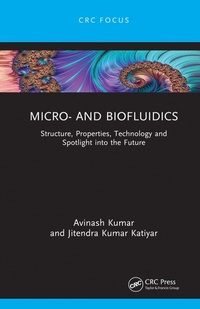
Micro- and Biofluidics
Structure, Properties, Technology and Spotlight into the Future
1st Edition
Published on 28. January 2025
150 pages
978-1-040-32832-3 (ISBN)
Description

The main objective of this book is to understand and manipulate the physical, chemical, and biological processes that occur in microscale fluidic systems. It explains microfluidics and biofluidics and their application to innovative design and computational intelligence methods used for solving nonlinear problems of engineering. It also covers new evolving trends in engineering related to green technologies, biomedical devices, computer-aided design, smart manufacturing, artificial intelligence systems, and sustainability. The book adopts a balanced approach between academic research and industrial applications.
Features:
Includes design and fabrication of microfluidic devices and systems for biological and medical applications.
Investigates physical properties and behavior of fluids at the microscale level.
Covers the development of microfluidic sensors and actuators for medical and environmental monitoring.
Studies fluid dynamics in biological systems.
Reviews tribological analysis of microfluidic and biofluidic devices for medical applications.
This book is aimed at researchers and graduate students in fluid dynamics, mechanical engineering, and bioengineering.
Features:
Includes design and fabrication of microfluidic devices and systems for biological and medical applications.
Investigates physical properties and behavior of fluids at the microscale level.
Covers the development of microfluidic sensors and actuators for medical and environmental monitoring.
Studies fluid dynamics in biological systems.
Reviews tribological analysis of microfluidic and biofluidic devices for medical applications.
This book is aimed at researchers and graduate students in fluid dynamics, mechanical engineering, and bioengineering.
More details
Series
Edition
1. Auflage
Language
English
Place of publication
London
United Kingdom
Publishing group
Taylor & Francis Ltd
Target group
College/higher education
Professional and scholarly
Illustrations
14 Tables, black and white; 12 Line drawings, black and white; 12 Halftones, black and white; 24 Illustrations, black and white
File size
16,02 MB
ISBN-13
978-1-040-32832-3 (9781040328323)
Copyright in bibliographic data and cover images is held by Nielsen Book Services Limited or by the publishers or by their respective licensors: all rights reserved.
Schweitzer Classification
Other editions
Additional editions
Avinash Kumar | Jitendra Kumar Katiyar
Micro- and Biofluidics
Structure, Properties, Technology and Spotlight into the Future
Book
approx. 07/2026
1st Edition
CRC Press
€30.00
Not yet published
Avinash Kumar | Jitendra Kumar Katiyar
Micro- and Biofluidics
Structure, Properties, Technology and Spotlight into the Future
Book
01/2025
1st Edition
CRC Press
€78.30
Shipment within 10-20 days
Persons
Dr. Avinash Kumar is currently working as an Assistant Professor in the Department of Mechanical Engineering at the Indian Institute of Information Technology, Design and Manufacturing (IIITD&M) Kancheepuram, Chennai India (An Institute of National Importance under Ministry of Education, Government of India). He is a Visiting Assistant Professor at Stanford University California, USA. His research interests include Micro/Nanofabrication, Laser Machining, and Surface Engineering for Micro-fludics and MEMS/Micro/Bio-devices. He has published more than 15 international journals, 12 chapters, 3 books and 10 international conference papers. His google scholar ID is eiJdMdoAAAAJ, ORCID ID is 0000-0002-8071-5748, Scopus ID is 56564412000 and Web of Science Researcher ID is P-6124-2018. He is a reviewer for many journals. He worked as a Post-Doctoral Fellow at Indian Institute of Technology Kanpur until 2019. His post-PhD research experience includes Early Post-Doctoral Fellow in the Department of Mechanical Engineering, Indian Institute of Technology Delhi. He obtained his PhD from the Department of Mechanical Engineering, Indian Institute of Technology Delhi in 2018. He received his Bachelor of Engineering in Mechanical Engineering from Rajiv Gandhi Proudyogiki Vishwavidyalaya, Bhopal in 2010 and M. Tech degree in Mechanical Engineering from Indian Institute of Technology Kanpur, India in 2012. He was Research Associate at the Bio-MEMS and Micro-fluidics Laboratory, Indian Institute of Technology Kanpur, India, from August 2012 to November 2012. He worked as Research Associate with Prof. G. K. Ananthsuresh and Prof. Ashitava Ghoshal in Robert Bosch Centre for Cyber Physical system, Mechanical Engineering Department, Indian Institute of Science Bangalore for a year (2013). He qualified Indian Engineering Services in 2010. He qualified GATE-2010 with 98.20 % in 2010. His PhD thesis was nominated for best thesis award by the foreign and Indian examiner. He was selected in India-Sri Lanka youth exchange program 2017, organized by the Ministry of youth affairs and sports, Government of India. He was awarded DST-International Travel Fellowship in 2018 to visit Hawaii, USA. He is currently working on the various research projects by CSIR and DST-GOI. He has coordinated and organised many conferences and workshops at IIITDM Kanchipuram-Chennai, IIT Delhi, IIT Kanpur and AIIMS Delhi. He has delivered many talks in Webinars, Faculty Development Programs and workshops in the institute. He has examined many M.Tech. and Ph.D. students at different universities across India. He has guided more than 10 B.Tech., M.Tech. and Ph.D. students for their thesis.
Dr Jitendra Kumar Katiyar holds the position of an Assistant Professor at the Centre for Research Impact & Outcome (CRIO), Chitkara University, Panjab, India. Additionally, He holds the position of local coordinator for the Global Initiative of Academic Network (GIAN) program started by the Ministry of Education at Chitkara University. He has 9 years of total teaching and research experience; his Scopus ID is 57150631600 and his Google Scholar ID is https://scholar.google.co.in/citations?user=HPlbnjwAAAAJ&hl=en. His research interest includes modern manufacturing techniques, tribology of carbon materials, polymer composites, self-lubricating polymers, lubrication tribology, and coatings for advanced technologies. He obtained his bachelor's degree from UPTU Lucknow with Honours in 2007. He received his master's from the Indian Institute of Technology Kanpur in 2010 and his PhD from the same institution in 2017. He is a life member of the Tribology Society of India, the Malaysian Society of Tribology, the Institute of Engineers, India, and The Indian Society for Technical Education (ISTE). He is elected Executive Committee Member, of the Tribology Society of India (2024-2025). He has authored/ co-authored/ published more than 80+ articles in reputed journals, 44 articles in international/national conferences, 22 Book Chapters, and 16 books. He holds the position of Associate Editor in the IMechE Part J: Journal of Engineering Tribology, a Member Editorial Board in Tribology-Materials, Surfaces and Interfaces and a Review Editor in Frontier in Mechanical Engineering and Frontiers in Materials. Further, he has effectively served as a guest editor for journals. Moreover, he currently holds the position of guest editor for the special issue TURKEYTRIB 2023 and Tribology of Additive Manufacturing and Micro/Nano-Structured Surfaces in the Journal of Engineering Tribology Part J, Composites and Advanced Materials, and Industrial Lubrication and Tribology for the special issue TRIBOINDIA 2023. He is also an active reviewer in 30+ reputed materials, manufacturing, and tribology journals. He has also delivered over 55+ invited talks on various research fields related to tribology, composite materials, surface engineering and machining.
Dr Jitendra Kumar Katiyar holds the position of an Assistant Professor at the Centre for Research Impact & Outcome (CRIO), Chitkara University, Panjab, India. Additionally, He holds the position of local coordinator for the Global Initiative of Academic Network (GIAN) program started by the Ministry of Education at Chitkara University. He has 9 years of total teaching and research experience; his Scopus ID is 57150631600 and his Google Scholar ID is https://scholar.google.co.in/citations?user=HPlbnjwAAAAJ&hl=en. His research interest includes modern manufacturing techniques, tribology of carbon materials, polymer composites, self-lubricating polymers, lubrication tribology, and coatings for advanced technologies. He obtained his bachelor's degree from UPTU Lucknow with Honours in 2007. He received his master's from the Indian Institute of Technology Kanpur in 2010 and his PhD from the same institution in 2017. He is a life member of the Tribology Society of India, the Malaysian Society of Tribology, the Institute of Engineers, India, and The Indian Society for Technical Education (ISTE). He is elected Executive Committee Member, of the Tribology Society of India (2024-2025). He has authored/ co-authored/ published more than 80+ articles in reputed journals, 44 articles in international/national conferences, 22 Book Chapters, and 16 books. He holds the position of Associate Editor in the IMechE Part J: Journal of Engineering Tribology, a Member Editorial Board in Tribology-Materials, Surfaces and Interfaces and a Review Editor in Frontier in Mechanical Engineering and Frontiers in Materials. Further, he has effectively served as a guest editor for journals. Moreover, he currently holds the position of guest editor for the special issue TURKEYTRIB 2023 and Tribology of Additive Manufacturing and Micro/Nano-Structured Surfaces in the Journal of Engineering Tribology Part J, Composites and Advanced Materials, and Industrial Lubrication and Tribology for the special issue TRIBOINDIA 2023. He is also an active reviewer in 30+ reputed materials, manufacturing, and tribology journals. He has also delivered over 55+ invited talks on various research fields related to tribology, composite materials, surface engineering and machining.
Content
1. Fundamentals of Micro- and Biofluidics 2. Development of Micro- and Biofluidic Devices 3. A Tribological Aspect of Micro- and Biofluidics 4. Applications of Micro- and Biofluidics 5. Future Outlook Of Micro- and Biofluidics
