

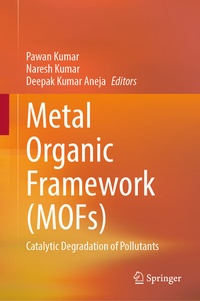
Metal Organic Framework (MOFs)
Description

This book presents the fundamental chemistry, synthesis, and classification of Metal Organic Framework (MOFs) for/in catalysis applications. As an introduction, the role of theoretical catalytic degradation studies on MOFs is also covered. The book includes all types of pollutants, i.e., pesticides, plastics, Polycyclic Aromatic Hydrocarbon compounds (PAHs), nitroaromatic compounds, and emerging pollutants degradation studies using MOFs. Finally, the book discusses the challenges and future prospective for catalytic degradation using MOFs. In the last decades, significant attention has been drawn on catalysis applications of Metal Organic Framework (MOFs). It is due to the structural characteristics, i.e., coordination vacancies available in the metal nodes, organocatalytic site of organic linkers, and ligand to metal charge transfer features, etc., of MOFs. Furthermore, some excellent features including presence of pendent groups, functionalization/bio conjugation possibility, optoelectronic properties as hosts, and additional catalytic sites possibility via post-synthetic modification of MOFs have made them potential materials for real-world application.
More details
Other editions
Additional editions
Persons
Dr. Pawan Kumar obtained his Ph.D. (Engineering) from the Academy of Scientific and Innovative Research-Central Scientific Instruments Organization (AcSIR-CSIO), Chandigarh (India). He was a post-doctoral fellow at Hanyang University Seoul from 2014 to 2016 and then joined as a young scientist (SERB-DST) at the Department of Chemical Engineering, Indian Institute of Technology (IIT), New Delhi, India. Currently, he is working as an Assistant Professor at the Dept. of Nano Sciences and Materials, Central University Jammu. His research interests are in the areas of Materials Science, Metal Organic Framework, and Biosensing.
Dr. Naresh Kumar obtained his Ph.D. (Engineering) from the Panjab University Chandigarh, India. He has worked as Lecturer at NIT Hamirpur & NIT Kurukshetra. Currently, he is working as Professor of Electronics and Communication Engineering at UIET, Panjab University, Chandigarh. His research interests are in the areas of Wireless Communication, MIMO, Image Processing, OFDM, and Underwater Acoustic Communications, & Nano-materials.
Dr. Deepak Kumar obtained Ph.D. (Science) from the Kurukshetra University, Kurukshetra (India). Presently, he is working as an assistant professor at the Department of Chemistry, Chaudhary Bansi Lal University, Bhiwani, Haryana. His research interests are in the areas of Organic and Medicinal Chemistry.
Content
Introduction: Metal Organic Framework.- Fundamental behind MOF synthesis.- Chemistry and Synthesis of MOFs.- Design aspects of MOFs for catalytic degradation.- MOFs for pesticide degradation.- Metal-organic frameworks for plastic degradation.- MOFs for nitroaromatic compound degradation.- MOFs for PAHs degradation.- MOFs for emerging pollutants degradation.- Challenges and future prospective of MOFs for catalytic degradation of organic pollutants.
