

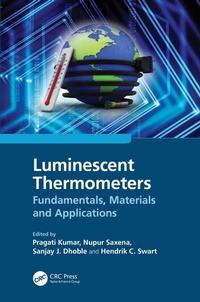
Luminescent Thermometers
Fundamentals, Materials and Applications
1st Edition
Published on 30. December 2024
340 pages
978-1-040-22747-3 (ISBN)
Description

Luminescent Thermometers deals with all aspects of the subject from principles of methods to their applications in different areas. This book familiarizes the readers with the fundamentals of luminescence thermometry, materials used for the development of different luminescence thermometers, viz. metal-organic frameworks (MOFs) including lanthanide-doped MOFs referred as LOFs, quantum dots (QDs), rare earth-doped phosphors, and upconversion phosphors. Further, some advanced and next generation approaches for luminescent thermometers such as carbon-based materials, nanocomposites, double perovskites and garnet systems are assimilated. The applications of luminescent thermometers in temperature sensing of biological cells and tumors, thermal imaging of biological cells, flexible temperature sensors, health monitoring with wearable thermometers, and environmental monitoring are the key features of this volume. It is a valuable contribution to the literature for material scientists and engineers in academia and R&D as well as researchers working in biology and environment science.
Key Features:
Covers entire range of luminescent thermometers from fundamentals to applications
Describes state-of-the-art of materials and next generation approaches for luminescence-based nanothermometery
Discusses the high-end utilities of luminescent thermometers in different aspects of human life are discussed
Key Features:
Covers entire range of luminescent thermometers from fundamentals to applications
Describes state-of-the-art of materials and next generation approaches for luminescence-based nanothermometery
Discusses the high-end utilities of luminescent thermometers in different aspects of human life are discussed
More details
Edition
1. Auflage
Language
English
Place of publication
London
United Kingdom
Publishing group
Taylor & Francis Ltd
Target group
Professional and scholarly
College/higher education
Illustrations
6 Tables, black and white; 64 Line drawings, color; 15 Halftones, color; 79 Illustrations, color
File size
35,02 MB
ISBN-13
978-1-040-22747-3 (9781040227473)
Copyright in bibliographic data and cover images is held by Nielsen Book Services Limited or by the publishers or by their respective licensors: all rights reserved.
Schweitzer Classification
Other editions
Additional editions
Pragati Kumar | Nupur Saxena | Sanjay J. Dhoble
Luminescent Thermometers
Fundamentals, Materials and Applications
Book
approx. 07/2026
1st Edition
CRC Press
€66.00
Not yet published

Pragati Kumar | Nupur Saxena | Sanjay J. Dhoble
Luminescent Thermometers
Fundamentals, Materials and Applications
Book
05/2025
CRC Press
Unfortunately, price unknown
Available (delivery time upon request)
Pragati Kumar | Nupur Saxena | Sanjay J. Dhoble
Luminescent Thermometers
Fundamentals, Materials and Applications
Book
12/2024
1st Edition
CRC Press
€213.10
Shipment within 10-20 days
Persons
Dr Pragati Kumar has been a senior Assistant Professor in the Department of Nanoscience and Materials, Central University of Jammu since 2016. Dr. Kumar has more than 15 years research and teaching experience. His research includes nanostructures, thin films, composites, and 2D materials, ion beam techniques, optoelectronic devices, sensors, and photocatalysis. Dr. Kumar has published 37 research papers, 14 chapters, and edited two books with international publishers.
Nupur Saxena is a DST-Women Scientist, Department of Physics, IIT Jammu. Previously, she has been awarded a number of PDFs and other fellowships including CSIR-Pool Scientist, UGC-DSK, IUAC-RA, CSIR-SRF, IUAC-JRF, etc. She has more than 18 years of research experience in the synthesis of nanostructures, thin films, composites, 2D materials, ion beam techniques, optoelectronic devices, sensors, and photocatalysis. Dr. Saxena has published 30 research papers and 9 chapters as well as presenting more than 40 papers in conferences. She is lifetime member of many scientific societies and reviewed for almost all international publishers.
Sanjay J. Dhoble is a senior professor in Department of Physics, RTM Nagpur, University of Nagpur. He has about 31 years of teaching and research experience. He has guided 76 students, published 62 patents (South Korean, South African, Australian, and Indian patents), 921 Articles, edited/authored 30 international books and delivered 177 plenary/keynote/invited talks and guest lectures. His research is well acknowledged globally and cited more than 15,000 times. He has secured a place among the top 2% scientists in the world in the last three years.
Hendrik C Swart is an internationally acclaimed researcher and currently a senior Professor in the Department of Physics at the University of the Free State. He brought luminescence materials to South Africa in the beginning of 1996 after since then he has led research in the degradation of phosphors for field emission displays, as well as developing materials for nano solid-state lighting. He has more than 900 publications, edited/authored 70 book/book chapters with more than 24,486 citations, H-index of 68, i10 index of 587. He is editor in critical reviews in Solid State and Materials Sciences.
Nupur Saxena is a DST-Women Scientist, Department of Physics, IIT Jammu. Previously, she has been awarded a number of PDFs and other fellowships including CSIR-Pool Scientist, UGC-DSK, IUAC-RA, CSIR-SRF, IUAC-JRF, etc. She has more than 18 years of research experience in the synthesis of nanostructures, thin films, composites, 2D materials, ion beam techniques, optoelectronic devices, sensors, and photocatalysis. Dr. Saxena has published 30 research papers and 9 chapters as well as presenting more than 40 papers in conferences. She is lifetime member of many scientific societies and reviewed for almost all international publishers.
Sanjay J. Dhoble is a senior professor in Department of Physics, RTM Nagpur, University of Nagpur. He has about 31 years of teaching and research experience. He has guided 76 students, published 62 patents (South Korean, South African, Australian, and Indian patents), 921 Articles, edited/authored 30 international books and delivered 177 plenary/keynote/invited talks and guest lectures. His research is well acknowledged globally and cited more than 15,000 times. He has secured a place among the top 2% scientists in the world in the last three years.
Hendrik C Swart is an internationally acclaimed researcher and currently a senior Professor in the Department of Physics at the University of the Free State. He brought luminescence materials to South Africa in the beginning of 1996 after since then he has led research in the degradation of phosphors for field emission displays, as well as developing materials for nano solid-state lighting. He has more than 900 publications, edited/authored 70 book/book chapters with more than 24,486 citations, H-index of 68, i10 index of 587. He is editor in critical reviews in Solid State and Materials Sciences.
Content
1. The Predominant Role and the need of Thermometers
2. Optical Thermometers: Importance and Advantages over other Thermometers
3. Luminescent Thermometers: Methods, Materials and Applications
4. Metal-organic Framework for Luminescent Thermometers
5. Quantum Dots for Luminescence Thermometers
6. Rare Earth Doped Phosphors for Luminescence Based Optical Thermometers
7. Upconversion Phosphors for Luminescence Based Optical Thermometers
8. Carbon-based Materials for Luminescence Thermometers
9. Nano-composites for Luminescence Thermometers
10. Recent Advancements in Optical Thermometry Based on Photoluminescent Perovskite Oxides
11. Luminescence Temperature Sensing Based on Ratiometric and Colorimetric Fluorescence in Garnet Systems
12. Temperature Sensing of Biological Cells and Tumours
13. Flexible Temperature Sensor
14. Health Monitoring with Wearable Thermometers
15. Luminescent Temperature Sensors for Environmental Monitoring
2. Optical Thermometers: Importance and Advantages over other Thermometers
3. Luminescent Thermometers: Methods, Materials and Applications
4. Metal-organic Framework for Luminescent Thermometers
5. Quantum Dots for Luminescence Thermometers
6. Rare Earth Doped Phosphors for Luminescence Based Optical Thermometers
7. Upconversion Phosphors for Luminescence Based Optical Thermometers
8. Carbon-based Materials for Luminescence Thermometers
9. Nano-composites for Luminescence Thermometers
10. Recent Advancements in Optical Thermometry Based on Photoluminescent Perovskite Oxides
11. Luminescence Temperature Sensing Based on Ratiometric and Colorimetric Fluorescence in Garnet Systems
12. Temperature Sensing of Biological Cells and Tumours
13. Flexible Temperature Sensor
14. Health Monitoring with Wearable Thermometers
15. Luminescent Temperature Sensors for Environmental Monitoring
