

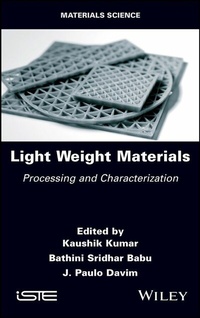
Light Weight Materials
Description

This book provides researchers and students with an overview of the recent advancements in light weight material processing, manufacturing and characterization. It contains chapters by eminent researchers on topics associated with light weight materials, including on the current buzzword "composite materials". First, this book describes the current status of light weight materials. Then, it studies applications of these materials, given that, as the densities vary, so do the applications, ranging from automobiles and aviation to bio-mechatronics. This book will therefore serve as an excellent guide to this field.
More details
Other editions
Additional editions
Persons
Kaushik Kumar is Associate Professor at the Birla Institute of Technology, India. He has many years of industrial experience and his research interests include composites, optimization, non-conventional machining and quality management systems.
Bathini Sridhar Babu is Professor and Dean of the IIIIC at the CMR Institute of Technology, India. His research interests include manufacturing, advanced materials and mechanics of materials, among others.
J. Paulo Davim is Full Professor at the University of Aveiro, Portugal, and a Fellow (FIET) of The Institution of Engineering and Technology, UK. His research interests include manufacturing, materials and mechanical and industrial engineering, with a special emphasis on machining and tribology.
Content
Preface xi
Part 1 Manufacturing Processing Techniques 1
Chapter 1 Additive Manufacturing: Technology, Materials and Applications in Aerospace 3
Veeman DHINAKARAN, Mahesh VARSHA SHREE, Thimmaiah JAGADEESHA and
Madabushi SWAPNA SAI
1.1 Introduction 4
1.2 Additive manufacturing configuration 5
1.3 Classification of AM technology 6
1.3.1 Laser beam melting 6
1.3.2 Electron beam melting 7
1.3.3 Selective laser melting 8
1.3.4 Direct metal laser sintering 9
1.3.5 Laser metal fusion 10
1.3.6 Direct metal deposition 11
1.4 Materials used in AM technology 12
1.4.1 Titanium and its alloys 13
1.4.2 Inconel 13
1.4.3 Aluminum 14
1.4.4 Stainless steel 15
1.5 Aerospace applications of additive manufacturing 15
1.6 Challenges faced in the aerospace industry 17
1.7 Overcoming aerospace challenges with AM 17
1.8 Future work 17
1.9 Conclusion 18
1.10 References 18
1.11 Key terms and definitions 21
Chapter 2 Study of the Manufacturing Process of Polymer Spur Gears: A Light Weight Gear Material 23
Jitendra Kumar KATIYAR and Hemalata JENA
2.1 Introduction 23
2.2 Gear manufacturing process 25
2.2.1 Gear hobbing machine 26
2.2.2 Injection molding 27
2.3 Additive manufacturing/rapid prototyping 31
2.4 Laser ablation 32
2.5 Hot embossing 33
2.6 Conclusion 34
2.7 References 35
Chapter 3 Recent Trends in Welding Polymers and Polymer-Metal Hybrid Structures 39
Jinesh Kumar JAIN and Pankaj SONIA
3.1 Introduction 40
3.2 Polymer and composites 41
3.3 Polymerization 42
3.4 Synthesis of polymer composites 45
3.5 Types of fillers in composites 48
3.5.1 Effect of reinforcement orientation 51
3.6 Welding polymers 51
3.7 Introduction of lightweight metal and alloys 53
3.7.1 Magnesium alloys 53
3.7.2 Aluminum alloys 59
3.8 Welding dissimilar metal alloys 61
3.8.1 Friction stir welding 61
3.8.2 Welding polymer and metal alloys 62
3.9 Industrial application of polymers 64
3.10 Conclusion 66
3.11 References 67
Part 2 Characterization 73
Chapter 4 Preparation and Characterization of a Composite Material Using Sisal fibers for Light Body Vehicles 75
Zewdie ALEMAYEHU, Ramesh Babu NALLAMOTHU, Mekonnen LIBEN,
Seshu Kishan NALLAMOTHU and Anantha Kamal NALLAMOTHU
4.1 Introduction 76
4.1.1 Statement of the problem 76
4.1.2 General objective 77
4.1.3 Specific objectives 77
4.1.4 Significance of the study 77
4.2 Literature review 78
4.2.1 Introduction 78
4.2.2 Previous works on natural fiber polymer composites 78
4.3 Materials and methods 79
4.3.1 Sample preparation methods 80
4.4 Results and discussion 90
4.4.1 Experimental results 90
4.4.2 Observation 103
4.5 Comparison of previous works 106
4.5.1 Tensile strength 106
4.5.2 Bending strength 106
4.6 Conclusion and recommendation 107
4.6.1 Recommendations for prospective applications 108
4.6.2 Scope for future work 108
4.7 References 109
Chapter 5 Optimizing the Polystyrene Catalytic Cracking Process Using Response Surface Methodology 111
Selvaganapathy THAMBIYAPILLAI, Muthuvelayudham RAMANUJAM
and Jayakumar MANI
5.1 Introduction 112
5.2 Material and methods 114
5.2.1 Materials 114
5.2.2 Experimental procedure and characterization 116
5.2.3 Design of catalytic cracking experiment using response surface methodology 118
5.3 Results and discussion 119
5.3.1 Thermal analysis of polystyrene 119
5.3.2 SEM-EDX analysis 120
5.3.3 Model development for catalytic cracking of polystyrene 124
5.3.4 Combined effect of process parameters on the response (Y) 128
5.3.5 Characterization of liquid yield 133
5.3.6 Factors affecting catalytic cracking of polystyrene 136
5.4 Conclusion 139
5.5 References 140
Part 3 Analysis 143
Chapter 6 FEA Comparative Studies on Heat Flux and Thermal Stress Analysis during Conduction Mode and Keyhole Mode in the Laser Beam Welding 145
Harinadh VEMANABOINA, Suresh AKELLA and Ramesh Kumar BUDDU
6.1 Introduction 145
6.2 Heat in laser welding 146
6.3 Modeling 148
6.4 Results and discussion 149
6.4.1 Keyhole model 149
6.4.2 Conduction model 152
6.5 Conclusion 155
6.6 References 156
Chapter 7 Effect of Formability Parameters on Tailor-Welded Blanks of Light Weight Materials 159
Dappu DEEPIKA, Akkireddy Anitha LAKSHMI, Tanya BUDDI and Chalamalasetti
Srinivas RAO
7.1 Introduction 159
7.2 Experimental procedure 161
7.3 Results and discussion 169
7.4 Conclusion 189
7.5 References 192
Chapter 8 Design and Analysis of Sedan Car B-pillar Outer Panel Using Abirbara with S-glass Fiber Hybrid Composites 197
Ramesh Babu NALLAMOTHU, Melkamu Yigrem YIHUNIE, Anantha Kamal
NALLAMOTHU and Seshu Kishan NALLAMOTHU
8.1 Introduction 198
8.2 Materials and methods 202
8.2.1 Materials 202
8.2.2 Methods 206
8.3 Composite preparation, testing and analysis 207
8.3.1 Composite preparation 207
8.3.2 Testing and analysis 210
8.4 Design analysis of the B-pillar panel 214
8.5 Conclusion 219
8.6 Recommendations 220
8.7 Acknowledgments 220
8.8 References 221
List of Authors 223
Index 227
Preface
We would like to present the book Light Weight Materials: Processing and Characterization. In the automotive industry, the need to reduce vehicle weight has led to extensive research efforts to develop aluminum and magnesium alloys for structural car body parts. In aerospace, the move towards composite airframe structures has led to an increased use of formable titanium alloys. All of the above-mentioned materials can be categorized into a group called "lightweight materials". The distinguishing feature of lightweight materials is their low densities, ranging from as low as 0.80 g/cm3 for unfilled polymers to as high as 4.5 g/cm3 for titanium. Although the density of titanium is higher than that of unfilled polymers, it is significantly lighter than metals: alloy steel (7.86 g/cm3) and superalloys (7.8-9.4 g/cm3). In a nutshell, lightweight materials exhibit a wide range of properties and therefore offer a wide range of applications.
This book primarily aims to provide researchers and students with an overview of the recent advancements in the processing, manufacturing and characterization of lightweight materials, which promises increased flexibility in manufacturing in tandem with mass communication, improved productivity and better quality. It has a collection of chapters contributed by eminent researchers who focus on the topics associated with lightweight materials, including the current buzzword composite materials. This book provides the recent advancements in the processing, manufacturing and characterization of lightweight materials and hence would be a panacea in all areas of lightweight materials.
This book has two major objectives. Firstly its chapters by eminent researchers in the field enlighten readers about the current status of the subject. Secondly, as the densities vary a lot so do the applications ranging from automobile, aviation to bio-mechatronics; hence, this book would serve as an excellent guideline for people in all of these fields.
The chapters of this book are divided into three parts, namely Part 1: Manufacturing Processing Techniques, Part 2: Characterization and Part 3: Analysis.
Part 1 contains Chapters 1-3, Part 2 contains Chapters 4 and 5 and Part 3 contains Chapters 6-8.
Chapter 1 explains an advanced technique called additive manufacturing (AM), which is predominantly known as 3D printing and rapid prototyping. It is an on-demand production without any dedicated apparatus or tooling, which allows breakthrough performance and supreme flexibility in industries. The aerospace industry is the primary user of AM, as it enables it to create complex user-defined part design and fabricate with different lightweight materials without wastage of raw materials, reducing the time and cost of production. This chapter provides in-depth knowledge about its classification and selection process for various applications required by engineering industries, especially in the aerospace industry.
Chapter 2 mainly deals with the manufacturing of polymer gears. Polymer gears are widely used in medical devices upon which human lives depend. In addition, they are useful in other applications such as in the automotive and manufacturing industries. A precise gear of better design and effective manufacturing process decides its long-term application, strength and property. Polymer gears can be fabricated with the same machining process as metal gears, usually milling or hobbing from a blank. However, for lightweight materials, such as polymers, it is preferable to be either fabricated by injection molding or machined from a rod (additive manufacturing). The details of such manufacturing techniques are presented in this chapter.
Chapter 3, the last chapter of Part 1, discusses in detail reinforcing, performance analysis, processing and characterization of various methods of polymer welding, i.e. laser welding, infrared welding, spin welding, stir welding, and vibration welding. This chapter also covers various alloys of aluminum for lightweight applications and the current status of polymer composite applications in industries and future prospects. This chapter highlights the complications related to fusion, heat transfer and joint strength, as well as their solutions with the future prospect of polymer welding empowering polymers to be an absolute substitute for metal, which can be achieved by understanding the concept of dissimilar welding for joining polymer composites with metals and their controlling factors, and by selecting an appropriate welding process for various types of polymers.
Chapter 4, the first chapter of Part 2, provides the reader with an idea of fabrication and a description of the processing techniques of natural-based composites for light body vehicle applications. In doing so, the genetic equation for modeling tool flank wear is developed using experimentally measured flank wear values and genetic programming. Using these results, the genetic model presenting the connection between cutting parameters and tool flank wear is extracted. Then, based on a defined machining performance index and the obtained genetic equation, optimum cutting parameters are determined. This chapter concludes that the proposed modeling and optimization methodology offer the optimum cutting parameters and can be implemented in real industrial applications.
Chapter 5 presents the response surface methodology, an optimization technique, to design a catalytic cracking experiment of plastic waste. The catalyst-to-feedstock ratio, the operating temperature and the reaction time were chosen as an effective parameter of the catalytic cracking process. The characterization of the obtained liquid product was performed using the Fourier transform with infrared (FTIR) spectra, gas chromatography with mass spectrometry (GC/MS) analysis and physico-chemical analysis. This chapter concludes that the developed quadratic model is well fit to the experimental domains and predicts operating conditions that are most suitable for conducting catalytic cracking experiments under recycling techniques of lightweight materials, especially plastics.
Chapter 6, the first chapter of Part 3, discusses laser welding. The uniqueness of this chapter is the way it has dealt with the subject. The finite element analysis was used to select suitable models for the Gaussian beam profile and the application of the Frustum model to conduction mode welding and keyhole laser welds. Temperature and stress analysis was carried out within and around the weld region. This chapter discusses the analytical comparative approximation of different model approaches applicable to the laser weld process, and indicates that the parametric study information will be useful to the engineers of nuclear fabrication applications in finalizing different components.
Chapter 7 elaborates on the effect of formability parameters on tailor-welded blanks of lightweight materials. The product finds its maximum application in the automotive manufacturing industry. It is quite common that different materials with varying cross-sections are used based on the requirements in aerospace and automotive industries. To manage the herculean task of organizing this, researchers have enthusiastically proposed a tailor-made welded blanks (TWB) strategy, and in many automotive industries this technique has been adopted. This chapter suggests testing the formability of tailor-welded blanks with various light alloy sheets used in the aerospace and automotive industries. An overall review of various parameters that affect the formability of tailor-welded blanks is presented in this chapter, so that other investigators can rely on the same for more critical observations in this field.
Chapter 8, the last chapter of this section, presents the various ways of optimizing a vehicle body, such as shape optimization for aerodynamics and aesthetics, and weight of materials to be used for fuel efficiency, material conservation, recyclability and others. This chapter considers a product called "B-pillar", one of the critical structural support members of sedan cars. They have replaced the existing material with a composite, mainly to overcome the stress developed due to the system as it is a structural member and to safeguard the occupant in the case of a side crash. Different mechanical properties such as tensile, compression and bending strength, as well as water absorption, were measured. The model of the sedan car B-pillar panel developed was analyzed for impact and crush simulation. It concluded that a composite can be used for the outer panel of B-pillar, which results in reduced vehicle weight and fuel consumption and increased energy absorption.
First and foremost, we would like to thank God. It was your blessing that provided us with the strength to believe in passion and hard work and to pursue our dreams. We thank our families for having the patience with us for taking yet another challenge that decreased the amount of time we could spend with them. They are our inspiration and motivation. We would like to thank our parents and grandparents for allowing us to follow our ambitions. We would like to thank all the contributing authors, as they are the pillars of this structure. We would also like to thank them for believing in us. We would like to thank all of our colleagues and friends in different parts of the world for sharing their ideas helping us to shape our thoughts. We will be satisfied with our efforts when the professionals concerned with all the fields...
