

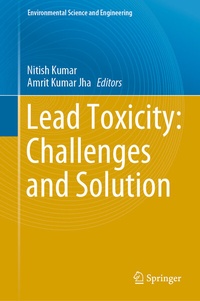
Lead Toxicity: Challenges and Solution
Description

More details
Other editions
Additional editions
Persons
Dr. Amrit Kumar Jha (Editor)
Dr. Amrit Kumar Jha is Scientist (Soil Science) and Head at Krishi Vigyan Kendra, Sahibganj, Birsa Agricultural University, Ranchi, Jharkhand, India. Dr. Jha completed his doctoral research in subject Soil Science and Agricultural Chemistry from Birsa Agricultural University, Ranchi, Jharkhand, India. He has more than 18 years of research experience in the field of soil chemistry, soil fertility, soil pollution, and heavy metal toxicity. He has published more than 40 research articles in leading international and national journals, more than 11 technical bulletins, and 2 books. He has received many awards such as Young Scientist Award conferred by Society of Krishi Vigyan in 2018, Best KVK Scientist Award conferred by Indian Society of Extension Education in 2018, and Best KVK Scientist Award conferred by Society of Krishi Vigyan in 2020.
Dr. Nitish Kumar (Co-editor)
Nitish Kumar is Senior Assistant Professor at the Department of Biotechnology, Central University of South Bihar, Gaya, Bihar, India. Dr. Kumar completed his doctoral research at the Council of Scientific and Industrial Research-Central Salt & Marine Chemicals Research Institute, Bhavnagar, Gujarat, India. He has more than 12 years of research and teaching experience in the field of plant and microbial biotechnology, and bioremediation. He has published more than 70 research articles in leading international and national journals, more than 20 chapters, and 7 books with Springer and Taylor & Francis. Dr. Kumar is Recipient of the Young Scientist Award from the Science and Engineering Research Board (SERB) in 2014 . He has received many awards/fellowships/projects from various organizations, for example, the CSIR, DBT, ICAR and SERB-DST, BRNS-BARC, among others. He is Active Reviewer for journals, including Biotechnology Reports, Aquatic Botany, Industrial Crops and Products, PLoS One, Plant Biochemistry and Biotechnology, and 3Biotech. He also serves as Associate Editor of the journal Gene (Elsevier)
Content
Section 1: Source and distribution of lead in the environment.- 1. Source and distribution of lead in soil and plant - A review.- 2. The dynamics of lead in plant-soil interactions.- Section 2: Lead toxicity and Health.- 3. Neurotoxic Effects of Lead: A Review.- 4. Lead: Exposure risk, Bio Assimilation and Amelioration Strategies in livestock Animals.- Section 3: Lead remediation strategies.- 5. Phytoremediation of lead: from fundamentals to application.- 6. Bioremediation potential of lead tolerant microorganism from contaminated soil: a review.- 7. Antioxidant defense: A key mechanism of lead tolerance.- 8. Phytoremediation of Lead: A Review.- 9. Microbial remediation of Lead: An overview.- 10. Treatment methods for lead removal from wastewater.- 11. Lead Removal from Aqueous Solutions Using Different Biosorbents.- 12. Molecular Mechanism of lead Toxicity and Tolerance in Plants.- 13. Microbial transformations of lead: perspectives for biological removal of lead from soil.
