

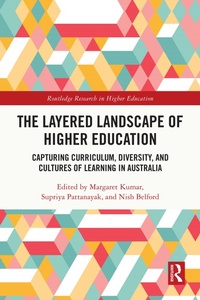
The Layered Landscape of Higher Education
Capturing Curriculum, Diversity, and Cultures of Learning in Australia
1st Edition
Published on 2. August 2024
314 pages
978-1-040-10947-2 (ISBN)
Description

This edited collection interrogates notions of curriculum, inclusivity, diversity, and cultures of learning in higher education from a variety of cultural backgrounds and educational perspectives.
Bringing together an international selection of contributors from a range of disciplines, this book presents different avenues for rethinking the foundational base of cultures of learning while emphasising the importance of interculturality. The crux of the book lies in the fact that the contributors, living through complex cultures, speak/write from their own experiences of seeing, knowing, and doing. Through insights presented by the authors, the book promotes a broadened and deeper understanding of teaching and learning across diverse fields, including alternative knowledge, creative arts, education, technology, STEM, study skills, and environmental sustainability. Arguing for the need to review curriculum issues and policies at both an institutional and national level, it highlights the importance of creating collaborative spaces for constructing new and alternative scholarship and methods within higher education. Supported by case studies and examples of teaching practice, the text reveals the current state of educational and cultural changes and challenges for students and educators in higher education while looking towards the future.
This book is a requisite text for academics, researchers, policymakers, support staff, and postgraduate students in higher education.
Bringing together an international selection of contributors from a range of disciplines, this book presents different avenues for rethinking the foundational base of cultures of learning while emphasising the importance of interculturality. The crux of the book lies in the fact that the contributors, living through complex cultures, speak/write from their own experiences of seeing, knowing, and doing. Through insights presented by the authors, the book promotes a broadened and deeper understanding of teaching and learning across diverse fields, including alternative knowledge, creative arts, education, technology, STEM, study skills, and environmental sustainability. Arguing for the need to review curriculum issues and policies at both an institutional and national level, it highlights the importance of creating collaborative spaces for constructing new and alternative scholarship and methods within higher education. Supported by case studies and examples of teaching practice, the text reveals the current state of educational and cultural changes and challenges for students and educators in higher education while looking towards the future.
This book is a requisite text for academics, researchers, policymakers, support staff, and postgraduate students in higher education.
Reviews / Votes
We form themselves partly through education, and we live in a shared world, one that continues towards convergence despite the complexity of the patterns and the climate-nature emergency that hangs overall. So, the unity-in-diversity encounter that is intercultural education, with its many possibilities for hybrid practices and much needed new thinking, might be the most important education for the future. This is a great book, accessible and full of ideas, which opens up a really exciting space for educationists.Simon Marginson
Professor of Higher Education
University of Oxford
Displaying commendable qualities of self-reflexivity, the essays in this volume discuss how the current challenges facing systems of Higher Education require them to rethink their fundamental purposes and modes of governance. The essays suggest that the trends associated with technologization, globalization, marketization and the like have made it necessary for educators to consider the shifts in the ways in which knowledge is now created and distributed, curriculum priorities are negotiated and established, learning is structured and assessed, and institutions are governed and reformed. Narrating their own personal experiences, the authors show how deliberations over these issues increasingly demand political and ethical reflexivity.
Fazal Rizvi
Emeritus Professor
The University of Melbourne and the University of Illinois at Urbana-Champaign
Rivers of knowledge flow stronger when the attributes of the tributaries are themselves strong and diverse. They will confront the stagnation of the status quo and closed mindsets then courageously take you to brave places of thinking and perspectives. So, allow yourself to get caught up in the current of deep thinking and the intellectual prismatic tapestry that this book provides, and let it take you to a new place.
Professor Mark Rose
Pro Vice-Chancellor, Indigenous Strategy and Innovation
Deakin University
More details
Series
Edition
1. Auflage
Language
English
Place of publication
London
United Kingdom
Publishing group
Taylor & Francis Ltd
Target group
College/higher education
Professional and scholarly
Illustrations
13 Tables, black and white; 6 Line drawings, black and white; 4 Halftones, black and white; 10 Illustrations, black and white
File size
4,35 MB
ISBN-13
978-1-040-10947-2 (9781040109472)
Copyright in bibliographic data and cover images is held by Nielsen Book Services Limited or by the publishers or by their respective licensors: all rights reserved.
Schweitzer Classification
Other editions
Additional editions
Margaret Kumar | Supriya Pattanayak | Nish Belford
The Layered Landscape of Higher Education
Capturing Curriculum, Diversity, and Cultures of Learning in Australia
Book
12/2025
1st Edition
Routledge
€67.30
Shipment within 10-20 days
Margaret Kumar | Supriya Pattanayak | Nish Belford
The Layered Landscape of Higher Education
Capturing Curriculum, Diversity, and Cultures of Learning in Australia
Book
08/2024
1st Edition
Routledge
€179.20
Shipment within 10-20 days
Persons
Margaret Kumar is Senior Fellow (Honorary) at The University of Melbourne, Australia and Adjunct Professor, Centurion University of Technology and Management (CUTM), Odisha, India. Dr Kumar lectures in Global Literacies, Multilingualism, Research and Academic Skills, Teacher Training and Teaching English to Speakers of Other Languages. Her research interests provide insightful perspectives on Curriculum issues, Cultures of Learning, New Knowledge Systems and Positioning Research.
Supriya Pattanayak is the Vice Chancellor of the Centurion University of Technology and Management (CUTM), Odisha, India. She has extensive teaching, research, and policy experience and her research interest is in the field of gender and development, sustainable livelihoods, research methodologies, and Social Work pedagogies in different contexts.
Nish Belford is Senior Lecturer in the Faculty of Education at Monash University, Australia. Her research interests in Creative arts and teacher education explore culturally responsive teaching and pedagogies for diversity and inclusion. Other research areas include gendered subjectivities of transnational women with education, work, family, diasporic cultures, and identities.
Supriya Pattanayak is the Vice Chancellor of the Centurion University of Technology and Management (CUTM), Odisha, India. She has extensive teaching, research, and policy experience and her research interest is in the field of gender and development, sustainable livelihoods, research methodologies, and Social Work pedagogies in different contexts.
Nish Belford is Senior Lecturer in the Faculty of Education at Monash University, Australia. Her research interests in Creative arts and teacher education explore culturally responsive teaching and pedagogies for diversity and inclusion. Other research areas include gendered subjectivities of transnational women with education, work, family, diasporic cultures, and identities.
Content
Introduction: Deliberation Foreword Part 1: Capturing Curriculum 1. A Curriculum is about content, process, context, and relationality...and they (should) always go together... 2. Dismantling sounds and silences of heritage curriculum and traditional pedagogies in music education 3. Conceptualising 'The Research Question', 'Academic Acclimatisation', and 'Supervisory Understandings', for International Research Candidates 4. Exploration of Curriculum Issues on STEM Subjects from an Australian - Indian Knowledge Perspective 5. Flexible curriculum to meet the needs of disadvantaged students during the Pandemic Part 2: Diversity 6. Intercultural collaborative pedagogy and co-design for Architecture and Built Environment Education 7. Culturally Responsive Teaching with pre-service teachers and the challenges to action Culturally Responsive Pedagogies in an Australian Education context 8. Teaching medical laboratory sciences in a Culturally and Linguistically Diverse (CALD) environment 9. Reflections on culturally responsive practices and pedagogies: Higher Education and Initial Teacher Education Programs and support, inclusivity and diversity in the Australian context 10. Teaching and learning to support inclusion in Law Education: Autoethnographic Reflections of a Law Teacher 11. Tertiary programs in Chinese languages: Challenges and expectations of mixed-background students Part 3: Cultures of Learning 12. Engaging Care for Mother Earth as Central Pedagogy for Sustainable, and Regenerative Social Work: A Field Education Example from lutruwita Tasmania 13. Work integrated learning (WIL): An investigation of strategies to enable access, participation, and success for Australian First Nations Students 14. Graduating from University: Cultures of Learning 15. The Importance of Aboriginal Hospital Liaison Officers in the History of Aboriginal Health in Victoria in the Period 1982-2010- Interview between Aunty Lyn McInnes and Dr Margaret Kumar 16. Australia - India Partnerships in Social Entrepreneurship: Lessons for students - Interview between Professor Mukti Mishra and Professor Supriya Pattanayak 17. Cultures of learning in social work field education: Australian students' experience Concluding Chapter - Future Focus
