

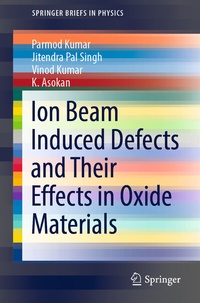
Ion Beam Induced Defects and Their Effects in Oxide Materials
Description

This book provides an overview of the applications of ion beam techniques in oxide materials. Oxide materials exhibit defect-induced physical properties relevant to applications in sensing, optoelectronics and spintronics. Defects in these oxide materials also lead to magnetism in non-magnetic materials or to a change of magnetic ordering in magnetic materials. Thus, an understanding of defects is of immense importance. To date, ion beam tools are considered the most effective techniques for producing controlled defects in these oxides. This book will detail the ion beam tools utilized for creating defects in oxides.
More details
Other editions
Additional editions
Persons
Parmod Kumar is an Assistant Professor at J C Bose University of Science and Technology, YMCA Faridabad, India. He has been recipient of prestigious DST-INSPIRE Faculty award, DAAD Fellow, etc. His research interest includes defects induced magnetism in oxides, wastewater treatment and irradiation/ implantation induced changes in oxides. He has published ~ 50 SCI-indexed publications.
Jitendra Pal Singh works at Pohang Accelerator Laboratory, Pohang, South Korea. His research interests are irradiation studies in nanoferrites, thin films and magnetic multilayers. He also studied the irradiation and implantation effects in ferrite thin films and nanoparticles. He has more than 100 SCI-indexed publications.
Vinod Kumar is on the DST-INSPIRE Faculty at Indian Institute of Technology Delhi, New Delhi India. He has worked at IUAC, New Delhi, India; UFS, Bloemfontein, South Africa; ICCF, UCA, France and University of Tulsa, US. His research focus is on oxide based nanomaterials for solar cells as well as solid state lighting applications and the role of irradiation on this. He has more than 100 SCI-indexed publications.
K. Asokan is a senior scientist at the Inter-University Accelerator Centre. He has been post-doctoral fellow in Tamkang university and Brain Pool Scientist in Inha University, South Korea. His research interests are in understanding the ion beam interaction in materials and synchrotron based spectroscopic studies. He has published over 400 SCI-indexed publications.
