

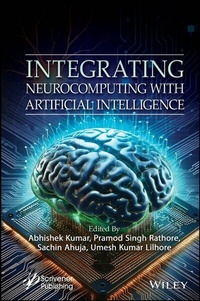
Integrating Neurocomputing with Artificial Intelligence
Description

Integrating Neurocomputing with Artificial Intelligence provides unparalleled insights into the cutting-edge convergence of neuroscience and computing, enriched with real-world case studies and expert analyses that harness the transformative potential of neurocomputing in various disciplines.
Integrating Neurocomputing with Artificial Intelligence is a comprehensive volume that delves into the forefront of the neurocomputing landscape, offering a rich tapestry of insights and cutting-edge innovations. This volume unfolds as a carefully curated collection of research, showcasing multidimensional perspectives on the intersection of neuroscience and computing. Readers can expect a deep exploration of fundamental theories, methodologies, and breakthrough applications that span the spectrum of neurocomputing.
Throughout the book, readers will find a wealth of case studies and real-world examples that exemplify how neurocomputing is being harnessed to address complex challenges across different disciplines. Experts and researchers in the field contribute their expertise, presenting in-depth analyses, empirical findings, and forward-looking projections. Integrating Neurocomputing with Artificial Intelligence serves as a gateway to this fascinating domain, offering a comprehensive exploration of neurocomputing's foundations, contemporary developments, ethical considerations, and future trajectories. It embodies a collective endeavor to drive progress and unlock the potential of neurocomputing, setting the stage for a future where artificial intelligence is not merely artificial, but profoundly inspired by the elegance and efficiency of the human brain.
More details
Other editions
Additional editions
Persons
Abhishek Kumar, PhD is a professor and Assistant Director in the Computer Science and Engineering Department at Chandigarh University, Punjab with over 13 years of teaching experience. He has published over 170 peer-reviewed papers, seven books, and one patent and edited over 50 volumes. His research interests include artificial intelligence, renewable energy systems, image processing, and data mining.
Pramod Singh Rathore is an assistant professor in the Department of Computer and Communication Engineering at Manipal University with over 11 years of teaching experience. He has published over 55 papers in reputable national and international journals, books, and conferences. His research interests include NS2, computer networks, mining, and database management systems.
Sachin Ahuja, PhD is the Executive Director of Engineering at Chandigarh University with extensive research and academic experience. He has served in key academic positions at various reputed higher education institutes, guiding several master's and doctoral scholars in areas including artificial intelligence, machine learning, and data mining.
Umesh Kumar Lilhore, PhD is affiliated with Galgotias University where he actively engages in academic leadership, research, and mentoring. He has published over 100 scholarly articles and is a senior member of the Institue for Electrical and Electronics Engineers. His areas of expertise include artificial intelligence, machine learning, Internet of Things (IoT), cloud computing, and cybersecurity.
Content
Foreword xiii
Preface xv
1 Integrating Fog Computing with AI Model on Decision Making for Distribution of Energy Management 1
Prajwal Hegde N., Parvathi C., Ajay Malpani, D. Suganthi and Priya Batta
2 Construction and Simulation of Hybrid Neural Network and LSTM to Language Process Model
Kiran Sree Pokkuluri, Ramakrishna Kolikipogu, K.S. Chakradhar, Rama Devi P. and Mamta
3 An Approach to Ensure the Safety of Industry 4.0 Mobile Robots 33
P. Balaji Srikaanth, Rajeshwari M. Hegde, Ramachandra V. Ballary, Poornachandran R., R. Senthamil Selvan and Amandeep Kaur
4 Feature Extrusion and Categorization of Disease by Hybrid Neuro-Fuzzy Computing 49
Manideep Yenugula, K.S. Chakradhar, Makhan Kumbhkar, D. Victorseelan and Rupinder Karur
5 AI Based Neuromorphic Vision to Control the Robotic Drilling Machine 69
Venkat Namdev Ghodke, Rajeshwari M. Hegde, Ramachandra V. Ballary and R. Senthamil Selvan
6 Design and Development of AI Neuromorphic to Control the Autonomous Driving System 87
J. Balamurugan, Mohammed Mahaboob Basha, Mamatha Bai B. G., J. A. Jevin, Rakesh Bharti and R. Senthamil Selvan
7 Design of Brain-Computer Interface System to Develop Humanoid Robot 105
R. Raffik, K. Senthilkumar, A. Sakira Parveen, K. Akila, B. Sabitha and P. Magudapathi
8 AI-Based Neural Network Used to Enhance the Decision-Making System to Improve Operational Performance 123
G. Naga Rama Devi, Manthena Swapna Kumari, Vijaykumar S. Biradar, Manish Maheshwari, Subramanian Selvakumar and Jenita Subash
9 Simulation and Implementation of English Speech Recognition by NLP 139
K. Kavita, K. Suresh Kumar, Sridevi Dasam and Kiran Sree Pokkuluri
10 Deep Learning-Based Neuro Computing to Classify and Diagnosis of Ophthalmology by OCT 159
D. Arul Pon Daniel, Santhana Sagaya Mary A. and S. Chidambaranathan
11 Deep CNN-Based Multi-Image Steganography: Private Key 175
S. Pavan Kumar Reddy, K. Suresh Kumar, Madhu G.C. and Pavitar Parkash Singh
12 Automatic Classification of Honey Bee Subspecies by AI-Based Neural Network 191
B. Sai Chandana, Ravindra Changala, R. Sivaraman and Anand Bhat B.
13 Acoustic Modeling and Evaluation of Speech Recognition by Neural Networks 207
Y. Ramadevi, K. Suresh Kumar, Venkata Pavankumar and G.N.R. Prasad
14 Brain-Computer Interface for Humanoid Robot Control Adaptation 227
B. Sai Chandana, K.S. Chakradhar, T. Rajasanthosh Kumar and Makhan Kumbhkar
15 Evaluation and Validation of Type 1 Diabetes Clinical Data by GAN 243
Robin Rohit Vincent, Senthilkumar Moorthy, F. Nisha and Soumya
16 Exploring Neuromorphic Computing with Deep Learning: Unveiling Opportunities, Applications, and Overcoming Challenges 261
Yogesh Kumar Sharma, Smitha, Shaik Saddam Hussain and Leena Arya
17 Quantum Neurocomputing: Bridging the Frontiers of Quantum Computing and Neural Networks 287
Smitha, Yogesh Kumar Sharma, Muniraju Naidu Vadlamudi and Leena Arya
References 303
Index 307
1
Integrating Fog Computing with AI Model on Decision Making for Distribution of Energy Management
Prajwal Hegde N.1*, Parvathi C.2, Ajay Malpani3, D. Suganthi4 and Priya Batta5
1Department of Artificial Intelligence and Data Science, NMAM Institute of Technology, Nitte Deemed to be University, Karkala, Karnataka, India
2Department of Computer Science Engineering, BGSCET, Bangalore, India
3Department of Management, Prestige Institute of Management and Research (PIMR), Indore, India
4Department of Computational Intelligence, Saveetha College of Liberal Arts and Sciences, SIMATS, Thandalam, Chennai, India
5Dept. of CSE, Chandigarh University, Punjab, India
Abstract
New obstacles to effective energy organization for system process are emerging as the number of Internet of Things strategies and dispersed energy possessions in the next-generation spreading network continues to grow. One explanation is that the supervisory control and data achievement system has limited computing and storage capacity; thus, it cannot link all the large-scale resources. An innovative approach to energy management known as cloud-fog classified architecture is presented in this study as a means to meet the evolving demands of next-generation distribution networks. The utility and revenue model that developed based on this design included regular consumers, prosumers, and operators of the distribution system. Additionally, energy management might be automatically accomplished by integrating an AI module into the suggested design. This study employs neural networks at the fog computing layer to make regression predictions of power source output and energy use behavior. Moreover, at the network's cloud layer, a genetic algorithm was used to optimize prosumers' and customers' energy usage in accordance with the maximizing utility goal function. Results, including recorded customer use patterns and stakeholder income, show that the suggested strategies work with a sample of regular and prosumer consumers in a generic distribution network. Building next-generation distribution network real-time energy management systems may benefit significantly from this work as a reference.
Keywords: Internet of Things, energy management, regression, predictions, cloud layer
1.1 Introduction
Conventional power users who own these small-scale generating facilities are becoming prosumers due to the fast penetration of DERs into the distribution network (DN). This means that they use energy from the utility grid and produce it [1, 2]. More grid operating flexibility is being made possible by the rising number of active prosumers, who enable bidirectional energy flows. Both ecological concerns and the desire of home prosumers to reap the benefits of efficient energy transactions with the grid are propelling this shift [3, 4].
By 2020, experts predict that 26 billion gadgets will be linked to the Internet of Things (IoT). A new age has dawned with the advent of the Internet of Things (IoT), in which a wide variety of end devices and sensors are connected wirelessly or via wires using different forms of contemporary communication and the Internet [5-7]. An ever-increasing number of controllable units are a part of the DN's energy operation and management process, and the frequency of information and data exchange between various parties is on the rise due to the proliferation of IoT devices and the widespread use of energy cyberspace knowledge in the power grid [8, 9]. A new generation of distribution networks is possible because of the widespread adoption of smart devices and renewable energy sources (RES) in the distribution network [10, 11]. This next-generation delivery grid's realtime energy management is becoming increasingly important [12].
With the widespread use of distributed RES and the integration of massive Internet of Things (IoT) devices into next-generation distributed networks (DN), this study intends to tackle the problem of energy management and executive [13]. First, a hierarchical fog-cloud design is suggested for decision-making and energy management. AI technologies deployed independently in fog and cloud layers using the large-scale data created in DN may capture customers' consumption and RES production [14]. Users' energy consumption behavior may be captured by microeconomic theory as well [15]. The model encompasses several stakeholders, including regular customs, prosumers, and the distribution system operator (DSO). Finally, the method's practicality is shown by optimizing retail power pricing and managing diverse DN stakeholders' income in real time [16, 17].
The paper is prepared like this. Section 1.2, lays down the groundwork for the cloud-fog hierarchical architecture that propose for DN energy management and explain how fog and cloud layer's function. Part 3 of the model describes the typical consumer, the prosumer, and the DSO. In Section 1.4, put the verification into action by incorporating AI technologies into the cloud and fog layers for energy organization and executive. At the fog layer, the main focus is on predicting power consumption and creating renewable energy sources (RES), while in the cloud, optimization of computations for particular objectives takes place. Optimal goal optimization with complete social welfare reproduction including ordinary users, prosumers, and DSO in a local DN based on utility and income models.
1.2 Methodology
1.2.1 Energy Management Using a Cloud-Fog Hierarchical Architecture
The suggested cloud-fog hierarchical architecture is mostly presented in this portion (see Figure 1.1). The fog computing deposits conduct gathering analysis and regression forecast by mining the fundamental data from the units of main consumers and prosumers in the DN. Using the cloud computation layer allows us to optimize the overall goal.
Figure 1.1 Energy management using cloud fog. Distribution operator.
1.2.2 Units Terminal
Customer or prosumer-installed DER (Internet of Things, photovoltaic, wind turbine, storage, etc.) and other IoT devices make up the terminal units of the next-generation DN. The communication and connectivity structure of the DN is shown in Figure 1.2. The database system stores data from clever meters and IoT devices. Fog layers, which are linked to the database systems, may conduct particular computational operations and prepare input for services supplied by higher layers. Wireless or wired protocols like Zigbee, 802.11, and 802.15 may facilitate communication between the device and the local area network gateway [18, 19]. Also, the gateway may gather data from utilities as well as Internet of Things devices; then, the terminal units and DN may communicate using the Open ADR protocol to operate the stated behaviors.
1.2.3 Operating Fog Layers
Fog computing involves placing databases and central processing units (CPUs) at the DN's designated nodes to handle requirements from users and DN operators [20, 21]. By storing and managing the terminal information, fog computing may alleviate the strain on cloud data processing and latency. Figure 1.2 shows that the user's smart meter and gateway may be communicated with by the fog computing nodes.
Figure 1.2 IoT device communication diagram.
Figure 1.3 Neuronal network (NN) deployment diagram for fog layers.
Furthermore, under some scenarios, customers' power use behavior may be captured by AI modules put at the fog layers. As the amount of data continues to grow, artificial neural networks (ANN) have shown encouraging gains in machine learning and pattern recognition. Figure 1.3 shows how artificial NNs may be trained and utilized for regression analysis using sample data. A typical ANN has three types of input layers: hidden, regression, and general [22, 23]. For instance, in a regression study of a user's power consumption, the variables that may influence consumption behavior are the input data and the quantity of energy used is the output. Then, use NN's regression analysis to forecast how consumers and prosumers would consume. This lets distribution system operators get sufficient load management data from the fog computing layers. In addition, geographical data, weather reports, distributed power type, and other inputs may be used in reversion analysis using NN learning and exercise at fog layers using the outputs from RES for prosumers [24-26].
1.2.4 Operation of the Cloud Layer
Optimal scheduling, stability calculations, and market transaction participation are all responsibilities of the cloud layer, which makes decisions founded on data acquired from fog films and manages the energy consumption of the whole DN. A vast area network, like the Internet, may be used to communicate with fog and provide command information. The best choice will be assisted by the AI algorithm that is implemented on the cloud [27-29].
In this paper, GA a method that consistently solves large-scale discrete and nonlinear problems-to take on the cloud-established global optimization issue. Through the use of the goal function, GA encodes all potential issue solutions into a vector, with each gene being a component of the vector....
