

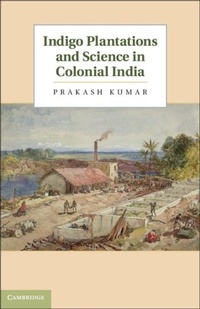
Indigo Plantations and Science in Colonial India
1st Edition
Published on 28. September 2012
978-1-139-57520-1 (ISBN)
Description

Prakash Kumar documents the history of agricultural indigo, exploring the effects of nineteenth-century globalisation on this colonial industry. Charting the indigo culture from the early modern period to the twentieth century, Kumar discusses how knowledge of indigo culture thrived among peasant traditions on the Indian subcontinent in the early modern period and was then developed by Caribbean planters and French naturalists who codified this knowledge into widely disseminated texts. European planters who settled in Bengal with the establishment of British rule in the late eighteenth century drew on this information. From the nineteenth century, indigo culture became more modern, science-based and expert driven, and with the advent of a cheaper, purer synthetic indigo in 1897, indigo science crossed paths with the colonial state's effort to develop a science for agricultural development. Only at the end of the First World War, when the industrial use of synthetic indigo for textile dyeing and printing became almost universal, did the indigo industry's optimism fade away.
Reviews / Votes
'In examining the history of indigo cultivation and agricultural science in India, Kumar lucidly explores the intersection between imperial systems, technological modernity, and global knowledge diasporas. The book combines exemplary research with insightful and challenging theorization about the application and understanding of science in a colonial setting.' David Arnold, Emeritus Professor of Asian and Global History, University of Warwick 'In his insightful history of modern indigo, Prakash Kumar nicely demonstrates that knowledge of the blue dye was fluid and fugitive, mobile and global.' Joyce Chaplin, Harvard University 'Professor Kumar has brought an entirely fresh perspective to the subject of indigo in India by examining the science and the patronage of science involved in the 'improvement' of indigo over several hundred years and by placing his study in a truly global framework. This book is a major contribution both to the history of modern South Asia and to the history of science.' Douglas E. Haynes, Dartmouth College 'Professor Kumar's book is a scholarly work of profound erudition. It is a masterful analysis of the complex and shifting interactions between agricultural practices, relations between European planters and Indian farmers, scientific research in Britain and India, and the role of the colonial state in Indian agriculture. Scholars interested in agriculture and science in colonial India will consult this work for years to come.' Daniel Headrick, Professor Emeritus of Social Science and History, Roosevelt University 'Prakash Kumar writes a new kind of history of indigo cultivation in British India, focusing on the vast mobility of productive scientific knowledge and its localization at the agrarian foundations of India's modern development regime in Bengal.' David Ludden, New York University 'This book is the first full-scale study of the odyssey of natural indigo manufacturing by European entrepreneurs and planters in South Asia across three centuries, as seen from the point of view of technical knowledge and efforts at 'improvement'. Its particular merit is that it analyzes the complex interplay between metropolitan science and local practice in the colony within a wider context of transnational market connections and cosmopolitan knowledge circulation at the global scale. This is a landmark study, based on wide-ranging and diversified sources, and written with impeccable clarity.' Jacques Pouchepadass, Emeritus Research Director, CNRS, Paris 'A meticulously researched work based on a wide variety of sources skilfully used in the narrative. It presents an engaging story of the indigo industry in India, in its global expanse and immensity, with its links to the international market, imperialism, and ultimately to the global system of capitalism ... Well written, and impressively readable, the book is sure to stimulate interest in the subject and prove a reference work for future research on indigo in India.' Reviews in History (history.ac.uk/reviews) 'Prakash's greatest achievement lies in recovering from the seams of history the course, context, and commercial benefits of indigo science, doing so in a way that contributes to the broader social history of colonial South Asia. Indigo Plantations and Science, therefore, deserves to be read as one of the finest studies on 'colonial knowledge' that has been published in recent years.' Madhumita Saha, Technology and CultureMore details
Language
English
Place of publication
Cambridge
United Kingdom
Publishing group
Cambridge University Press
Target group
Professional and scholarly
Illustrations
7 Tables, unspecified; 2 Maps; 13 Halftones, unspecified
File size
3,42 MB
ISBN-13
978-1-139-57520-1 (9781139575201)
Copyright in bibliographic data and cover images is held by Nielsen Book Services Limited or by the publishers or by their respective licensors: all rights reserved.
Schweitzer Classification
Other editions
Additional editions
Prakash Kumar
Indigo Plantations and Science in Colonial India
Book
08/2012
Cambridge University Press
€140.40
Shipment within 15-20 days
Person
Prakash Kumar is Assistant Professor of South Asian History at Colorado State University.
Content
Introduction: the odyssey of indigo; 1. The world of indigo plantations: diasporas and knowledge; 2. The course of colonial modernity: negotiating the landscape in Bengal; 3. Colony and the external arena: seeking validation in the market; 4. Local science: agricultural institutions in the age of nationalism; 5. The last stand in science and rationalization; 6. A lasting definition of improvement in the era of world war.
