

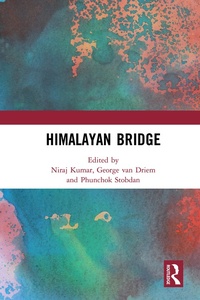
Himalayan Bridge
1st Edition
Published on 18. November 2020
454 pages
978-1-000-21549-6 (ISBN)
Description

The centrality of the Himalayas as a connecting point or perhaps a sacred core for the Asian continent and its civilisations has captivated every explorer and scholar. The Himalaya is the meeting point of two geotectonic plates, three biogeographical realms, two ancient civilisations, two different language streams and six religions.
This book is about the determinant factors which are at work in the Himalayas in the context of what it constitutes in terms of its spatiality, legends and myths, religious beliefs, rituals and traditions. The book suggests that there is no single way for understanding the Himalayas. There are layers of structures, imposition and superimposition of human history, religious traits and beliefs that continue to shape the Asian dynamics. An understanding of the ultimate union of the Himalayas, its confluences and its bridging role is essential for Asian balance.
This book is a collaborative effort of an internationally acclaimed linguist, a diplomat-cum-geopolitician and a young Asianist. It provides countless themes that will be intellectually stimulating to scholars and students with varied interests.
Please note: This title is co-published with KW Publishers, New Delhi. Taylor & Francis does not sell or distribute the Hardback in India, Pakistan, Nepal, Bhutan, Bangladesh and Sri Lanka.
This book is about the determinant factors which are at work in the Himalayas in the context of what it constitutes in terms of its spatiality, legends and myths, religious beliefs, rituals and traditions. The book suggests that there is no single way for understanding the Himalayas. There are layers of structures, imposition and superimposition of human history, religious traits and beliefs that continue to shape the Asian dynamics. An understanding of the ultimate union of the Himalayas, its confluences and its bridging role is essential for Asian balance.
This book is a collaborative effort of an internationally acclaimed linguist, a diplomat-cum-geopolitician and a young Asianist. It provides countless themes that will be intellectually stimulating to scholars and students with varied interests.
Please note: This title is co-published with KW Publishers, New Delhi. Taylor & Francis does not sell or distribute the Hardback in India, Pakistan, Nepal, Bhutan, Bangladesh and Sri Lanka.
Reviews / Votes
Himalayan bridge covers a major gap in our knowledge and understanding about the Himalayas. All aspects of the geopolitical significance have been discussed in the book.- Nirmala Joshi, Director, India Central Asia Foundation.
More details
Edition
1. Auflage
Language
English
Place of publication
London
United Kingdom
Publishing group
Taylor & Francis Ltd
Target group
College/higher education
Illustrations
1 Tables, black and white; 97 Halftones, black and white; 97 Illustrations, black and white
ISBN-13
978-1-000-21549-6 (9781000215496)
Copyright in bibliographic data and cover images is held by Nielsen Book Services Limited or by the publishers or by their respective licensors: all rights reserved.
Schweitzer Classification
Other editions
Additional editions
Niraj Kumar | George van Driem | Phunchok Stobdan
Himalayan Bridge
Book
11/2020
1st Edition
Routledge
€233.20
Shipment within 15-20 days
Persons
Niraj Kumar is the author of a magnum opus on Asian Integration-Arise Asia: Respond to White Peril (2002). His recent works include Sriyantra and Geophilosophy of India (2014), Asia in Post-Western Age (2014) and Rainbow of Indian Civilization (2015). He received initiation from Swami Ranganathanandaji Maharaj of the Ramakrishna Mission in 1992 and is associated with the Society for Asian Integration (SAI).
George van Driem is the Director of the Linguistics Institute at the University of Bern in Switzerland, where he holds the Chair of Historical Linguistics. He has conducted field research in Bhutan, Nepal, northeastern India and the western Indian Himalayas since 1983. In 2001, he produced the first major ethnolinguistic synthesis of the Greater Himalayan region-extending from Central and South Asia to Southeast and East Asia-Languages of the Himalayas: An Ethnolinguistic Handbook of the Greater Himalayan Region Containing an Introduction to the Symbiotic Theory of Language (2 vols). Nowadays, he is working on the Asian populations' prehistory in collaboration with linguists and population geneticists in order to finally reconstruct the prehistory of the human population.
Ambassador Phunchok Stobdan is a distinguished academician, diplomat, national security expert and Senior Fellow at IDSA. Ambassador Stobdan is a specialist on Asian affairs covering Central Asia and Inner Asia-including Xinjiang, Tibet, Myanmar and the Himalayan region. He served in Central Asia twice: first, as Director at the Embassy of India, Almaty (1999 and 2002) and then as the Ambassador at the Embassy of India, Bishkek (2010-2012). He has also served as Joint Director in the Indian National Security Council. He has established the Ladakh International Centre (LIC) at Leh to promote research on Himalayas.
George van Driem is the Director of the Linguistics Institute at the University of Bern in Switzerland, where he holds the Chair of Historical Linguistics. He has conducted field research in Bhutan, Nepal, northeastern India and the western Indian Himalayas since 1983. In 2001, he produced the first major ethnolinguistic synthesis of the Greater Himalayan region-extending from Central and South Asia to Southeast and East Asia-Languages of the Himalayas: An Ethnolinguistic Handbook of the Greater Himalayan Region Containing an Introduction to the Symbiotic Theory of Language (2 vols). Nowadays, he is working on the Asian populations' prehistory in collaboration with linguists and population geneticists in order to finally reconstruct the prehistory of the human population.
Ambassador Phunchok Stobdan is a distinguished academician, diplomat, national security expert and Senior Fellow at IDSA. Ambassador Stobdan is a specialist on Asian affairs covering Central Asia and Inner Asia-including Xinjiang, Tibet, Myanmar and the Himalayan region. He served in Central Asia twice: first, as Director at the Embassy of India, Almaty (1999 and 2002) and then as the Ambassador at the Embassy of India, Bishkek (2010-2012). He has also served as Joint Director in the Indian National Security Council. He has established the Ladakh International Centre (LIC) at Leh to promote research on Himalayas.
Content
Introduction PART I: Himalayas: Geology, Genetics, Identity 1. India-Asia Collision and the Making of Himalayas 2. Challenges to the Himalayan Watershed 3. From the Dhaulagiri to Lappland, the Americas and Oceania 4. Textile, Text, Terracing, Territoriality: Weaving a Pan-Himalayan Identity
PART II: Prism of the Past 5. Reflection of the Himalayas in the Ancient Indian Texts: A Note 6 Encounter and Engagement: Vignettes of the Trans-Himalayan Region 7. The Indian Frontier Administrative Service: Romanticism and Hostile Borders 8. Himalayan Buddhism Travels West
PART III: Mosaic of Politics 9. The Trans-Himalayan Geopolitics 10. Himalayas to Unite 11. Why Siachen Matters to India 12. Empowering the Kashmiris 13. Drug and Arms Flow in the Eastern Himalayan Region 14. Cultural Continuity and School Education in Bhutan: Current Initiatives, Challenges and Opportunities 15. Buddhist Identity Politics in Nepal since the 1990s
PART IV: Philosophy, Art and Culture 16. Relevance of the Nalanda Tradition for Contemporary Society: Wisdom, Non-Sectarianism and Secular Ethics 17. Footprints of Nalanda Master Naropa in the Himalayas 18. Sowa Rigpa: Traditional Medical System of the Himalayas 19. Himalayan Food Culture 20. Art Heritage and Law: Railroading Geographical Indications Act and Kangra Miniature Paintings 21. Alchi Murals: Tracing the Multiple Traditions 22. Pre-Vaishnavite and Post-Vaishnavite Dance Forms of Manipur
PART V: Spiritual Odyssey 23. Rishikesh: Silent Hum of Mystery 24. The Himalayas: A Mystic's Viewpoint
PART II: Prism of the Past 5. Reflection of the Himalayas in the Ancient Indian Texts: A Note 6 Encounter and Engagement: Vignettes of the Trans-Himalayan Region 7. The Indian Frontier Administrative Service: Romanticism and Hostile Borders 8. Himalayan Buddhism Travels West
PART III: Mosaic of Politics 9. The Trans-Himalayan Geopolitics 10. Himalayas to Unite 11. Why Siachen Matters to India 12. Empowering the Kashmiris 13. Drug and Arms Flow in the Eastern Himalayan Region 14. Cultural Continuity and School Education in Bhutan: Current Initiatives, Challenges and Opportunities 15. Buddhist Identity Politics in Nepal since the 1990s
PART IV: Philosophy, Art and Culture 16. Relevance of the Nalanda Tradition for Contemporary Society: Wisdom, Non-Sectarianism and Secular Ethics 17. Footprints of Nalanda Master Naropa in the Himalayas 18. Sowa Rigpa: Traditional Medical System of the Himalayas 19. Himalayan Food Culture 20. Art Heritage and Law: Railroading Geographical Indications Act and Kangra Miniature Paintings 21. Alchi Murals: Tracing the Multiple Traditions 22. Pre-Vaishnavite and Post-Vaishnavite Dance Forms of Manipur
PART V: Spiritual Odyssey 23. Rishikesh: Silent Hum of Mystery 24. The Himalayas: A Mystic's Viewpoint
