

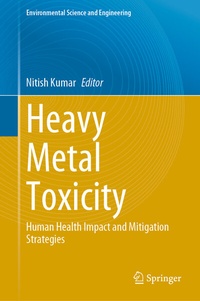
Heavy Metal Toxicity
Description

This edited book brings together a diverse group of environmental science, sustainability, and health researchers to address the challenges posed by global mass poisoning caused by heavy metals contamination of soil and plants. In recent years, contamination of the environment by heavy metals has become a major concern. Their multiple industrial, domestic, agricultural, medical, and technological applications have led to their wide distribution in the environment, raising concerns over their potential effects on human health and the environment. Owing to their toxic, non-degradable, and bio-accumulative nature, the health burden on the population has increased significantly. Heavy metals such as arsenic, lead, mercury, cadmium, and uranium do not play a significant role in metabolism in the human body and are thus toxic. Their exposure in high concentration can cause acute toxicity resulting in acute health conditions, which is easy to observe and regulate, while similar is not visible for immediate action when their exposure is in trace amounts over the years. Heavy metals enter in the food chain through consumption of plant material. A high concentration of heavy metals has been found to be harmful to vegetation. As the heavy metals concentration in plants increases, it adversely affects several biological parameters and eventually renders the soil barren.
The book sheds light on this global environmental issue and proposes solutions to contamination through multi-disciplinary approaches and case studies from different parts of the world. This book is a valuable resource to students, academicians, researchers, and environmental professionals who are doing field work on heavy metals contamination throughout the world.
More details
Other editions
Additional editions
Content
Heavy Metals-Toxicity and Environmental Pollution.- Heavy Metals Dynamics in the Soil-Plant Continuum.- Impacts of Heavy Metals Contamination on Human Health.- Role of Microbes in Heavy Metals Remediation.- Antioxidant Defence: A key mechanism of Heavy Metals Tolerance.- Role of Plants in Heavy Metals Remediation.- Molecular Mechanisms of Heavy Metals Tolerance in Plants: a Key Role of Antioxidant Defence.- Heavy Metal Contamination of Water and Their Toxic Effect on Living Organisms.- Heavy Metal Stress in Plants.- Adsorption Technology for Removal of Heavy Metal Pollutants.- Eco-Friendly Technologies for Heavy Metal Remediation.- Biotechnological Approaches in Remediation of Heavy Metals.- Development of Nano-adsorbent for Heavy Metals Removal from Wastewater.- Heavy Metals Uptake and Bioaccumulation in Plants.- Oxidative Stress of Heavy Metals Toxicity in Animals and its Amelioration.- Perspective on the Heavy Metal Pollution and Recent Remediation approaches.
