

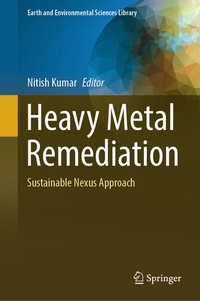
Heavy Metal Remediation
Description

Heavy metals, in general trace elements, are one of the major environmental problems. Nowadays, increasing environmental and global public health concerns related with environmental contamination by heavy metals are well known. Moreover, human exposure has risen dramatically because of an exponential increase of their use in several activities such as agricultural, industrial, technological and urban applications. They are presented in soils, water and atmosphere and they are a serious risk for the food chain.
Approximately 10 million contaminated sites have been reported globally, occupying approximately 49.42 million acres of land, of which >50% is contaminated with toxic heavy metals. This situation warrants immediate attention to limit the introduction of heavy metals into soil systems and to remove the prevailing heavy metals from polluted soils. However, the majorities of existing heavy-metal-removal technologies are expensive, inefficient, or generate secondary pollutants. Therefore, it is of great importance to develop cheaper, environmentally friendly and sustainable approaches (including the development of new immobilizing agents) to manage and rehabilitate heavy-metal-contaminated soils.
In the light of the aforementioned facts, this book sheds light on this global environmental issue, and proposes solutions to contamination through multi-disciplinary approaches and case studies from different parts of the world. It addresses sustainable heavy metal contamination remediation strategies using the potential applications of recent biological technology such as biotechnology, bioremediation, phytoremediation, biochar, absorbent, genetic engineering, and nanotechnology approaches. This book is of interest to researchers, teachers, environmental scientists, environmental engineers, environmentalists, and policy makers. Also, the book serves as additional reading material for undergraduate and graduate students of environmental microbiology, biotechnology, eco-toxicology, environmental remediation, waste management, and environmental sciences as well as the general audience.
More details
Other editions
Additional editions
Person
Dr. Kumar completed his doctoral research at the Council of Scientifc & Industrial Research-Central Salt & Marine Chemicals Research Institute, Bhavnagar, Gujarat, India. He has more than 12 years of research and teaching experience in the field of plant and microbial biotechnology, and heavy metal bioremediation. . He has published more than 70 research articles in leading international and national journals, more than 20 book chapters and 7 books with Springer and Taylor & Francis. Dr. Kumar is a recipient of the Young Scientist Award from the Science and Engineering Research Board (SERB) in 2014. He has received many awards/fellowships/projects from various organizations, for example, the CSIR, DBT, ICAR and SERB-DST, BRNS-BARC, among others. He is an active reviewer for journals, including Biotechnology Reports, Aquatic Botany, Industrial Crops and Products, PLoS One, Plant Biochemistry and Biotechnology, and 3Biotech. He also serves as an associate editor of the journal Gene (Elsevier). He has H-Index 22 and i10-Index 30 as per google scholar database 2022.
Content
