

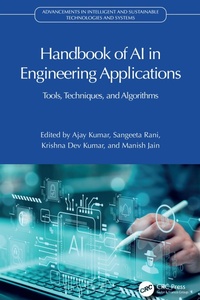
Handbook of AI in Engineering Applications
Tools, Techniques, and Algorithms
Published on 12. August 2025
320 pages
978-1-040-39634-6 (ISBN)
Description

There is a need to categorize artificial intelligence (AI) applications, tools, techniques, and algorithms based on their intended use in various design stages. Specifically, there is a need to explore AI techniques that are utilized for tasks such as designing, including but not limited to inspiration, idea and concept generation, concept evaluation, optimization, decision-making, and modeling. This includes things like generating ideas and concepts, evaluating those ideas, optimizing designs, making decisions, and creating models. This handbook brings all of these categories with compatible AI techniques, tools, and algorithms together in one place.
Handbook of AI in Engineering Applications: Tools, Techniques, and Algorithms covers applications of AI in engineering and highlights areas such as future cities, mechanical system analysis, and robotic process automation, and presents the application of AI and the use of computerized systems that aim to simplify and automate the processes of design and construction of civil works. The handbook discusses the design and optimization of mechanical systems and parts, such as engines, gears, and bearings, which can be automated using AI and it explores the performance of robotics and automation systems which can be simulated and analyzed using AI to forecast behavior, spot future issues, and suggest changes. Rounding out this handbook is AI technology automation and how analyzing relevant data can provide a reliable basis for relevant personnel to carry out their work.
This handbook fills the gap between R&D in AI and will benefit all stakeholders including industries, professionals, technologists, academics, research scholars, senior graduate students, government, and public healthcare professionals.
Handbook of AI in Engineering Applications: Tools, Techniques, and Algorithms covers applications of AI in engineering and highlights areas such as future cities, mechanical system analysis, and robotic process automation, and presents the application of AI and the use of computerized systems that aim to simplify and automate the processes of design and construction of civil works. The handbook discusses the design and optimization of mechanical systems and parts, such as engines, gears, and bearings, which can be automated using AI and it explores the performance of robotics and automation systems which can be simulated and analyzed using AI to forecast behavior, spot future issues, and suggest changes. Rounding out this handbook is AI technology automation and how analyzing relevant data can provide a reliable basis for relevant personnel to carry out their work.
This handbook fills the gap between R&D in AI and will benefit all stakeholders including industries, professionals, technologists, academics, research scholars, senior graduate students, government, and public healthcare professionals.
More details
Series
Language
English
Place of publication
London
United Kingdom
Publishing group
Taylor & Francis Ltd
Target group
Professional and scholarly
Illustrations
50 Tables, black and white; 59 Line drawings, black and white; 6 Halftones, black and white; 65 Illustrations, black and white
File size
12,03 MB
ISBN-13
978-1-040-39634-6 (9781040396346)
Copyright in bibliographic data and cover images is held by Nielsen Book Services Limited or by the publishers or by their respective licensors: all rights reserved.
Schweitzer Classification
Other editions
Additional editions
Ajay Kumar | Sangeeta Rani | Krishna Dev Kumar
Handbook of AI in Engineering Applications
Tools, Techniques, and Algorithms
Book
08/2025
1st Edition
CRC Press
€242.40
Shipment within 10-20 days
Persons
Ajay Kumar is Professor (Research Track), Department of Mechanical Engineering, School of Core Engineering, Faculty of Science, Technology & Architecture, Manipal University Jaipur. He received his Ph.D. in the field of Advanced Manufacturing from Guru Jambheshwar University of Science & Technology, Hisar, India after B.Tech. (Hons.) in mechanical engineering and M.Tech. (Distinction) in manufacturing and automation. Dr. Kumar's areas of research include Incremental Sheet Forming, Artificial Intelligence, Sustainable Materials, Additive Manufacturing, Mechatronics, Smart Manufacturing, Industry 4.0, Waste Management, and Optimization Techniques. He has over 120 publications in international journals of repute including SCOPUS, Web of Science and SCI indexed database and refereed international conferences. Dr. Kumar has also co-authored and co-edited many books with ELSEVIER, CRC Press, WILEY, De Gruyter and IGI Global and conference proceedings with IOP. He has organized various national and international events including an International conference on Mechatronics and Artificial Intelligence (ICMAI-2021), International conference on Artificial Intelligence, Advanced Materials, and Mechatronics Systems (AIAMMS-2023) as conference chair. Dr. Kumar is credited with more than 20 national and international patents, and has supervised more than 8 M.Tech, Ph.D scholars and numerous undergraduate projects/thesis. He has a total of 15 years of experience in teaching and research and is a Guest Editors and Review Editor of several reputed journals, including Frontiers in Sustainability. Dr. Kumar has contributed to many international conferences/symposiums as a session chair, expert speaker, and member of the editorial board. Throughout his career, Dr. Kumar has won several proficiency awards, including merit awards and best teacher awards. He is adviser of QCFI, Delhi Chapter student cell at JECRC University and has also authored many in-house course notes, lab manuals, monographs and invited chapters in books. Dr. Kumar has organized a series of Faculty Development Programs, International Conferences, workshops, and seminars for researchers, PhD, UG and PG level students, and is associated with many research, academic, and professional societies in various capacities.
Sangeeta Rani is an Assistant Professor in the Department of Computer Science and Engineering, World College of Technology & Management, Gurgaon, India. She is pursuing her Ph.D. from Amity University, Manesar, Gurugram, and completed her M. Tech. from Maharshi Dayanand University, Rohtak, India. Dr. Rani's areas of research include Cloud Computing and Machine Learning. Dr. Rani has over 20 research publications in international journals of repute, refereed international conferences, and co-authored more than 5 book chapters. She has a total of 14 years of teaching experience, won the best paper awards at various international conferences, and has more than 5 national and international patents in her credit.
Krishna D. Kumar is a Professor of Aerospace Engineering and the Director of the Artificial Intelligence for Aerospace Systems (AIAS) Laboratory at Toronto Metropolitan University, Canada. He is also the Founder and President of iSAC Systems Inc., a leader in Artificial Intelligence, Internet of Things, and Automation since 2010. Dr. Kumar received his Ph.D. degree in aerospace engineering from the Indian Institute of Technology, Kanpur, India, in 1998 and his experience in academia spans more than two and half decades at various premier institutions in Canada, Japan, South Korea, and India (including Toronto Metropolitan University (formerly Ryerson University), Canada; National Aerospace Laboratory, Japan; Kyushu University, Japan; Korea Advanced Institute of Science and Technology, South Korea; Defense Research and Development Organization, India; and Birla Institute of Science and Technology, Pilani, India). Dr. Kumar has made significant contributions with major impact in the areas of autonomous systems, fault diagnosis and prognosis, big data, predictive analytics, and artificial intelligence with over 220 publications in high-ranking journals (100 papers) and conference proceedings (125), 5 books, 14 intellectual properties, and four patents (two granted; two provisional). His internet-of-things devices and artificial intelligence software have been deployed in several industries including aerospace, manufacturing, transportation, and waste management.
Manish Jain is a Professor in the Computer Science and Engineering Department, School of Engineering and Technology, JECRC University, Jaipur, Rajasthan, India. He received his Ph.D. from Malaviya National Institute of Technology, Jaipur, India, after his B.Tech. (Hons.) in Computer Science and Engineering from Govt. Engineering College, Bikaner, and his M. Tech. in Computer Science and Engineering from Malaviya National Institute of Technology, Jaipur. Dr. Jain's areas of research include Artificial Intelligence, Machine Learning, Natural Language Processing, Software Testing, Aspect Oriented Programming, and Generative Adversarial Networks. He has over 15 publications in international journals of repute including SCOPUS, Web of Science, and SCIE indexed database and refereed international conferences. Dr. Jain has a unique patent on "Smart Library Management System" to his credit, which proposes the use of Machine Learning for increasing the efficiency of an institution's library. He has a total of 18 years of experience in teaching and research, and has made significant contributions to international conferences/symposiums as an expert speaker and spearheads the Industry Interface cell at JECRC University.
Sangeeta Rani is an Assistant Professor in the Department of Computer Science and Engineering, World College of Technology & Management, Gurgaon, India. She is pursuing her Ph.D. from Amity University, Manesar, Gurugram, and completed her M. Tech. from Maharshi Dayanand University, Rohtak, India. Dr. Rani's areas of research include Cloud Computing and Machine Learning. Dr. Rani has over 20 research publications in international journals of repute, refereed international conferences, and co-authored more than 5 book chapters. She has a total of 14 years of teaching experience, won the best paper awards at various international conferences, and has more than 5 national and international patents in her credit.
Krishna D. Kumar is a Professor of Aerospace Engineering and the Director of the Artificial Intelligence for Aerospace Systems (AIAS) Laboratory at Toronto Metropolitan University, Canada. He is also the Founder and President of iSAC Systems Inc., a leader in Artificial Intelligence, Internet of Things, and Automation since 2010. Dr. Kumar received his Ph.D. degree in aerospace engineering from the Indian Institute of Technology, Kanpur, India, in 1998 and his experience in academia spans more than two and half decades at various premier institutions in Canada, Japan, South Korea, and India (including Toronto Metropolitan University (formerly Ryerson University), Canada; National Aerospace Laboratory, Japan; Kyushu University, Japan; Korea Advanced Institute of Science and Technology, South Korea; Defense Research and Development Organization, India; and Birla Institute of Science and Technology, Pilani, India). Dr. Kumar has made significant contributions with major impact in the areas of autonomous systems, fault diagnosis and prognosis, big data, predictive analytics, and artificial intelligence with over 220 publications in high-ranking journals (100 papers) and conference proceedings (125), 5 books, 14 intellectual properties, and four patents (two granted; two provisional). His internet-of-things devices and artificial intelligence software have been deployed in several industries including aerospace, manufacturing, transportation, and waste management.
Manish Jain is a Professor in the Computer Science and Engineering Department, School of Engineering and Technology, JECRC University, Jaipur, Rajasthan, India. He received his Ph.D. from Malaviya National Institute of Technology, Jaipur, India, after his B.Tech. (Hons.) in Computer Science and Engineering from Govt. Engineering College, Bikaner, and his M. Tech. in Computer Science and Engineering from Malaviya National Institute of Technology, Jaipur. Dr. Jain's areas of research include Artificial Intelligence, Machine Learning, Natural Language Processing, Software Testing, Aspect Oriented Programming, and Generative Adversarial Networks. He has over 15 publications in international journals of repute including SCOPUS, Web of Science, and SCIE indexed database and refereed international conferences. Dr. Jain has a unique patent on "Smart Library Management System" to his credit, which proposes the use of Machine Learning for increasing the efficiency of an institution's library. He has a total of 18 years of experience in teaching and research, and has made significant contributions to international conferences/symposiums as an expert speaker and spearheads the Industry Interface cell at JECRC University.
Content
Section One: Integrating AI Tools, Techniques, and Algorithms. 1.A Comparative Analysis of Symbolic And Subsymbolic Approaches In Artificial Intelligence. 2. Revisiting the Impact of AI-Driven Feature Selection Approaches in Software Fault Prediction. 3. Advancing Depression Detection: Insights from Standard Datasets and Multimodal Approaches. 4. Machine Learning and Natural Language Processing Strategies for Fake News Detection: An Empirical Study. 5. Exploring the Nexus of AI, the Metaverse and Quality of Life. 6. A Literature Survey on AI-Driven Code-Mixed Text Analysis and Normalization. 7. Reviewing Different Artificial Intelligence Algorithms For Sarcasm Detection. 8. Advances in Automatic Question Generation by AI based Algorithms: A Review. 9. Hands on Practices, Reflection on Data Wisdom with AI Principles: A Review. Section Two: Harnessing the Applications of AI. 10. FPGA Accelerated Deep Learning Network For Liver Tumor Segmentation in 3D CT Images. 11. Deep Learning Enhanced Restaurant Recommendations: Leveraging Artificial Neural Networks. 12. AI-Driven Solutions for Career Counselling Based on the Personality of an . 13. Exploration of Machine Learning Enabled Automated Crop-Disease Detection, Segmentation and Classification Techniques. 14. Digital Camouflage Generation by AI Based Methods: A Survey of Recent Techniques. 15. Plant Disease Detection Using Deep Learning Techniques: A Comprehensive Review and Comparative Analysis. 16. AI for disaster prediction and Management. 17. Investigation of Stress Among University Students using PSS and AI Based Analysis. 18. An Experimental Overview of Assessment of Authenticity of Face Recognition by AI Techniques in Smart Phones.
