

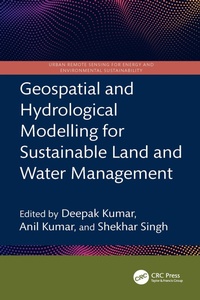
Geospatial and Hydrological Modelling for Sustainable Land and Water Management
Published on 6. April 2026
352 pages
978-1-040-67409-3 (ISBN)
Description

This book presents a holistic scientific approach to addressing current and future challenges in the sustainable management of land and water resources, supported by geospatial and hydrological modeling. It explores remote sensing integrated with hydrological modeling for watershed management, land and water resource planning, soil erosion and sediment transport studies using satellite data, and climate change impact assessments on land and water systems-all illustrated through case studies.
Focuses on both geospatial and hydrological modelling for effective land and water resource management.
Covers topics including Google Earth Engine, forest land management, coastal land issues, geo-hydrology, and salinity problems.
Discusses IPCC guidelines for water resource management.
Incorporates big data and machine learning applications in water resource management.
Reviews digital image processing techniques applied to satellite data.
This book is intended for researchers and professionals in hydrological engineering, geospatial technologies, and environmental engineering.
Focuses on both geospatial and hydrological modelling for effective land and water resource management.
Covers topics including Google Earth Engine, forest land management, coastal land issues, geo-hydrology, and salinity problems.
Discusses IPCC guidelines for water resource management.
Incorporates big data and machine learning applications in water resource management.
Reviews digital image processing techniques applied to satellite data.
This book is intended for researchers and professionals in hydrological engineering, geospatial technologies, and environmental engineering.
More details
Series
Language
English
Place of publication
London
United Kingdom
Publishing group
Taylor & Francis Ltd
Target group
College/higher education
Professional and scholarly
Product notice
Reflowable
Illustrations
36 Tables, black and white; 60 Line drawings, black and white; 34 Halftones, black and white; 94 Illustrations, black and white
File size
17,90 MB
ISBN-13
978-1-040-67409-3 (9781040674093)
Copyright in bibliographic data and cover images is held by Nielsen Book Services Limited or by the publishers or by their respective licensors: all rights reserved.
Schweitzer Classification
Other editions
Additional editions
Deepak Kumar | Anil Kumar | Shekhar Singh
Geospatial and Hydrological Modelling for Sustainable Land and Water Management
Book
approx. 04/2026
1st Edition
CRC Press
€163.50
Not yet published
Persons
Deepak Kumar is currently working as an Assistant Professor in Department of Soil and Water Conservation Engineering, GB Pant University of Agriculture & Technology (GBPUA&T), Pantnagar, India. His specific research interests focus on surface and groundwater remediation methods, soil and water conservation technologies, Artificial Intelligence and remote sensing technologies in agriculture and allied sectors. He holds a Ph.D. in Civil Engineering with emphasis on Water Resource Engineering from IIT Delhi; M. Tech in Agricultural Systems and Management from IIT Kharagpur, India. He also has Post-Doctoral research and teaching experiences at Department of Hydrology, IIT Roorkee. He is also reviewer for several research articles such asTaylor & Francis, and several other internationally acclaimed publishing houses. He has delivered invited lectures in various engineering, research institutions, and technical associations like Western Sydney University, Australia; IIT Roorkee; Graphic Era Deemed to be University, Uttarakhand; Assam University, Silchar etc. He has also conducted several workshops, training program, international programs. He is also an active Coordinated of IIRS, ISRO programs.
Anil Kumar is a professor of Soil and Water Conservation Engineering with G.B. Pant University of Agriculture and Technology, Pantnagar, Uttarakhand, India. He has been head of the department for six years. He is an active member of various national and international professional societies. He has conducted various filed studies on the design and construction of cost-effective harvesting of surface runoff; rejuvenation of natural water springs using biological and mechanical measures; vegetative measures to check landslides along hill roads; and use of soil amendments to check the loss of runoff, sediment and nutrients from sloped lands in Himalayan region. He has taught various courses to under-graduate, post-graduate and PhD students. He has more than 140 publications to his credit, including over 90 research articles in peer-reviewed international and national journals, 19 book chapters, and 45 conference proceedings.
Shekhar Singh holds a Ph.D. in Soil and Water Conservation Engineering from the Department of Soil and Water Conservation Engineering, GBPUAT Pantnagar, India. His core research areas include climate change, climate extremes, hydrological modeling, and land & water management. Dr. Singh has worked as a Post-Doctoral Research Associate at the Indian Institute of Technology Indore, Madhya Pradesh, India, where he was actively involved in research related to water policy research. His work at IIT Indore focused on addressing pressing issues related to water governance in the Indian context. He has authored and co-authored various research papers and book chapters published in reputed SCI, ESCI, and Scopus-indexed journals. In addition to academic publishing, He has presented his research at a wide range of national and international conferences, receiving recognition and awards for his scholarly excellence. He also serves as a reviewer for prestigious journals such as Journal of Hydrology, Discover Water, Theoretical and Applied Climatology, Water Resources Management,among others.
Anil Kumar is a professor of Soil and Water Conservation Engineering with G.B. Pant University of Agriculture and Technology, Pantnagar, Uttarakhand, India. He has been head of the department for six years. He is an active member of various national and international professional societies. He has conducted various filed studies on the design and construction of cost-effective harvesting of surface runoff; rejuvenation of natural water springs using biological and mechanical measures; vegetative measures to check landslides along hill roads; and use of soil amendments to check the loss of runoff, sediment and nutrients from sloped lands in Himalayan region. He has taught various courses to under-graduate, post-graduate and PhD students. He has more than 140 publications to his credit, including over 90 research articles in peer-reviewed international and national journals, 19 book chapters, and 45 conference proceedings.
Shekhar Singh holds a Ph.D. in Soil and Water Conservation Engineering from the Department of Soil and Water Conservation Engineering, GBPUAT Pantnagar, India. His core research areas include climate change, climate extremes, hydrological modeling, and land & water management. Dr. Singh has worked as a Post-Doctoral Research Associate at the Indian Institute of Technology Indore, Madhya Pradesh, India, where he was actively involved in research related to water policy research. His work at IIT Indore focused on addressing pressing issues related to water governance in the Indian context. He has authored and co-authored various research papers and book chapters published in reputed SCI, ESCI, and Scopus-indexed journals. In addition to academic publishing, He has presented his research at a wide range of national and international conferences, receiving recognition and awards for his scholarly excellence. He also serves as a reviewer for prestigious journals such as Journal of Hydrology, Discover Water, Theoretical and Applied Climatology, Water Resources Management,among others.
Content
1.Impact of Land use Landcover (LULC) Change on Watershed Hydrology: A Review 2. Urban Land Use Dynamics: A Remote Sensing and GIS Approach 3. Application of remote sensing and GIS for the study of Climate Change on Glacier Retreat 4. Land Use Pattern Changes and Their Impact on Sustainable Agriculture using Remote Sensing and GIS 5. Assessment of Diara Land under Koshi River in Bihar Using Remote Sensing and GIS Techniques 6. Google Earth Engine-Based Hypsometric Evaluation and Statistical Moments Analysis of Large River Basins 7. Methods to quantify salinity problems using remote sensing technology 8. Dynamic Assessment of Soil Erosion Risk using Hydrological Model and Geo-Spatial Approach: A Case Study from Chamoli, Uttarakhand 9. Study of Rainfall Variability using Multi-scale Entropy for Mandi and Shimla regions of Himachal Pradesh, India 10. Ecosystem Restoration of Lakes through Biomanipulation and Aeration 11.A Performance Evaluation Of K-Nearest Neighbours and Artificial Neural Networks for Predicting Total Dissolved Solids Concentrations in Groundwater Sources 12. Remote Sensing and GIS Applications for Solid Waste Management in Hilly Terrains 13. Water quality assessment of Ashtamudi Ramsar Wetland System, India for achieving environmental sustainability: A GIS based approach 14. GIS-Based Modeling of Flash Flood Susceptibility and Water Resource Management: A Case Study of the Gulf of Aqaba Drainage Basins, Egypt 15. Evaluating Detrending Methods of Crop Yield Time Series for Drought Studies: A Machine Learning-Based Approach 16. Hydrological Models & It's Limitations for sustainable Land and water Resource Management 17. Glacial Lakes of Garhwal Himalaya: An Inventory and Change Detection Analysis Using Multi-Decadal Satellite Imagery 18. Handling big data of remote sensing in land and water resources management
