

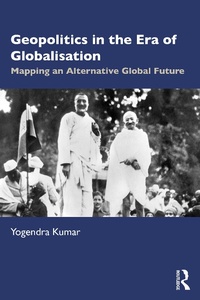
Geopolitics in the Era of Globalisation
Mapping an Alternative Global Future
1st Edition
Published on 16. September 2020
206 pages
978-1-000-17798-5 (ISBN)
Description

This book presents an alternative roadmap for a world characterised by geopolitical uncertainty. The surging expectations about a future world of democratic values and high economic growth, born out of superpower bonhomie at the end of the Cold War, did not lead to the promised outcomes. Instead we are faced with deeply destabilising challenges, like climate change, widespread state fragility, terrorism, arms race, disruptive newer technologies, global economic volatility, and ineffectiveness of multilateral institutions, old and new.
The volume:
surveys the intellectual discourse, the attempts to redesign the global institutions, and the geopolitical trends since the end of the Cold War for an understanding of the contemporary geopolitics,
analyses the characteristics of the contemporary geopolitics, the seeming intractability of the global challenges, and the ongoing discourse about preventing their further deterioration,
foregrounds the Gandhian praxis and IR theory for managing power transitions anchored in non-violent mobilisation of empowered masses, ensuring institutional resilience, and illustrates them through ongoing conflicts in Iraq and Afghanistan,
outlines an approach, based on the Gandhian experience of managing political change, towards conflict, geopolitical uncertainties, and institutional ineffectiveness for securing a better future globally, including South Asia.
Accessibly written, this volume will be indispensable for foreign policy experts, government think tanks, and career bureaucrats. It will also be essential for scholars and researchers of international relations, foreign policy, politics, and governance and public policy.
The volume:
surveys the intellectual discourse, the attempts to redesign the global institutions, and the geopolitical trends since the end of the Cold War for an understanding of the contemporary geopolitics,
analyses the characteristics of the contemporary geopolitics, the seeming intractability of the global challenges, and the ongoing discourse about preventing their further deterioration,
foregrounds the Gandhian praxis and IR theory for managing power transitions anchored in non-violent mobilisation of empowered masses, ensuring institutional resilience, and illustrates them through ongoing conflicts in Iraq and Afghanistan,
outlines an approach, based on the Gandhian experience of managing political change, towards conflict, geopolitical uncertainties, and institutional ineffectiveness for securing a better future globally, including South Asia.
Accessibly written, this volume will be indispensable for foreign policy experts, government think tanks, and career bureaucrats. It will also be essential for scholars and researchers of international relations, foreign policy, politics, and governance and public policy.
Reviews / Votes
"The value of this work derives, firstly, from its comprehensive analysis of the evolution of world geopolitics since the end of the Cold War, and the insight that among the forces driving this process was not only the interaction among nation states, but also the adequacy or otherwise of their cumulative learning experience in managing these forces. Also relevant is the elaboration it provides of all pervading influence of globalisation, which gathered pace precisely over this period, in shaping international politics - and not least, the huge problems and challenges it generated. One should further note the author's effort to give rigorous expression to the generalised discomfort and concern regarding the inadequacy of the emergent international system to cope with them. The high point of the book is the bold and refreshing suggestion that the Gandhian praxis might well offer a viable alternative - something which should stimulate reflection. This is an ambitious and multidimensional project, which has indeed turned out well, because of the author's conviction, good sense, diligence and striving for analytical clarity. Overall, we have here a meaningful addition to the corpus of distinctive Indian perspectives on the subject."K. Raghunath, former Foreign Secretary of India, former Indian ambassador to the Russian Federation, the Philippines, and the German Democratic Republic, and former High Commissioner to Bangladesh.
"This is an immensely ambitious work, a sweeping survey of geopolitics in the post-Cold War years. Combining erudition with originality, Ambassador Yogendra Kumar analyses the growing inability of global institutions to cope with contemporary challenges. He argues that the answer lies in a Gandhian approach to steering political change and highlights the enduring relevance of the Mahatma's teachings."
C. Dasgupta, Padma Bhushan, former Indian ambassador to the European Union, Belgium and Luxembourg, former Indian ambassador to China, and former High Commissioner to Singapore and Tanzania.
"This is a significant contribution in the study of contemporary global power politics on account of the author's insights anchored in the Gandhian philosophy. The author breaks new grounds, brings a rich new archive to our notice and immensely contributes towards our understanding of the contemporary geopolitical realities through the examination of an important, transformative phase of Indian history."
Santosh Kumar Rai, Associate Professor in Modern Indian History, Department of History, Social Science Faculty, University of Delhi.
"Yogendra Kumar's 'Geo-politics' adds a distinctive voice to the crowded field of global politics. This closely argued book conflates his ringside view of politics in the making at the high table of diplomacy with the historian's skill of rigorous documentation, deep knowledge of the challenge of multilateral governance and institutional evolution in the post-cold war era. The added bonus is his empathy for the visions and values of epochal thinkers like Mahatma Gandhi. These insights enrich his analysis of international relations, based on which he outlines the possibility of an alternative future."
Subrata Mitra, Emeritus Professor of Political Science, Heidelberg University, and former Director, Institute of South Asian Studies, National University of Singapore.
"The Cold War is supposed to have ended with the dismantling of the Berlin Wall. But it is back, in a new, perhaps more dangerous guise, increasing the prospects for armed conflict. Yogendra Kumar a diplomatic veteran who watched a lot of these developments from the front row, offers a sweeping perspective of the post-Cold War world. In his own reflections he harks back to the past and urges a return to Gandhian praxis of consensus building in order to restore a saner world."
Nayan Chanda, Associate Professor of International Relations at Ashoka University, former Director of Publications at the Yale Centre for the Study of Globalisation at Yale University and founder of the YaleGlobal Online, former Editor of the Far Eastern Economic Review.
"Empirically engaged, conceptually innovative and theoretically robust, this scholarly contribution by a distinguished diplomat-scholar is the first of its kind to elucidate an alternative Gandhian approach from below in pursuit of a more Global IR and Geopolitics."
Sanjay Chaturvedi, Professor and Chairperson, Department of International Relations and Dean, Faculty of Social Sciences, South Asian University, New Delhi, and former Lala Lajpat Rai Professor in Political Science at the Punjab University, Chandigarh. "The value of this work derives, firstly, from its comprehensive analysis of the evolution of world geopolitics since the end of the Cold War, and the insight that among the forces driving this process was not only the interaction among nation states, but also the adequacy or otherwise of their cumulative learning experience in managing these forces. Also relevant is the elaboration it provides of all pervading influence of globalisation, which gathered pace precisely over this period, in shaping international politics - and not least, the huge problems and challenges it generated. One should further note the author's effort to give rigorous expression to the generalised discomfort and concern regarding the inadequacy of the emergent international system to cope with them. The high point of the book is the bold and refreshing suggestion that the Gandhian praxis might well offer a viable alternative - something which should stimulate reflection. This is an ambitious and multidimensional project, which has indeed turned out well, because of the author's conviction, good sense, diligence and striving for analytical clarity. Overall, we have here a meaningful addition to the corpus of distinctive Indian perspectives on the subject."
K. Raghunath, former Foreign Secretary of India, former Indian ambassador to the Russian Federation, the Philippines, and the German Democratic Republic, and former High Commissioner to Bangladesh.
"This is an immensely ambitious work, a sweeping survey of geopolitics in the post-Cold War years. Combining erudition with originality, Ambassador Yogendra Kumar analyses the growing inability of global institutions to cope with contemporary challenges. He argues that the answer lies in a Gandhian approach to steering political change and highlights the enduring relevance of the Mahatma's teachings."
C. Dasgupta, Padma Bhushan, former Indian ambassador to the European Union, Belgium and Luxembourg, former Indian ambassador to China, and former High Commissioner to Singapore and Tanzania.
"This is a significant contribution in the study of contemporary global power politics on account of the author's insights anchored in the Gandhian philosophy. The author breaks new grounds, brings a rich new archive to our notice and immensely contributes towards our understanding of the contemporary geopolitical realities through the examination of an important, transformative phase of Indian history."
Santosh Kumar Rai, Associate Professor in Modern Indian History, Department of History, Social Science Faculty, University of Delhi.
"Yogendra Kumar's 'Geo-politics' adds a distinctive voice to the crowded field of global politics. This closely argued book conflates his ringside view of politics in the making at the high table of diplomacy with the historian's skill of rigorous documentation, deep knowledge of the challenge of multilateral governance and institutional evolution in the post-cold war era. The added bonus is his empathy for the visions and values of epochal thinkers like Mahatma Gandhi. These insights enrich his analysis of international relations, based on which he outlines the possibility of an alternative future."
Subrata Mitra, Emeritus Professor of Political Science, Heidelberg University, and former Director, Institute of South Asian Studies, National University of Singapore.
"The Cold War is supposed to have ended with the dismantling of the Berlin Wall. But it is back, in a new, perhaps more dangerous guise, increasing the prospects for armed conflict. Yogendra Kumar a diplomatic veteran who watched a lot of these developments from the front row, offers a sweeping perspective of the post-Cold War world. In his own reflections he harks back to the past and urges a return to Gandhian praxis of consensus building in order to restore a saner world."
Nayan Chanda, Associate Professor of International Relations at Ashoka University, former Director of Publications at the Yale Centre for the Study of Globalisation at Yale University and founder of the YaleGlobal Online, former Editor of the Far Eastern Economic Review.
"Empirically engaged, conceptually innovative and theoretically robust, this scholarly contribution by a distinguished diplomat-scholar is the first of its kind to elucidate an alternative Gandhian approach from below in pursuit of a more Global IR and Geopolitics."
Sanjay Chaturvedi, Professor and Chairperson, Department of International Relations and Dean, Faculty of Social Sciences, South Asian University, New Delhi, and former Lala Lajpat Rai Professor in Political Science at the Punjab University, Chandigarh.
More details
Edition
1. Auflage
Language
English
Place of publication
London
United Kingdom
Publishing group
Taylor & Francis Ltd
Target group
College/higher education
Professional and scholarly
ISBN-13
978-1-000-17798-5 (9781000177985)
Copyright in bibliographic data and cover images is held by Nielsen Book Services Limited or by the publishers or by their respective licensors: all rights reserved.
Schweitzer Classification
Other editions
Additional editions
Book
09/2020
1st Edition
Routledge India
€72.20
Shipment within 15-20 days
Book
09/2020
1st Edition
Routledge India
€206.10
Shipment within 10-20 days
Person
Yogendra Kumar has had a long career as an Indian Foreign Service (IFS) officer. He joined the IFS in 1977 and began his diplomatic career in Moscow, subsequently serving in Indian diplomatic missions in London, Islamabad, and Brussels (covering EU, EC, Belgium, and Luxembourg). In between serving at headquarters, he headed the Indian Consulate General in Tashkent, covering the entire Soviet Central Asia. He later served as ambassador in Tajikistan (2000-2003) when he also covered Afghanistan until the opening of the resident mission there. He was High Commissioner in Namibia and retired in 2012 as ambassador in the Philippines with concurrent accreditation to Palau, Micronesia and the Marshall Islands. Amongst his numerous assignments at headquarters, he handled multilateral organisations/dialogues such as the G8-G5 Dialogue, ASEAN, IBSA, IORA, and many others. He was on the faculty of the National Defence College, New Delhi. Since retirement, he has been participating in national and international conferences; writing in newspapers, specialist journals, and contributing chapters to edited volumes; and speaking on foreign and security affairs to diverse audiences. He has authored a book titled Diplomatic Dimension of Maritime Challenges for India in the 21st Century (2015) and edited and contributed to Whither Indian Ocean Maritime Order? (2017).
Content
1. Introduction 2. From Triumphalism to Vertiginous Unease: Post-Cold War Thinking on Geopolitics and IR Theory 3. A New (Still)born Global Order: Post-Cold War Redesigning of Multilateral Governance Institutions 4. Post-Cold War Power Transitions: From Hope to Dismay 5. Geopolitics of the New Global (Dis)order: Hopes and Certitudes? 6. The Gandhian Praxis: Nation-building and IR Theory 7. Our Current Options: A Rethink 8. Conclusions
