

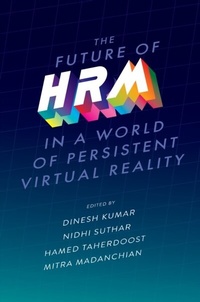
The Future of HRM in a World of Persistent Virtual Reality
1st Edition
Published on 11. March 2025
370 pages
978-1-83662-110-2 (ISBN)
Description

As virtual reality (VR) technology not only redefines the boundaries of human resource management (HRM) but also offers innovative solutions to long-standing challenges in the field, a comprehensive understanding of the transformative impact of VR on HRM is critical now more than ever.
The Future of HRM in a World of Persistent Virtual Reality delves into how the integration of VR technologies is revolutionizing HRM practices, challenging traditional norms, and creating new paradigms for work, employee engagement, training, and recruitment. A timely and essential exploration into the rapidly evolving field of HRM in the context of persistent VR, the chapters within provide insights into current applications and future potential.
Treading new ground by synthesizing interdisciplinary perspectives, including social sciences, technology, psychology, and business studies, offering a holistic view of the subject, The Future of HRM in a World of Persistent Virtual Reality addresses the gap in existing literature by focusing on the practical, ethical, and theoretical implications of VR in HRM, which have not been extensively explored to date.
The Future of HRM in a World of Persistent Virtual Reality delves into how the integration of VR technologies is revolutionizing HRM practices, challenging traditional norms, and creating new paradigms for work, employee engagement, training, and recruitment. A timely and essential exploration into the rapidly evolving field of HRM in the context of persistent VR, the chapters within provide insights into current applications and future potential.
Treading new ground by synthesizing interdisciplinary perspectives, including social sciences, technology, psychology, and business studies, offering a holistic view of the subject, The Future of HRM in a World of Persistent Virtual Reality addresses the gap in existing literature by focusing on the practical, ethical, and theoretical implications of VR in HRM, which have not been extensively explored to date.
More details
Language
English
Place of publication
Bingley
United Kingdom
Target group
Professional and scholarly
ISBN-13
978-1-83662-110-2 (9781836621102)
Copyright in bibliographic data and cover images is held by Nielsen Book Services Limited or by the publishers or by their respective licensors: all rights reserved.
Schweitzer Classification
Other editions
Additional editions
Dinesh Kumar | Nidhi Suthar | Hamed Taherdoost
The Future of HRM in a World of Persistent Virtual Reality
Book
03/2025
Emerald Publishing Limited
€111.50
Shipment within 3-4 weeks
Persons
Dinesh Kumar is a distinguished professional with 17+ years of experience spanning the military, academia, business and charity sectors. He holds a PhD from the Indian Institute of Technology (IIT) Roorkee and received admission offers for the Fellow Program in Management from the Indian Institute of Management (IIM) Ranchi that made him the first soldier in Indian history to secure doctoral admission offers from the prestigious IIT and IIM. He is a former Chief Executive Officer of Pomento and the propounder of the concept of 'Lifestyle Social Work.' Currently, he teaches Analytics at the School of Business, Woxsen University and leads Commercialization and Business Strategy as the Head at AI Research Centre, Woxsen University.
Nidhi Suthar is the Chief Executive Officer of Pomento IT Services. She has seventeen years of experience including industry and academia.
Hamed Taherdoost is an award-winning leader and R&D professional as well as Founder of Hamta Group | Hamta Business Corporation and Associate Professor at University Canada West.
Mitra Madanchian possesses a Ph.D.in Business Management and a Master's in Human Resource Administration, serves as CEO at Hamta Business Corporation, holds a full-time position as Assistant Professor Faculty Member at University Canada West and is a Sessional Faculty member at Fairleigh Dickinson University, USA.
Nidhi Suthar is the Chief Executive Officer of Pomento IT Services. She has seventeen years of experience including industry and academia.
Hamed Taherdoost is an award-winning leader and R&D professional as well as Founder of Hamta Group | Hamta Business Corporation and Associate Professor at University Canada West.
Mitra Madanchian possesses a Ph.D.in Business Management and a Master's in Human Resource Administration, serves as CEO at Hamta Business Corporation, holds a full-time position as Assistant Professor Faculty Member at University Canada West and is a Sessional Faculty member at Fairleigh Dickinson University, USA.
Content
Part 1. Foundations of VR in HRM
Chapter 1. Theoretical Perspectives on Virtual Reality in HR; Dinesh Kumar
Chapter 2. How Virtual Reality Can Enhance Human Resource Management: A Strategic Road Map; Mitra Madanchian, Tuan-Vinh Le, and Hamed Taherdoost
Chapter 3. Leveraging the Metaverse for Inclusive Workplaces: Opening the Research Agenda; Ujjal Mukherjee, Bhavana Raj, and Drishti Arora
Chapter 4. A Deep Understanding of Virtual Reality's Role in Human Resource Management, with A Specific Focus on Recruitment; Pinnika Syam Yadav, P.B. Narendra Kiran, Rajesh Vemula, Preeti Kumari, and Raghvi Wazir
Part 2. Strategies and Applications
Chapter 5. Enhancing HRM with VR: Strategies for Effective Integration; Evangeline E.T.
Chapter 6. Exploring the Dynamics of Virtual Reality and Employee Wellbeing: Addressing the Motherhood Penalty; Saba N. Reshi and Mohd Rafiq Teli
Chapter 7. Exploring the Synergies of Artificial Intelligence in Virtual Reality-Based HR Practices: Augmentations and Implications; Rickard Enstroem and Bhawna Swami
Part 3. Cultural and Ethical Dimensions
Chapter 8. Virtual Horizons: Navigating Legal and Ethical Frontiers in HR Virtual Reality Technology; Sadhna Chauhan and Vinod Kumar
Chapter 9. Building Culturally Intelligent Teams in VR Environments; Aaliya Ashraf and Nancy Sahni
Chapter 10. Exploring the Intersection of Virtual Reality and Workplace Spirituality: A Human Resource Intervention to Improve Individual Effectiveness; Akashdeep Joshi, Dinesh Kumar, and Shabnam Bhagat
Part 4. Future Directions and Innovations
Chapter 11. Unveiling the Pillars of Soft Skills in the Realm of Virtual Academic Entrepreneurship and its Symbiotic Bond with Virtual Transformation; Aayushi Pandey, Shivani Dhand, Mehnaz Manzoor, Priyanka Chibber, and Kiran Thakur
Chapter 12. A Virtual Onboarding: Crafting Immersive Introduction Experiences for New Hires; Gagandeep Singh, Jasdeep Singh Walia, and Avtar Singh
Chapter 13. VR Digitized HRM; Ravishka Weerasinghe
Chapter 1. Theoretical Perspectives on Virtual Reality in HR; Dinesh Kumar
Chapter 2. How Virtual Reality Can Enhance Human Resource Management: A Strategic Road Map; Mitra Madanchian, Tuan-Vinh Le, and Hamed Taherdoost
Chapter 3. Leveraging the Metaverse for Inclusive Workplaces: Opening the Research Agenda; Ujjal Mukherjee, Bhavana Raj, and Drishti Arora
Chapter 4. A Deep Understanding of Virtual Reality's Role in Human Resource Management, with A Specific Focus on Recruitment; Pinnika Syam Yadav, P.B. Narendra Kiran, Rajesh Vemula, Preeti Kumari, and Raghvi Wazir
Part 2. Strategies and Applications
Chapter 5. Enhancing HRM with VR: Strategies for Effective Integration; Evangeline E.T.
Chapter 6. Exploring the Dynamics of Virtual Reality and Employee Wellbeing: Addressing the Motherhood Penalty; Saba N. Reshi and Mohd Rafiq Teli
Chapter 7. Exploring the Synergies of Artificial Intelligence in Virtual Reality-Based HR Practices: Augmentations and Implications; Rickard Enstroem and Bhawna Swami
Part 3. Cultural and Ethical Dimensions
Chapter 8. Virtual Horizons: Navigating Legal and Ethical Frontiers in HR Virtual Reality Technology; Sadhna Chauhan and Vinod Kumar
Chapter 9. Building Culturally Intelligent Teams in VR Environments; Aaliya Ashraf and Nancy Sahni
Chapter 10. Exploring the Intersection of Virtual Reality and Workplace Spirituality: A Human Resource Intervention to Improve Individual Effectiveness; Akashdeep Joshi, Dinesh Kumar, and Shabnam Bhagat
Part 4. Future Directions and Innovations
Chapter 11. Unveiling the Pillars of Soft Skills in the Realm of Virtual Academic Entrepreneurship and its Symbiotic Bond with Virtual Transformation; Aayushi Pandey, Shivani Dhand, Mehnaz Manzoor, Priyanka Chibber, and Kiran Thakur
Chapter 12. A Virtual Onboarding: Crafting Immersive Introduction Experiences for New Hires; Gagandeep Singh, Jasdeep Singh Walia, and Avtar Singh
Chapter 13. VR Digitized HRM; Ravishka Weerasinghe
