

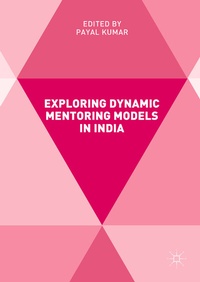
Exploring Dynamic Mentoring Models in India
Description

This edited collection explores the variations of mentoring in India in comparison to western models, providing rich contextual interpretation and paving the way for a greater understanding of mentoring as a phenomenon. With India having the world's largest youth population, its longstanding mentoring tradition is increasingly being replaced by emerging mentoring models in which younger generations are constantly exposed to both Indian and western influences. Paying particular attention to formal and informal mentoring models, the contributions cover the corporate sector, higher education, the developmental sector and venture capitalist-enabled entrepreneurial mentoring. Offering a uniquely non-western perspective, this innovative study also showcases both mentor and protégé perceptions of mentoring, and will be of great appeal to both practitioners and scholars of leadership.
Reviews / Votes
"Although mentoring is a universal relationship, we know little about cultural variations in its processes and outcomes. Addressing this gap, this volume offers important and needed insights on mentoring in India and will be a key resource for scholars and practitioners." (Belle Rose Ragins, Professor, University of Wisconsin-Milwaukee, USA and Editor of Academy of Management Review)"Can the observed correlational or cause-effect relationships that make up the mentoring literature be generalised beyond low power distance western cultures? It is to this classic problem of external validity that this fine new text makes its contribution. And what better way to explore this critical question than to study mentoring in the high power distance context of the Indian workforce. This is an important new book for all scholars of the mentoring process." (G. F Dreher, Professor, Kelly School of Business, USA)
More details
Other editions
Additional editions
Person
Payal Kumar is an independent scholar with rich experience in senior leadership positions in both higher education and the corporate sector, including former Registrar and Professor at a North Indian university. Payal has published widely on topics including gender, diversity and leadership. She is the series editor of Palgrave Studies in Leadership and Followership and sits on the editorial board of several reputed journals. The topic of her thesis for the Fellow Management Programme, XLRI, India, was Personality Incongruence in the Mentoring Dyad and Its Impact on the Protégé.
