

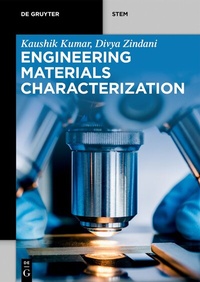
Engineering Materials Characterization
Description

Materials Science today is the base for all technological and industrial developments. The book provides the understanding of the advanced spectroscopic and microscopic instruments used for material characterization. The main issues addressed are 1) a detailed understanding of the instrument, including working and handling, 2) sample preparation, and 3) data analysis and interpretation.
The book is divided in two parts i.e., Part A discusses microscopic instruments, consisting of Optical Microscope, Scanning Electron Microscopy, Atomic Force Microscopy, Field Emission Scanning Electron Microscope and X-Ray Diffraction. Part B is on spectroscopic instruments and covers FTIR Spectrometer, Raman Spectrometer, X-ray Photoelectron Spectroscopy, Ultraviolet Photoelectron Spectroscopy, Fluorescence Spectroscopy, and Nuclear Magnetic Resonance Spectroscopy.
More details
Other editions
Additional editions
Persons
Dr. Kaushik Kumar, B.Tech (Mechanical Engineering, REC (Now NIT), Warangal), MBA (Marketing, IGNOU) and Ph.D (Engineering, Jadavpur University), is presently an Associate Professor in the Department of Mechanical Engineering, Birla Institute of Technology, Mesra, Ranchi, India. He has 20 years of Teaching & Research and over 11 years of industrial experience in a manufacturing unit of Global repute. His areas of teaching and research interest are Composites, Optimization, Non-conventional machining, CAD / CAM, Rapid Prototyping and Quality Management Systems. He has 14 Patents, 60+ Books, 30+ Edited Book Volume, 65+ Book Chapters, 180+ International Journal, 21 International and 1 National Conference Publications to his credit. He is on the editorial board and review panel of many International and National Journals of repute. He has been felicitated with many awards and honours.
Dr. Divya Zindani, BE (Mechanical Engineering, Rajasthan Technical University, Kota), M.E. (Design of Mechanical Equipment, BIT Mesra), and Ph.D. (Mechanical Engineering, National Institute of Technology, Silchar), is presently an Assistant Professor in the Department of Mechanical Engineering, Sri Sivasubramaniya Nadar College of Engineering, Kalavakkam, Tamil Nadu, India. He has over 2 years of Industrial experience. His areas of interests are Optimization, Product and Process Design, CAD/CAM/CAE and rapid prototyping. He has 6 Patents, 7 Authored Books, 7 Edited Book, 20 Book Chapters and 20 international Journal publications to his credit. He has been felicitated with awards.
Content
Chapter 1: Optical Microscope
Introduction
Instrumental Details
Working And Handling of Instruments
Sample Preparation
Imaging Analysis and Interpretation.
Chapter 2: Scanning Electron Microscopy
Introduction
Instrumental Details
Working And Handling of Instruments
Sample Preparation
Imaging Analysis and Interpretation.
Chapter 3: Atomic Force Microscopy
Introduction
Instrumental Details
Working And Handling of Instruments
Sample Preparation
Imaging Analysis and Interpretation.
Chapter 4: Scanning Probe Microscopy
Introduction
Instrumental Details
Working And Handling of Instruments
Sample Preparation
Imaging Analysis and Interpretation.
Chapter 5: X-Ray Diffraction.
Introduction
Instrumental Details
Working And Handling of Instruments
Sample Preparation
Imaging Analysis and Interpretation.
PART B SPECTROSCOPIC CHARACTERIZATION
Chapter 1: FTIR Spectrometer
Introduction
Instrumental Details
Working And Handling of Instruments
Sample Preparation
Data Analysis and Interpretation.
Chapter 2: Raman Spectrometer
Introduction
Instrumental Details
Working And Handling of Instruments
Sample Preparation
Data Analysis and Interpretation.
Chapter 3: X-ray Photoelectron Spectroscopy
Introduction
Instrumental Details
Working And Handling of Instruments
Sample Preparation
Data Analysis and Interpretation.
Chapter 4: Ultraviolet Photoelectron Spectroscopy
Introduction
Instrumental Details
Working And Handling of Instruments
Sample Preparation
Data Analysis and Interpretation.
Chapter 5: Fluorescence Spectroscopy
Introduction
Instrumental Details
Working And Handling of Instruments
Sample Preparation
Data Analysis and Interpretation.
Chapter 6: Nuclear Magnetic Resonance Spectroscopy
Introduction
Instrumental Details
Working And Handling of Instruments
Sample Preparation
Data Analysis and Interpretation.
