

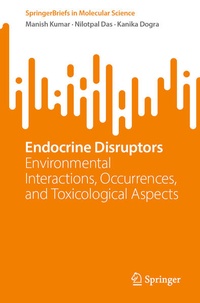
Endocrine Disruptors
Description

This book provides a concise yet comprehensive overview of endocrine-disrupting chemicals (EDCs), examining their sources, classification, and mechanisms of action. It explores the global distribution of EDCs across air, water, soil, and living systems, their toxicological effects, and the growing concern of the "cocktail effect", i.e., the combined impact of multiple contaminants on human health and ecosystems.
The chapters cover key topics including exposure pathways, environmental fate, and interactions with other pollutants, as well as advances in detection methods, remediation technologies, and regulatory frameworks worldwide. The book also highlights evidence-based strategies for mitigating EDC contamination and shaping effective environmental policies.
Designed for researchers, academics, policymakers, and professionals in environmental science, toxicology, and public health, this resource bridges cutting-edge research with practical applications. It equips readers with practical strategies for detecting and managing EDCs effectively.
More details
Other editions
Additional editions
Persons
Manish Kumar is a Distinguished Professor at the Tecnológico de Monterrey, Mexico & Institute Professor at Chuo University Japan as well as UPES, India. Previously, he was director of the Sustainability Cluster in the School of Advanced Engineering at UPES, Dehradun, India. With a Ph.D. in Environmental Engineering from the University of Tokyo, Japan, and a Fellow of the Royal Society of Chemistry, he has authored 250+ articles, 50+ book chapters, and 15+ books, ranking among the top 2% scientists globally. His research spans wastewater epidemiology, climate change, and sustainable water management. He led the first detection of SARS-CoV-2 in Indian wastewater and serves on editorial boards of leading journals.
Nilotpal Das is currently working as the Chief Technical Officer at ENCORE Insoltech Consulting, India. Previously he has worked guest faculty in the Tezpur Central University and the Royal Global University from India and was also a National Post-doctoral fellow under the Department of Science and Technology (under Government of India). Dr. Das specializes in hydrochemistry, emerging contaminants, and PFAS research. He has published 14 papers, 5+ book chapters, and reviews for top environmental journals.
Kanika Dogra is a research scholar at the Sustainability Cluster, School of Advanced Engineering, UPES, India. Her research focuses on emerging contaminants, with a particular emphasis on interaction of microplastics, per- and polyfluoroalkyl substances (PFAS), and endocrine-disrupting compounds (EDCs). She holds an M.Tech in Agricultural Water Management, has published five papers, and participated in Japan's Sakura Science Program on renewable energy and carbon neutrality.
Content
Understanding Endocrine Disrupting Chemicals: Origins, Types, and Environmental Implications.- Global Occurrence and Guidelines of Endocrine-Disrupting Chemicals.- Exposure, Metabolism, and Toxicity of Endocrine Disrupting Chemicals.- Interactions, Degradation, and Removal of Endocrine-Disrupting Chemicals.
