

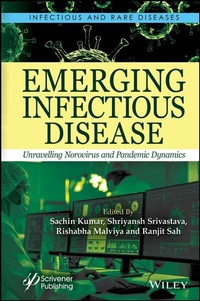
Emerging Infectious Diseases
Description

Equip yourself to preempt the next global health disaster by mastering the cutting-edge molecular insights and One Health frameworks essential for decoding norovirus's genetic complexity and pandemic potential.
Recently, there has been a global surge in infectious diseases, including norovirus, which is responsible for millions of gastroenteritis cases annually. Despite its tremendous impact, studying norovirus has been difficult due to its discrete nature, genetic complexity, and limited in vitro replication. However, recent advances in virology, epidemiology, and molecular biology have offered more information about norovirus dynamics and its pandemic potential. This book provides an in-depth discussion of norovirus, a major contributor to global gastroenteritis outbreaks, and its deeper implications for pandemic research. To provide useful insights into norovirus control, prevention, and future challenges, the book explores virology, transmission dynamics, environmental factors, and state-of-the-art research. With emphasis on the crucial role of norovirus in gastroenteritis outbreaks and its genetic makeup in determining its pathogenicity and epidemiology, the book presents an explanation of viral storms and their effects on world health. The book includes a thorough analysis of zoonotic transmission mechanisms, environmental factors including temperature and rainfall, and the public health implications of these elements. To reduce norovirus risks, the book also covers the genetic evolution of the virus and the integration of the One Health concept, which bridges the gaps between environmental, animal, and human health.
Readers will find the volume:
- Focuses on Norovirus, providing an in-depth examination of its characteristics, transmission, and impact on human health;
- Explores the complex interactions between viruses, human hosts, and environmental factors that contribute to viral spread and pandemic dynamics;
- Offers a scientific yet narrative-driven approach to understanding infectious diseases, blending rigorous research with engaging storytelling;
- Examines the broader context of viral outbreaks, tracing the journey of viruses from microscopic interactions to global public health challenges;
- Provides insights into the mechanisms of viral transmission, outbreaks' origins, and current prevention and control strategies.
Audience
Public health professionals, medical researchers, epidemiologists, healthcare workers, and academics in microbiology, virology, and infectious disease studies seeking a comprehensive understanding of viral dynamics.
More details
Other editions
Additional editions
Persons
Sachin Kumar, PhD is an Assistant Professor in the Department of Pharmacology, Delhi Pharmaceutical Sciences and Research University, New Delhi, India. He has published more than 60 peer-reviewed papers in national and international journals and six book chapters. His research interests include diagnosis, biomarkers, meta-analysis, and pharmacoeconomic analysis.
Shriyansh Srivastava is a PhD Research Scholar in the Department of Pharmacology at Delhi Pharmaceutical Sciences and Research University, New Delhi India. He has published more than 60 research articles in prestigious international journals, ten book chapters, five books, and two patents.
Rishabha Malviya, PhD is an Associate Professor in the Department of Pharmacy in the School of Medical and Allied Sciences at Galgotias University, Greater Noida, India, with more than 13 years of experience. He has authored more than 150 research papers for national and international journals of repute, 102 books, and 51 patents. His areas of interest include formulation optimization, nanoformulation, targeted drug delivery, localized drug delivery, and characterization of natural polymers as pharmaceutical excipients.
Ranjit Sah, MD is a Research Coordinator at BMC South, Boston Medical Centre Health System, MA, USA. He has made significant contributions to research and clinical practice, notably as the Head of COVID-19 testing facilities in Nepal during the pandemic.
Content
Preface xxi
Part 1: Introduction and Genetic Insights 1
1 Introduction to Viral Storms: Infectious Disease 3
Shivaprasad Sirimalla, Sanjit Sah, Uday Venkat Mateti and Allen Pinto
1.1 Introduction to Infectious Disease 4
1.2 Virology: Overview of Virus, Virus Structure, Classification, Replication, and Transmission 6
1.3 Viral Storms (Major Pandemics) 17
1.4 Factors Contributing to Viral Storms 21
1.5 Norovirus 25
1.6 Summary of Key Points 29
1.7 Conclusion 30
2 Norovirus: Its Role in Gastroenteritis Outbreaks 39
Ranjana Rohilla and Shriyansh Srivastava
2.1 Infectious Etiology of Gastroenteritis 40
2.2 Introduction to Norovirus Gastroenteritis 41
2.3 History of Norovirus and Outbreaks 42
2.4 Epidemiology and Common Settings of Norovirus Outbreaks 44
2.5 Clinical Features 48
2.6 Gastroenteritis in Immunocompromised Individuals 49
2.7 Gastroenteritis in Immunocompetent Individuals 50
2.8 Economic Burden of Infection 51
2.9 Preparedness for Outbreaks 51
2.10 Conclusion 52
3 The Genetics of Norovirus: Understanding Its Genome and Genogroups 61
Naga Rani Kagithala, Rahul Sharma, Sasikanth Kothamasu, Shriyansh Srivastava and Ismail A. Ibrahim
3.1 Introduction 62
3.2 Norovirus Genome 64
3.3 Genetic Diversity in Norovirus 66
3.4 Norovirus Genogroups 71
3.5 Molecular Techniques for Norovirus Genetic Analysis 75\
3.6 Implications of Norovirus Genetic Variability 82
3.7 Recent Advances in Norovirus Genetics 85
3.8 Conclusion 87
4 Environmental Factors in Norovirus Outbreaks: Temperature and Rainfall 99
Neeraj Kumar, Akanksha, Shriyansh Srivastava and Mohd Mujeeb
4.1 Introduction 100
4.2 Evolution of Norovirus 103
4.3 Fatal Details Regarding the Norovirus 105
4.4 Mode of Transmission of Norovirus 106
4.5 Correlation Between Temperature Fluctuations and Outbreaks 109
4.6 Effect of Norovirus on Humidity 110
4.7 The Impact of Rainfall on the Spread of the Norovirus 110
4.8 The Impact of Water on the Spread of the Norovirus 111
4.9 Norovirus Combined Effects of Temperature and Rainfall 112
4.10 Stability of Norovirus 112
4.11 Case Study 113
4.12 Global Patterns in Temperature- and Rainfall-Related Outbreaks 120
4.13 Mitigation Strategies and Public Health Interventions 121
4.14 Conclusion 123
5 Zoonotic Transmission of Norovirus: Current Understanding and Future Implications 129
Vini Mehta, Sapna Negi, Snehasish Tripathy, Sarvesh Rastogi and Ankita Mathur
5.1 Brief Overview of Norovirus 130
5.2 Epidemiology of Norovirus 131
5.3 Symptoms of Norovirus-Associated Gastroenteritis 132
5.4 Mode of Transmission of Norovirus 132
5.5 Zoonotic Transmission 134
5.6 Zoonotic Transmission Mechanisms of Norovirus 139
5.7 Zoonotic Transmission Mechanism 141
5.8 Future Implications and Research Directions 142
5.9 Conclusion 143
Part 2: Transmission, Dynamics and Environmental Impacts 151
6 Genetic Changes in Norovirus and Their Impact on Infectivity/Virulence 153
Soumya Patil, Vijayalaxmi Bangra Manjeshwara, Uday Venkat Mateti and Raushan Kumar Chaudhary
6.1 Introduction 154
6.2 Classification of NoV 155
6.3 Genomic Structure and Functions 156
6.4 NoV Life Cycle: Molecular Mechanism of NoV Genome Replication 159
6.5 Transmission 161
6.6 Molecular Diversity 162
6.7 Evolutionary Mechanisms and Dominance 163
6.8 Recent Epidemiological Trends 170
6.9 Global Impact and Challenges 174
6.10 Conclusion 176
7 Bridging the Gap: One Health Approach in Norovirus 187
Sasikanth Kothamasu, Naga Rani Kagithala, Dheeraj Sharma, Shriyansh Srivastava, Aroop Mohanty and Rakesh Sahu
7.1 Overview of Norovirus: Structure and Epidemiology 188
7.2 Understanding the One Health Approach 190
7.3 Transmission Pathways of Norovirus 194
7.4 Epidemiology of Norovirus: A Global Perspective 196
7.5 The One Health Approach to Norovirus Surveillance 198\
7.6 Prevention and Control Strategies 200
7.7 Interdisciplinary Collaboration in One Health 202
7.8 Case Studies: One Health Success Stories 205
7.9 Future Directions in Norovirus Research and Control 207
7.10 Conclusion 208
8 Recent Insights into the Dynamics of Norovirus Outbreak 221
Sejal Porwal, Sonali Sundram, Rishabha Malviya and Shriyansh Srivastava
8.1 Introduction 222
8.2 Symptoms Related to Norovirus 223
8.3 Epidemiology of Norovirus Outbreak 225
8.4 Norovirus Genome and Structure 226
8.5 Virion Morphology 227
8.6 Transmission Mechanism 227
8.7 Administration of Pharmaceuticals and Challenges in Vaccination 230
8.8 Immunity to Norovirus Infection 233
8.9 Public Health Measures to Avoid Being Infected with Norovirus 235
8.10 Conclusion 236
9 Norovirus Excretion Patterns and their Role in Spread 249
Cynthia Lizzie Lobo, Soumya Patil, Raushan Kumar Chaudhary and Pukar Khanal
9.1 Introduction 250
9.2 Routes of Norovirus Excretion 251
9.3 Duration of Noroviral Shedding 255
9.4 Quantitative Analysis of Noroviral Load 258
9.5 Transmission Modes of Norovirus 261
9.6 Role of Excretion Patterns in Norovirus Spread 264
9.7 Public Health Implications of Excretion Patterns 266
9.8 Research Gaps and Future Directions 267
10 The Role of Rainfall in the Control of Norovirus Outbreaks 275
Sandhya Chaudhary, Rahul Kumar, Kalpana Rahate, Shriyansh Srivastava and Sathvik Belagodu Sridhar
10.1 Introduction 276
10.2 Characteristics of Norovirus 276
10.3 Possible Environmental Markers for Outbreaks of the Human Norovirus 281
10.4 Relationship Between Rainfall and Norovirus Outbreaks 283
10.5 Public Health and Infrastructure Challenges 284
10.6 Prevention and Mitigation Strategies 285
10.7 Future Directions and Research Needs 287
10.8 Conclusion 288
11 The Impact of COVID-19 on Norovirus Circulation and Research 295
Laxmi, Shriyansh Srivastava, Sanjita Das, Malakapogu Ravindra Babu, Rishabha Malviya and S.K. Abdul Rahaman
11.1 Introduction 296
11.2 Norovirus: Characteristics and Epidemiology 297
11.3 The COVID-19 Pandemic: An Overview 302
11.4 Effects of COVID-19 on Norovirus Circulation 304
11.5 Research Trends and Findings 306
11.6 Public Health Implications 312
Part 3: Cross-Species Studies and Therapeutic Development 327
12 Norovirus in Animals: Bovine, Murine, and Other Hosts 329
Aritra Banerjee, K.V. Leela, Shriyansh Srivastava, Pranav Gupta, Malakapogu Ravindra Babu and Ranjit Sah
12.1 Introduction 330
12.2 Genomic Organization and Virus 331
12.3 Interactions Between Viruses and Cells 332
12.4 Norovirus in Bovines 333
12.5 Bovine Norovirus Distribution 334
12.6 The Pathophysiology and Clinical Characteristics of Bovine Norovirus 335
12.7 Diagnosis of the Bovine Norovirus 337
12.8 Norovirus in Murine 338
12.9 Porcine Norovirus 341
12.10 In Lions, Norovirus 342
12.11 Conclusion 343
13 The Challenges of Developing Norovirus Vaccines and Therapies 359
Gita Chawla, Tathagata Pradhan and Ojasvi Gupta
13.1 Overview of Norovirus Epidemiology 359
13.2 Classification and Molecular Biology of Norovirus 361
13.3 Current Approaches to Norovirus Therapy 363
13.4 Challenges in Norovirus Vaccine Development 369
13.5 Conclusion and Future Perspectives 374
14 The Importance of Animal Models and In Vitro Cultivation for Norovirus Research 379
Prarambh S.R. Dwivedi, Masmarika Mohan, Pukar Khanal, Sanjit Sah and C.S. Shastry
14.1 Introduction 380
14.2 Importance of Animal and Cell Culture Models for Human Norovirus 381
14.3 Animal Models of HuNoV Infection 383
14.4 Advancement of In Vitro Models for Norovirus 393
14.5 Conclusion 402
15 The Role of Human Intestinal Enteroids in Norovirus Research 413
Apeksha Shetty, Anushree Deshpande, Raushan Kumar Chaudhary and Prakash Patil
15.1 Introduction to Human Intestinal Enteroids (HIEs) 414
15.2 Components Required for Norovirus Activation 419
15.3 Pathophysiology of Norovirus Infection 425
15.4 Norovirus Cell Tropism 430
15.5 Role of Additional Gastrointestinal Components in Norovirus Infection 432
15.6 Antiviral Compound Screening Using HIEs 435
15.7 Future Perspectives 438
15.8 Conclusion 439
Abbreviations 439
References 440
Index 447
1
Introduction to Viral Storms: Infectious Disease
Shivaprasad Sirimalla1, Sanjit Sah2,3,4, Uday Venkat Mateti1* and Allen Pinto1
1Department of Pharmacy Practice, NGSM Institute of Pharmaceutical Sciences (NGSMIPS), Nitte (Deemed to be University), Mangalore, Karnataka, India
2Department of Pediatrics, Dr. D. Y. Patil Medical College, Hospital and Research Centre, Dr. D. Y. Patil Vidyapeeth (Deemed-to-be-University), Pimpri, Pune, Maharashtra, India
3Department of Public Health Dentistry, Dr. D.Y. Patil Dental College and Hospital, Dr. D.Y. Patil Vidyapeeth (Deemed-to-be-University), Pune, Maharashtra, India
4Department of Medicine, Korea University, Seoul, South Korea
Abstract
Infectious diseases, caused by pathogenic microorganisms including bacteria, viruses, and fungi, continue to present significant challenges to global health. The emergence of highly virulent viruses in the twenty-first century has resulted in pandemics that have profoundly affected humans worldwide. Major pandemics and epidemics such as H1N1 influenza, severe acute respiratory syndrome, human immunodeficiency virus, and coronavirus disease have already afflicted humanity. Several factors contribute to the emergence and spread of these viral outbreaks, including environmental changes, urbanization, global travel, and biological factors such as viral mutations and host immune responses. For many infections, geographical and seasonal patterns are inherently linked to the climate, raising the possibility of using climate parameters as predictive indicators in disease early warning systems (EWS). Norovirus infection, a significant global problem, shows predictable seasonality, with activity peaks during the winter seasons and in cold-temperature places. The primary step to prevent the spread of infectious diseases is the early identification of diseases and following effective interventions to control the diseases, resulting in reduction of mortality and morbidity. Using climate parameters and EWS is effective in predicting the diseases and can prevent the huge spread of transmission of a disease. Public health measures such as isolating, quarantining, and controlling the border had helped in past events to control the disease spread and it maintained social structure. Analyzing the past events and current examples provides great understanding of different aspects of viral storms; it may help to combat future pandemics in terms of prevention and management.
Keywords: Infectious diseases, viral pandemics, norovirus, climate change, viral transmission, global health
1.1 Introduction to Infectious Disease
Infectious diseases have been a continuously major health concern in human history, which caused various pandemics that impacted human population in various ways such as the economy. There are various pathogens that cause these infectious diseases such as parasites, fungus, viruses, and bacteria, leading to continuous damage to human health globally. Research in the field of infectious disease explored the infection mechanism, host-pathogen interaction, disease spread, and prevention and control of disease. It is very essential to understand completely the dynamics of an infectious disease that changes in response to environment, social, and biological factors [1-3].
Infectious diseases can happen in a large range of severity such as mild and self-limiting, i.e., common cold. Some other infections can cause severe and life-threatening situations such as sepsis. Cytokine storm is one of the severe manifestations of infectious diseases. It is a huge and uncontrolled immune response of the host after an infection. The host's immune system releases a large amount of cytokines into the blood stream that causes inflammation and damage to the tissue and finally leads to organ failure. This unusual situation happens in severe infections such as COVID-19, influenza, etc., giving importance to the host's immune response in combating infections [4-6].
Infectious diseases significantly impacted global health and accounts for a considerable number of morbidity and mortality. It was much more in low- and middle-income countries which are having limited access to healthcare. Infectious diseases also burden the economic and social domains, saturating the healthcare system, causing financial collapse, and worsening social inequalities [7, 8].
Research has made significant progress and contributions in fighting infectious diseases. In the past, diseases like polio, smallpox, and measles were prevented by the invention of vaccines, which has been the most profound advancement and thereby saving millions of lives. The invention of antibiotics and its wide usage made new revolution for bacterial infection and thereby reduced significant mortality rates. Likewise, invention by the use of antiviral drugs has made transformations on the management of viral infections like HIV/AIDS and hepatitis. The medical advancement has significantly decreased the burden on countries caused by the infectious diseases, and this leads to improved quality of life and improved human lifespan [9, 10].
Nevertheless, the combat against infectious diseases is not yet finished. As the new emergence of infectious diseases arises, such as novel coronavirus like SARS-CoV-2 that causes COVID-19, it is still a problem to the health of mankind. The emergence of new diseases is due to various factors such as interaction of humans with wild animals, leading to zoonotic spillover in which deadly pathogens transfer from animals to humans. This event happens due to several factors like increased human-animal interaction, deforestation, and climate change. In most parts of the world, deadly old pathogens like tuberculosis and measles which are under control are again re-emerging as new mutant forms of viruses along with new infectious diseases [11, 12].
Along with newly emerging viruses, antimicrobial resistance (AMR) is another challenge to fight against infectious diseases. Misuse and overuse of antibiotics, antivirals, and antifungals have happened over a period of time, and these lead to the development of drug-resistant strains of these pathogenic microorganisms. AMR has been the major obstacle in fighting the infectious diseases. This may lead to problems in fighting very common infectious diseases and become untreatable, and thus small surgical infections and minor infections can become severe and life-threatening [13, 14].
Viruses face a variety of challenges in the process of emergence of infectious diseases. Viruses require a host's cells to grow, replicate, and transmit. They cannot live and reproduce outside of the hosts, and this nature of replication is different from other pathogenic microorganisms like bacteria. This nature of dependence of viruses leads to frequent mutations to sustain the host's response to a virus, and this causes the frequent emergence of new strains. For example, influenza virus goes through several genetic mutations and leads to seasonal outbreaks and sometimes pandemics whenever a new strain comes. Likewise, SARS-CoV 2 virus showed several mutations in the RNA genome, and it leads to the emergence of new variants showing their new virulent effects [15].
The spread of infectious diseases is based on several interconnected factors including human nature, climate changes, and a variety of characteristics of pathogenic microorganisms. There are several human nature or behavior, including urbanization, global travel, and population density, causing the greater transmission of virus across the globe. Likewise, climate changes causes the transmission of vector-borne diseases like malaria and dengue. Thus, it is very essential to consider these factors to prevent and manage infectious diseases effectively [3].
After the huge development of research and science, infectious diseases are still a major challenge in human health. Complete surveillance on public health and research in the field of infectious diseases still need to be developed and conducted as there is the emergence of new pathogenic microorganisms in the world, emergence of frequent mutant viruses, and increased AMR. Considering all of the factors like how a new infectious disease emerge and spreads along with understanding the pathogenic microorganisms and through a comprehensive, multidisciplinary approach can make us understand, manage, and prevent the disease effectively, and thereby it can decrease the disease impact on public health globally.
1.2 Virology: Overview of Virus, Virus Structure, Classification, Replication, and Transmission
1.2.1 Overview of the Virus
Viruses are acellular pathogenic microorganisms that cause infectious diseases. Unlike other pathogenic agents such as bacteria, fungi, etc., viruses require a host cell to survive, replicate, and transmit disease, as they lack a proper cellular mechanism to perform metabolic function on their own to replicate and spread the diseases. It will proliferate by taking access of the host's cell through infection [16, 17].
Basically, every virus has a genetic material, i.e., either DNA or RNA, to replicate into viral particles inside the host's cell. Since viruses are acellular, the genetic material will be enveloped inside the protein case called capsid. In certain conditions, the virus additionally enveloped inside the lipid case which is generally derived from the host's cell. The envelop is usually arranged with...
