

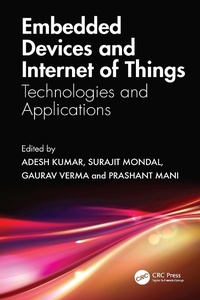
Embedded Devices and Internet of Things
Technologies, and Applications
1st Edition
Published on 11. September 2024
360 pages
978-1-040-11391-2 (ISBN)
Description

The text comprehensively discusses machine-to-machine communication in real-time, low-power system design and estimation using field programmable gate arrays, PID, hardware, accelerators, and software integration for service applications. It further covers the recent advances in embedded computing and IoT for healthcare systems. The text explains the use of low-power devices such as microcontrollers in executing deep neural networks, and other machine learning techniques.
This book:
Discusses the embedded system software and hardware methodologies for system-on-chip and FPGA
Illustrates low-power embedded applications, AI-based system design, PID control design, and CNN hardware design
Highlights the integration of advanced 5G communication technologies with embedded systems
Explains weather prediction modeling, embedded machine learning, and RTOS
Highlights the significance of machine-learning techniques on the Internet of Things (IoT), real-time embedded system design, communication, and healthcare applications, and provides insights on IoT applications in education, fault attacks, security concerns, AI integration, banking, blockchain, intelligent tutoring systems, and smart technologies
It is primarily written for senior undergraduates, graduate students, and academic researchers in the fields of electrical engineering, electronics and communications engineering, and computer engineering.
This book:
Discusses the embedded system software and hardware methodologies for system-on-chip and FPGA
Illustrates low-power embedded applications, AI-based system design, PID control design, and CNN hardware design
Highlights the integration of advanced 5G communication technologies with embedded systems
Explains weather prediction modeling, embedded machine learning, and RTOS
Highlights the significance of machine-learning techniques on the Internet of Things (IoT), real-time embedded system design, communication, and healthcare applications, and provides insights on IoT applications in education, fault attacks, security concerns, AI integration, banking, blockchain, intelligent tutoring systems, and smart technologies
It is primarily written for senior undergraduates, graduate students, and academic researchers in the fields of electrical engineering, electronics and communications engineering, and computer engineering.
More details
Edition
1. Auflage
Language
English
Place of publication
London
United Kingdom
Publishing group
Taylor & Francis Ltd
Target group
College/higher education
Professional and scholarly
Illustrations
27 Tables, black and white; 81 Line drawings, black and white; 46 Halftones, black and white; 127 Illustrations, black and white
ISBN-13
978-1-040-11391-2 (9781040113912)
Copyright in bibliographic data and cover images is held by Nielsen Book Services Limited or by the publishers or by their respective licensors: all rights reserved.
Schweitzer Classification
Other editions
Additional editions
Adesh Kumar | Surajit Mondal | Gaurav Verma
Embedded Devices and Internet of Things
Technologies, and Applications
Book
approx. 07/2026
1st Edition
CRC Press
€80.50
Not yet published
Adesh Kumar | Surajit Mondal | Gaurav Verma
Embedded Devices and Internet of Things
Technologies, and Applications
Book
09/2024
1st Edition
CRC Press
€241.70
Shipment within 10-20 days

Adesh Kumar | Surajit Mondal | Gaurav Verma
Embedded Devices and Internet of Things
Technologies and Applications
Book
09/2024
CRC Press
Unfortunately, price unknown
Available (delivery time upon request)
Persons
Adesh Kumar is a Professor with the Department of Electrical & Electronics, Engineering, School of Advanced Engineering, UPES, Dehradun, India. He earned a BTech in electronics and communication engineering from Uttar Pradesh Technical University Lucknow, India, in 2006; an MTech (Hons) in embedded systems technology, from SRM University, Chennai, in 2008; and a PhD in electronics engineering from the University of Petroleum and Energy Studies (UPES), Dehradun, India, in 2014. He has also worked as a senior engineer in TATA ELXSI Limited Bangalore and a faculty member at ICFAI University, Dehradun, India. His areas of interest are VLSI design, embedded systems design, signal processing, and digital image analysis. He has published more than 100 research papers in international peer-reviewed journals (SCI/Scopus) and conferences (h-index-20, i-10 index-40, citations > 2000). He has contributed as conference secretary to ICICCD-2016 and ICICCD-2017, and editor in ICICCD 2018, 2022, and 2024. He has supervised ten PhD scholars, and five candidates are doing PhD research under his guidance.
Surajit Mondal is an Assistant Professor- Selection Grade with the Department of Electrical & Electronics, Engineering, University of Petroleum and Energy Studies, Dehradun, India. He did his BTech in electrical engineering from Asansol Engineering College, West Bengal, India; MTech in energy systems from UPES, Dehradun, India; and PhD in electrical engineering from the University of Petroleum and Energy Studies (UPES), Dehradun, India, in 2020. His areas of interest are wireless power transformation, renewable energy, waste to energy, alternate energy, ESG, and carbon footprint. He has published more than 35 research papers in international peer-reviewed journals (SCI/Scopus) and conferences, published more than 85 patents (25 granted), and published three books with eminent publishers. He has also handled many government- funded projects as a lead or principal investigator. He received the prestigious Young Scientist award from the DST, Government of India, New Delhi. Three students are pursuing their PhD research under his guidance.
Gaurav Verma earned BTech, MTech, and PhD degrees in electronics and communication engineering in 2005, 2012, and 2018, respectively. He earned his BTech from COER (UP Technical University, Lucknow, India), MTech from IIT Kharagpur, West Bengal, India, and PhD from Jaypee University, Noida, India. In addition, he earned an MBA degree in marketing management from IMT, Ghaziabad, India, in 2008. Since 2013, Verma has been an Associate Professor (senior grade) and head of research group (IoT, embedded, and AI) in the Department of Electronics & Communication Engineering, Jaypee Institute of Information Technology, Sector-62 campus, Noida (UP), India. He started his career as a trainer in VLSI, embedded domain at CIPL, Noida, in 2005, and was promoted to the position of assistant manager. From 2007 to 2013, he served at different engineering colleges in different positions such as DBIT, Dehradun (2007-2008), DIT Dehradun (2008-2010), and VIT, Greater Noida (2012-2013). He has about 15 years of experience in training, teaching, research, and administration. He has multidisciplinary abilities in teaching and training in the latest technologies. His current research focuses on the development of IoT and embedded-based solutions for the benefit of society and power estimation of FPGA implementations using machine learning. He is an active researcher with about 25 publications in reputed SCI and SCOPUS journals and about 40 publications in conferences of IEEE and Springer repute. He has also authored a book on embedded system design for students and published more than five book chapters for Springer. He is a senior member of IEEE and served as a TPC member, session chair, and keynote speaker at reputed conferences in India and abroad. He also serves as a member of the Website and Portal Management Sub-Committee, IEEE UP Section (R-10), India; and as an editor, advisor, and reviewer of several well-known international journals published by IEEE, Taylor & Francis, Springer, and Elsevier. He was also awarded the Best Doctoral Thesis award in RACE-2019 at Kasetsart University, Bangkok, Thailand.
Prashant Mani is an Associate Professor and Principal at the Government Engineering College Aurangabad Bihar, India. He has worked for 14 years in the Department of Electronics & Communication Engineering, SRM University, NCR campus. He holds a PhD in VLSI from the Faculty of Engineering and Technology, SRM University, Chennai, India. The focus of his research is related to nanoscale SOI devices. He has multidiscipline/ cross-disciplined ability in teaching, and he has been teaching both core nanoelectronics engineering subjects, such as, nanoscale devices, microelectronics, VLSI devices and design, VLSI testing, nanotechnology, digital image processing, and real-time and embedded systems. He is the deputy head of Research & Publication, SRM University Campus. He is also the author of several research articles indexed in SCOPUS/SCI journals.
Surajit Mondal is an Assistant Professor- Selection Grade with the Department of Electrical & Electronics, Engineering, University of Petroleum and Energy Studies, Dehradun, India. He did his BTech in electrical engineering from Asansol Engineering College, West Bengal, India; MTech in energy systems from UPES, Dehradun, India; and PhD in electrical engineering from the University of Petroleum and Energy Studies (UPES), Dehradun, India, in 2020. His areas of interest are wireless power transformation, renewable energy, waste to energy, alternate energy, ESG, and carbon footprint. He has published more than 35 research papers in international peer-reviewed journals (SCI/Scopus) and conferences, published more than 85 patents (25 granted), and published three books with eminent publishers. He has also handled many government- funded projects as a lead or principal investigator. He received the prestigious Young Scientist award from the DST, Government of India, New Delhi. Three students are pursuing their PhD research under his guidance.
Gaurav Verma earned BTech, MTech, and PhD degrees in electronics and communication engineering in 2005, 2012, and 2018, respectively. He earned his BTech from COER (UP Technical University, Lucknow, India), MTech from IIT Kharagpur, West Bengal, India, and PhD from Jaypee University, Noida, India. In addition, he earned an MBA degree in marketing management from IMT, Ghaziabad, India, in 2008. Since 2013, Verma has been an Associate Professor (senior grade) and head of research group (IoT, embedded, and AI) in the Department of Electronics & Communication Engineering, Jaypee Institute of Information Technology, Sector-62 campus, Noida (UP), India. He started his career as a trainer in VLSI, embedded domain at CIPL, Noida, in 2005, and was promoted to the position of assistant manager. From 2007 to 2013, he served at different engineering colleges in different positions such as DBIT, Dehradun (2007-2008), DIT Dehradun (2008-2010), and VIT, Greater Noida (2012-2013). He has about 15 years of experience in training, teaching, research, and administration. He has multidisciplinary abilities in teaching and training in the latest technologies. His current research focuses on the development of IoT and embedded-based solutions for the benefit of society and power estimation of FPGA implementations using machine learning. He is an active researcher with about 25 publications in reputed SCI and SCOPUS journals and about 40 publications in conferences of IEEE and Springer repute. He has also authored a book on embedded system design for students and published more than five book chapters for Springer. He is a senior member of IEEE and served as a TPC member, session chair, and keynote speaker at reputed conferences in India and abroad. He also serves as a member of the Website and Portal Management Sub-Committee, IEEE UP Section (R-10), India; and as an editor, advisor, and reviewer of several well-known international journals published by IEEE, Taylor & Francis, Springer, and Elsevier. He was also awarded the Best Doctoral Thesis award in RACE-2019 at Kasetsart University, Bangkok, Thailand.
Prashant Mani is an Associate Professor and Principal at the Government Engineering College Aurangabad Bihar, India. He has worked for 14 years in the Department of Electronics & Communication Engineering, SRM University, NCR campus. He holds a PhD in VLSI from the Faculty of Engineering and Technology, SRM University, Chennai, India. The focus of his research is related to nanoscale SOI devices. He has multidiscipline/ cross-disciplined ability in teaching, and he has been teaching both core nanoelectronics engineering subjects, such as, nanoscale devices, microelectronics, VLSI devices and design, VLSI testing, nanotechnology, digital image processing, and real-time and embedded systems. He is the deputy head of Research & Publication, SRM University Campus. He is also the author of several research articles indexed in SCOPUS/SCI journals.
Content
1. Low Power Embedded System Design Applications using FPGAs. 2. CNN Embedded Hardware Chip Design and Simulation. 3. Imperative Role of Embedded System in Solar Photovoltaic based Stand-alone Applications. 4. PID Embedded Control and DC Motor Behaviour for FPGA-Based Simulation. 5. Design of Rectangular Microstrip Patch Array Antenna at Sub 6 GHz. 6. Weather Prediction Model for Telangana State Using ANN. 7. RTOS and Task-Role Based Access Control Algorithm Using Internet of Things for Health Monitoring and Live Video Streaming of Remote Patients. 8. Role of IoT in Communications. 9. Smart Healthcare System using Machine Learning and IoT: Vaccine Delivery and Monitoring. 10. IoT in Agile Management and Banking Sector. 11. IoT-Powered Training for Employee Potential through Smart Embedded Tools and Technologies. 12. IoT and Blockchain Technology as Transformative Technology. 13. IoT in Schools: Revolutionizing Education through Smart Technology. 14. The efficiency of Blending AI Technology to Enhance Behavior Intention and Critical Thinking in Higher Education. 15. Embedded Machine Learning. 16. Applications of Machine Learning inside Channel and Fault Analysis. 17. Embedding Learning Models with Pedagogy Recommendation in Adaptive Intelligent Tutoring System. 18. Security Issues and Challenges for IIoT in Industry 4.0 Paradigm
