

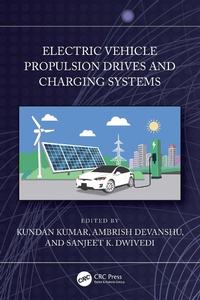
Electric Vehicle Propulsion Drives and Charging Systems
1st Edition
Published on 18. June 2024
336 pages
978-1-040-03250-3 (ISBN)
Description

This book covers the introduction, theory, development, and applications of hybrid and electric vehicles and their charging infrastructures. It also discusses the real applications of power converters and electric drives to give the readers a flavour of how to design propulsion drives and fast charging systems for electric vehicles. It further covers important topics such as static and dynamic wireless charging systems, battery management, and battery swapping systems for electric vehicles.
This book:
Presents comprehensively different types of electric vehicles and their powertrain architecture.
Highlights modern optimization techniques such as genetic algorithms, simulated annealing, particle swarm optimization, and ant colony optimization.
Discusses different charging methods such as wired and wireless for a variety of batteries including lead acid, lithium-ion, and vanadium redox.
Covers grid-to-vehicle, vehicle-to-grid, and vehicle-to-vehicle bidirectional power flow analysis.
Showcases power 2X technologies such as power-to-ammonia, power-to-chemicals, power-to-fuel, power-to-gas, and power-to-hydrogen.
The text is primarily written for senior undergraduate and graduate students as well as academic researchers in the fields of electrical engineering, electronics, and communications engineering.
This book:
Presents comprehensively different types of electric vehicles and their powertrain architecture.
Highlights modern optimization techniques such as genetic algorithms, simulated annealing, particle swarm optimization, and ant colony optimization.
Discusses different charging methods such as wired and wireless for a variety of batteries including lead acid, lithium-ion, and vanadium redox.
Covers grid-to-vehicle, vehicle-to-grid, and vehicle-to-vehicle bidirectional power flow analysis.
Showcases power 2X technologies such as power-to-ammonia, power-to-chemicals, power-to-fuel, power-to-gas, and power-to-hydrogen.
The text is primarily written for senior undergraduate and graduate students as well as academic researchers in the fields of electrical engineering, electronics, and communications engineering.
More details
Edition
1. Auflage
Language
English
Place of publication
London
United Kingdom
Publishing group
Taylor & Francis Ltd
Target group
College/higher education
Professional and scholarly
Product notice
Reflowable
Illustrations
51 Tables, black and white; 245 Line drawings, black and white; 12 Halftones, black and white; 257 Illustrations, black and white
ISBN-13
978-1-040-03250-3 (9781040032503)
Copyright in bibliographic data and cover images is held by Nielsen Book Services Limited or by the publishers or by their respective licensors: all rights reserved.
Schweitzer Classification
Other editions
Additional editions
Kundan Kumar | Ambrish Devanshu | Sanjeet K. Dwivedi
Electric Vehicle Propulsion Drives and Charging Systems
Book
05/2026
1st Edition
CRC Press
€86.00
Shipment within 10-20 days
Kundan Kumar | Ambrish Devanshu | Sanjeet K. Dwivedi
Electric Vehicle Propulsion Drives and Charging Systems
Book
06/2024
1st Edition
CRC Press
€272.90
Shipment within 10-20 days
Persons
Kundan Kumar is presently working as an Assistant Professor in the Department of Electrical Engineering, NIT Manipur. He has done his B. Tech. from the Institute of Engineering and Technology, Mahatma Jyotiba Phule Rohilkhand University, Bareilly in 2008. He has received the M. Tech. degree from NIT Jamshedpur, Jamshedpur, India, and the Ph.D. degree from the University of Padova, Padova, Italy, both in Electrical Engineering, in 2010 and 2016, respectively.
Ambrish Devanshu received his B.Tech. degree in Electrical and Electronics Engineering from the School of Engineering, Cochin University of Science and Technology, Cochin, Kerala, India in 2011. Where he had completed his major project in the lead center of Indian Space Research Organization (ISRO) under the Department of Space (DOS), Government of India, Vikram Sarabhai Space Centre (VSSC). From September 2011 to June 2014, he served as a Project Engineer in Wipro Technologies, Greater Noida, and India. Thereafter, he joined as a full-time PhD in the Department of Electrical Engineering, Delhi Technological University (DTU), Delhi, India and got awarded his PhD degree in 2019. In 2020, he joined National Institute of Technology Patna as an assistant professor. In 2022, he joined National Institute of Technology Silchar and currently working there as an Assistant Professor.
Sanjeet K. Dwivedi is Fellow of IET (UK) & working as Senior Technology Manager in Green Hydrogen Danish MNC Everfuel A/S. Prior to this he was Senior Research Leader at Danfoss, Denmark from 2008 to 2021. Prior to this, Dr. Sanjeet was an electrical engineer in Larsen and Toubro, an infrastructure company in India (1991-92), Electrical Engineer in CPWD, Government of India (GoI). He worked as senior faculty member of the Department of Technical Education, MP, India (1993-2006) and Dean R&D, Government Engineering College SAGAR MP India(2006-2008) Dr Sanjeet has awarded with two master degrees, first one from IIT Roorkee, ME (Gold Medal) in Power Apparatus and Drives and second one from South Denmark University, M.Sc. Engineering in Innovation and Business. He has completed his Ph.D. degree in Green Technologies from IIT Delhi India.
Ambrish Devanshu received his B.Tech. degree in Electrical and Electronics Engineering from the School of Engineering, Cochin University of Science and Technology, Cochin, Kerala, India in 2011. Where he had completed his major project in the lead center of Indian Space Research Organization (ISRO) under the Department of Space (DOS), Government of India, Vikram Sarabhai Space Centre (VSSC). From September 2011 to June 2014, he served as a Project Engineer in Wipro Technologies, Greater Noida, and India. Thereafter, he joined as a full-time PhD in the Department of Electrical Engineering, Delhi Technological University (DTU), Delhi, India and got awarded his PhD degree in 2019. In 2020, he joined National Institute of Technology Patna as an assistant professor. In 2022, he joined National Institute of Technology Silchar and currently working there as an Assistant Professor.
Sanjeet K. Dwivedi is Fellow of IET (UK) & working as Senior Technology Manager in Green Hydrogen Danish MNC Everfuel A/S. Prior to this he was Senior Research Leader at Danfoss, Denmark from 2008 to 2021. Prior to this, Dr. Sanjeet was an electrical engineer in Larsen and Toubro, an infrastructure company in India (1991-92), Electrical Engineer in CPWD, Government of India (GoI). He worked as senior faculty member of the Department of Technical Education, MP, India (1993-2006) and Dean R&D, Government Engineering College SAGAR MP India(2006-2008) Dr Sanjeet has awarded with two master degrees, first one from IIT Roorkee, ME (Gold Medal) in Power Apparatus and Drives and second one from South Denmark University, M.Sc. Engineering in Innovation and Business. He has completed his Ph.D. degree in Green Technologies from IIT Delhi India.
Content
1. Impact of EVs & its Business Case Studies for the Automobile Market. 2. An Overview of Motors Used in Electric Vehicle Applications. 3. Electric Vehicles and their Charging Technologies. 4. Design and Implementation of Solar PV Assisted Sensorless Predictive Current Controlled SPMSM LEV Drive with Regenerative Braking. 5. Implementation of Model Predictive Control of PMSM for EVPT system. 6. Charging Technology:Wired and Wireless. 7. Design, Modelling, and Control of Resonant Converters, Resonant Immittance Converters, and Front-end Converters for EV Charging. 8. Duty-Cycle Charts and its Application to Multi-port DC-DC Converters in Vehicular Applications. 9. Effect of Misalignment Issues for Different Coil Structures in Dynamic Wireless Charging (DWC) System. 10. Power quality issues in EV charging station. 11. Sign Linear Mean Kurtosis & Least Mean Forth (SLMFK/LMF) Based Power Quality Analysis in Grid Tied EV SPV System. 12. Modified Damped SOGI Based controller for grid Interfaced Solar System with Multifunctional Capabilities. 13. An adaptive Reinforcement Learning MPPT Technique Applied to Standalone Solar PV System. 14. Technical and Economic Evaluation of Renewable powered Electric Vehicle Charging Loads for New Delhi Region. 15. Energy Storage System Optimum Sizing in Battery Electric Vehicle: The Role of Battery Modelling. 16. Multiport DC-DC Converters to Integrate Multiple Energy Storages for Electric Vehicles
