

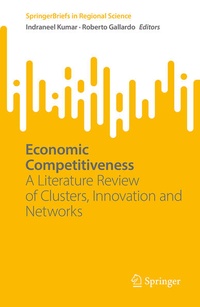
Economic Competitiveness
Description

This Springer Brief offers a comprehensive synthesis of research on four domains shaping regional economic competitiveness: industry clusters, economic geography of knowledge and innovation, occupation and skill clusters, and social networks. The selection and review of literature draws on a bibliometric analysis and interdisciplinary perspectives. This volume traces the origins of the industry cluster concept, its evolution and contemporary frameworks, and definitions developed in the U.S. The review analyses knowledge and innovation through the lens of economic geography and includes case studies of industry clusters and international examples. The review further explores occupation and skills clusters and the importance of regional workforce competitiveness and labor market information, including applications for skills targeting and workforce development. This book provides a succinct but thorough review of social networks, including theory and evolution, explanation of key concepts, structural and relational flows, application of networks in industry clusters, planning, and urban development.
More details
Other editions
Additional editions
Persons
Indraneel Kumar, Ph.D., is Director of the Purdue Center for Regional Development. He works on regional economic and workforce analysis, demographics, identification of new data sources, spatial analysis, and quantitative methods. He has degrees in architecture, planning, and civil engineering, and has led or participated in multiple federal- and state-funded projects.
Roberto Gallardo, Ph.D., is the Vice President for Engagement and an Associate Professor in the Agricultural Economics Department. He holds an electronics engineering undergraduate degree, a master's in economic development, and a Ph.D. in Public Policy and Administration. Gallardo has worked with rural communities over the past decade conducting local & regional community economic development, including use of technology for development.
Content
Chapter 1: Introduction.- Chapter 2: Industry clusters and regional economic competitiveness.- Chapter 3: Economic geography of knowledge and innovation: National and international contexts.- Chapter 4: Occupation and skills clusters.- Chapter 5: Social networks.
