

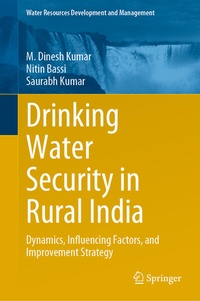
Drinking Water Security in Rural India
Description

This book highlights the multi-pronged strategy for achieving sustainable rural domestic water supply in India. It deepens the understanding of groundwater (predominant source of water supply) behaviour in response to natural processes in different geological settings, analyses the factors influencing the performance of water supply schemes; identifies the conditions under which groundwater-based drinking water sources become sustainable, suggests measures for improving the sustainability of drinking water wells in hard rock regions (covering 2/3rd of India's geographical area), presents a decision-making framework for planning rural water supply schemes in the country for ensuring long-term sustainability, and suggests physical strategies and policy measures for achieving them.
The analyses for development and validation of various models that explain groundwater system behaviour and performance of rural water supply schemes are undertaken for different geological settings in Maharashtra, as the state represents a microcosm of the various hydrological, topographical, and geohydrological conditions encountered in the country. The final analysis for proposing nation-wide strategies considers the various hydrological, geological, geohydrological, and topographical and climatic settings and groundwater contamination and pollution in the country.More details
Other editions
Additional editions
Persons
M. Dinesh Kumar completed his B-Tech in Civil Engineering, M.E. in Water Resources Management, and Ph.D. in Water Management. He has 30 years of professional experience in the field of water resources. He is the executive director of Institute for Resource Analysis and Policy, a water policy think-tank which he established in 2008. His research works of global relevance are: IWRM in river basins; agriculture water productivity; global virtual water trade; integrated urban water management; methodology for assessing global water and food security challenges; climate risk in WASH; and socio-economic impacts of large water systems.
Nitin Bassi holds an M. Phil in Natural Resource Management, having 15 years of experience undertaking research, consultancy and s in the field of water resource. Presently, he works as a principal researcher with the Institute for Resource Analysis and Policy. His areas of work include: River basin water accounting, agriculture water management, institutional and policy analysis in irrigation and water supply management, water quality analysis, climate variability and climate induced water risk analysis, and wetland management. He has been engaged as a specialist in projects, research studies, and assignments supported by various national and international organizations.
Saurabh Kumar is Ph.D. in Forestry (Wetland Ecology) from the Forest Research Institute, Dehradun, India. He has eight years of experience in the field of forest and wetland ecology. His research interest includes groundwater analysis, soil and water quality assessment, biodiversity assessment, and RS&GIS. He has worked extensively in swamp forests and wetlands of Western Himalayas. At present, he is a researcher at the Institute for Resource Analysis and Policy, Hyderabad, and engaged in an action research project financially supported by the European Commission and Department of Bio-technology, Government of India.
