

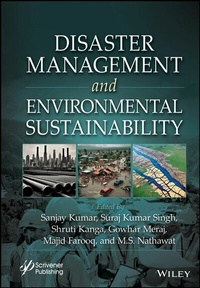
Disaster Management and Environmental Sustainability
Description

Communities are often driven to ruin their natural environment as a short-term coping mechanism for dealing with immediate issues; for instance, surviving a bad harvest by selling wood. Strategies for decreasing poverty by investing in environment-sensitive development should therefore support initiatives to minimize disaster risk and build resilience. There are common aspects in successful policies throughout various regions at the policy level, which extends to controlling climate change. Tools such as integrated water resources and coastal zone management, the removal of environmentally harmful subsidies, especially on fossil fuels and/or carbon taxes, renewable energy, marine protected areas, and cross-boundary biodiversity conservation, are all examples of policies used in more than one region but customized to each context. This scoping study finds and assesses available materials that relate environmental challenges and management with catastrophes and risk reduction activities in the Asia-Pacific area. This volume's analysis relies on case studies, examples, and the results of questionnaires and interviews of practitioners and organizations operating in the environment, disaster, and development domains.
More details
Other editions
Additional editions
Persons
Sanjay Kumar, PhD is an associate professor and assistant coordinator at Nalanda Open University and the Study Centre at Maharaja College, Ara. Over his tenure, he has attended several workshops, national and international seminars, quality webinars, and faculty development programs and during COVID-19, he delivered online lectures on different topics hosted by different institutions. He serves as one of the team members for curriculum design for the Master's Geography program at Indira Gandhi National Open University, New Delhi and the Bachelor's and Master's Geography programs in Bihar.
Suraj Kumar Singh, PhD is a National Service Scheme program officer at the Central University of Jharkhand and a coordinator at the Centre for Sustainable Development, Suresh Gyan Vihar University, Jaipur. He has 12 years of teaching and research experience in waterlogging and flood hazards, geospatial applications in water resources, disaster management, hydrogeomorphology, urban planning, and wasteland mapping.
Shruti Kanga, PhD is an assistant professor and head of the Department of Geography, School of Environment and Earth Sciences, Central University of Punjab. She has 12 years of teaching and research experience in the area of forest fire risk modeling and management, tourism, and resource management. She has also attended and organized 35 national and international conferences.
Gowhar Meraj, PhD is the principal investigator of the Department of Science and Technology, Government of India where he assesses the impact of climate change on the critical ecosystem services of the Kashmir Valley. More specifically, he is working on INVEST modelling for assessing sediment retention services, water yield services, and habitat quality in the Kashmir Valley. He has more than 40 research publications and serves as an editor for several additional publications.
Majid Farooq, PhD is a scientist in the Department of Ecology, Environment and Remote Sensing, Government of Jammu and Kashmir, India. He has more than 15 years of experience in research, teaching, and consultancy related to remote sensing and GIS. In addition to his experience, he has more than 25 publications in various international and national journals.
M. S. Nathawat, PhD is a scientist of international repute. He has more than 150 publications in various international and national journals and has guided more than 50 PhD and masters students. He is also a member of expert committees in various national bodies.
Content
Editorial xi
Preface xiii
Acknowledgments xvii
1 Assessment of Changes in River Morphology Due to Illegal Sand Mining by Geospatial Techniques 1
Saurabh Singh, Deepak Kumar Prajapat, Vikas Pandey, Rajat Agrawal and Jerripotu Gopala Rao
2 Feasibility of Solar Power Generation Potential in Una, Bilaspur, Solan, and Sirmaur Districts of Himachal Pradesh Using Geospatial Techniques 13
Lalit Jain, Krishan Chand, Rohit Chauhan and Brijesh Saklani
3 Assessment of the Drivers of Domestic Water Consumption Pattern in Growing Population of Idah LGA, Kogi State, Nigeria 39
Ogunkolu Ayodeji Bolade, Ogbole Moses, Stephen Favour Ojonuba and Oyetunji Adewale Bashir
4 Disaster Risk Reduction and Risk Management: A Conceptual Framework 61
Fouzia Rahman
5 Impact of Environmental Degradation and Disaster Happenings on Human Health 75
Kishor Kumar Anand and Sanjay Kumar
6 Impact of Development on Environmental Degradation: An Indian Diaspora 85
Rekha Vishwakarma
7 Food Crisis During Covid-19 Pandemic Among Migrants: A Study With Reference to Rohtak City (Haryana) 97
Vinod Kumar and Nitin
8 Crime Against Women in Patna and Its Environs: Degradation in Social Environment 109
Vimlesh Kumar
9 Expansion of Irrigation Facilities and Its Impact on Cropping Intensity: A Spatio-Temporal Analysis With Reference to Haryana 121
Neeraj
10 Dwindling Forest Cover and Environmental Degradation: A Case Study of Bihar 131
Vinita Prasad
11 Environment and Sustainable Development: Issues and Challenges 139
Anshu Veenapani
12 Government Programs and Policies Towards Green Environment 145
Suraj Dev
13 Use of Geospatial Technique in Urban Flood Hazard Management 155
Pallavi Tomar, Suraj Kumar Singh, Shruti Kanga, Amitanshu Pattanaik and Gowhar Meraj
14 Impact of Urbanization on Infrastructure and Environment of the Cities in Bihar 169
Anshu Veenapani and Sharat Chandra
15 Uses of Wi-Fi Technology and Its Effects on Social Life 177
Vishal Kumar
16 Application of Remote Sensing and GIS in Disaster Management: An Applied Review 191
Sadaf
17 Population Change and Its Impact on the Shortfall of Groundwater: A Case Study of Berhampore in Murshidabad, West Bengal 207
Subodh Singha and Harsha Kumar Das Gupta
18 Development of Future Rule Curves for KLRS Pulichintala Reservoir Operation Using SWAT and GA Models 219
Jerripotu Gopala Rao, Saurabh Singh, Bishnu Prasad Panda, Deepak Kumar Prajapat, Sujeet Kumar and Azmeera Balu
19 Understanding the Relationship Between River Health and Society for River Restoration: A Review 229
Pradeep kr Shrivastava, Deepak Kumar Prajapat and Saurabh Singh
20 Geospatial Mapping of Groundwater Potential Zones Using Multi-Criteria Decision Making AHP Approach in a Pisangan Watershed, Ajmer District (RAJ.) 241
Shilpi Yadav and S.S. Khinchi
References 259
Index 261
Preface
In this critical juncture of human history, the importance of an understanding and commitment to environmental sustainability and disaster management cannot be overemphasized. This book, titled Disaster Management and Environmental Sustainability, is a significant endeavor towards developing a more in-depth understanding of these complex issues, focusing primarily on the diverse context of India. The chapters herein are designed to serve as a resource for academics, practitioners, policymakers, students, and anyone interested in grasping the intricacies of our natural world and its governance. The book's fifteen chapters explore a range of related themes, each contributing to a holistic understanding of the environmental and disaster management landscape. The earlier chapters provide a foundation in understanding the geography of disaster-prone areas in Bihar and the subsequent impact on its citizens. We delve into the role of urbanization in shaping our environment and analyze both its boons and banes. The book brings to light the paradoxical relationship between development and environmental conservation. While development is seen as a symbol of human progress, it can also lead to environmental degradation, underlining the need for sustainable practices. We also underscore the need for legal measures and regulations to ensure environmental preservation, detailing the evolution of environmental laws in India. In subsequent chapters, the narrative shifts towards the issues of urban crime, agricultural growth, and forest resources, demonstrating the multifaceted nature of environmental sustainability. These chapters show how every aspect of our society is intertwined with the environment, from safety and law enforcement to agriculture and economic development. The later chapters incorporate the use of modern technologies such as geographic information systems (GIS) and remote sensing in managing disasters like urban flooding. We also examine the role of the internet in our lives, a pertinent issue given the digital revolution and the post-pandemic scenario. This chapter will help readers understand how these technological advancements can both aid and pose challenges to environmental sustainability. Each chapter has been meticulously researched and is built on evidence-based facts, aiming to enlighten and engage readers in these crucial topics. It is my hope that this book will not only serve as a comprehensive guide to disaster management and environmental sustainability but also inspire readers to become proactive agents of change in their communities. This book is a testament to the belief that despite the complexity and magnitude of the challenges we face, collective understanding, sustained effort, and persistent innovation can indeed foster a harmonious coexistence between humanity and the environment. It is a call to all of us to tread the path of sustainability, making informed decisions that are beneficial not just for us, but for generations to come.
Chapter 1 delves into the alarming consequences of illegal sand mining on river ecosystems, with an in-depth focus on the Chambal River. The researchers leverage advanced geospatial techniques to map the changes in river morphology due to unlawful extraction activities. The findings illuminate the pressing need for sustainable sand mining practices to safeguard our rivers and their delicate ecosystems. Chapter 2 shifts our attention to the energy sector, focusing on the enormous potential of solar power as a green energy alternative. The research identifies suitable areas for solar power plant installation in four districts of Himachal Pradesh, India, with the help of geospatial technology. It spotlights the role of solar energy in relieving the increasing pressure on exhaustible resources, like coal and petroleum, imposed by population growth and industrial expansion. Chapter 3 is the third chapter in our journey. It deals with the essential role of potable water in households and takes a close look at the consumption patterns in Idah LGA, Kogi State. It presents an analysis of water sources, household water demand, and influential factors, underpinned by a scientific method involving questionnaires, interviews, and observations. The findings provide a basis for effective water supply planning.
Chapter 4 presents a broad overview of disasters, emphasizing their omnipresence and destructive nature. It underscores the necessity of comprehensive knowledge about disasters to manage their risks and impacts effectively. The chapter elucidates the concept of disasters, frequency of occurrences, and how to build resilience against these calamities, drawing from the author's vast expertise in the field. Chapter 5 focuses on the detrimental effects of human activities on the environment. Detailing various types of pollution, it underlines their consequences on human health. Stressing the need for environmental education, the chapter calls for simple techniques to measure pollution and appropriate remedies to mitigate their effects. Chapter 6 discusses the interplay between environmental degradation and human progress. Using an allegory from mythology, it stresses the necessity of balancing development and environmental preservation. The chapter emphasizes the urgency to address environmental issues while ensuring economic growth and poverty eradication.
Chapter 7 addresses the effects of the pandemic and the ensuing lockdown on migrants in India. Using Rohtak, a significant migrant destination, as a case study, it provides insights into the experiences of migrant laborers during these trying times. This chapter paints a vivid picture of the human toll of the pandemic, extending beyond health issues to include broader socio-economic implications. Chapter 8 delves into the geography of crime, a social issue whose variable nature provides geographers with a dynamic field to study. Despite its relevance, this discipline has struggled to capture the attention of mainstream geographers. Taking the city of Patna as a case study, we explore how urban transformations and economic, political, and social changes influence the city's crime rates, with a specific focus on crimes against women. The intricate and layered nature of urban crime is discussed, alongside the impacts of fear perception and gender differences in such contexts. Chapter 9 discusses the significance of cropping intensity as an indicator of agricultural development. The potential of multiple cropping as a solution to maximize agricultural production and augment farmer incomes in India is examined, taking into account irrigation impacts on cropping intensity. Analyzing secondary data from 1991-92 to 2017-18 in Haryana, we delve into how higher degrees of cropping intensity can signify a higher level of agricultural development. Chapter 10 underlines the importance of forests as crucial ecological resources, detailing the direct and indirect uses they serve. With Bihar's forest cover at a mere 7.75%, we discuss the reasons behind forest cover disappearance and the prospects of forest resources in the state. Measures to improve and sustain forest cover are suggested, all based on an empirical study conducted via secondary data, literature surveys, and self-observation.
Chapter 11 emphasizes the profound challenges of environmental degradation in the modern century, a result of population growth and the overexploitation of natural resources. It introduces sustainable development as a crucial solution, stressing the need for a rational and equitable balance between economic growth and environmental conservation for the sake of future generations. Chapter 12 provides a historical overview of environmental laws in India, beginning with the single law of the colonial era-the Indian Forest Act (1927)-and tracing the evolution to the current comprehensive suite of laws and regulatory bodies that protect and improve the environment. Chapter 13 explores how remote sensing and GIS have revolutionized the approach to flood management, mapping flood risks and defining flood zones. The chapter evaluates various techniques, methodologies, and models used globally for urban flood management, underscoring the role of technology in keeping hazards under control. Chapter 14 dissects the unique challenges of urbanization in Bihar, where a rapidly growing urban population grapples with environmental degradation and social disparities. The focus lies on the cities of Patna, Gaya, Bhagalpur, Muzaffarpur, and Darbhanga, as we explore how unchecked migration, illegal settlements, socio-cultural disparities, and infrastructure shortcomings contribute to environmental deterioration and threaten the quality of life.
Chapter 15 presents an in-depth analysis of the Network-the Internet-and its profound effects on our social life. As the world increasingly shifts online, we examine how this digital realm shapes our daily interactions, from shopping to learning, and the ramifications of this transformation on our societal structures, especially in the wake of the COVID-19 pandemic. Chapter 16 unveils the grave reality of natural and man-made disasters affecting both developed and developing nations. It emphasizes the dire need for tools and methodologies to mitigate the disastrous impacts on human life, economy, infrastructure, and the environment. Highlighting the importance of technological advancements, the chapter delves into the role of remote sensing and GIS in disaster management, drawing from comprehensive...
