

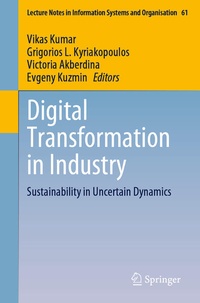
Digital Transformation in Industry
Description

This book offers a selection of the best papers presented at the annual international scientific conference "Digital Transformation in Industry: Trends, Management, Strategies," which was held by the Institute of Economics of the Ural Branch of the Russian Academy of Sciences (Ekaterinburg, Russia) on October 28, 2022.
The book focuses on concepts for initiating digitalization processes and identifying successful digital transformation strategies in all sectors of industry. Key topics include the sustainability of digital transformation in uncertain dynamics; conditions of uncertainty and barriers; industrial logistics in the new reality; best practices for implementing digital solutions to ensure sustainable, barrier-free and flexible supply chains; the achievement of sustainability in the process of digital transition; the adaptation of enterprises to the ESG concept through digital solutions; assessing the impact of industrial digital transformation on society and the environment; and clarifying how ESG aspects affect the economy. The experiences of various countries, regions and types of enterprise implementing IT and other technological innovations are also included, making the book a valuable asset for researchers and managers alike.More details
Other editions
Additional editions
Persons
Dr. Vikas Kumar is Director of Research and a Professor of Operations and Supply Chain Management at Bristol Business School, University of the West of England, UK. He serves on the editorial boards of six international journals including International Journal of Supply Chain and Operations Resilience, International Journal of Service, and International Journal of Manufacturing Systems. Prof. Kumar's current research focus is on sustainable supply chain management and Supply Chain 4.0. His other research interests include supply chain improvement, short food supply chains, green supply chains, process modelling, innovation in SMEs, operations strategy, and service supply chains.
Dr. Grigorios L. Kyriakopoulos is a Teaching and Research Associate at the School of Electrical and Computer Engineering, National Technical University of Athens (NTUA), Greece. He has 25 years of research and teaching experience at the NTUA, Hellenic Naval Academy, Hellenic Merchant Marine Academy, and School of Pedagogical and Technological Education of Athens. Dr. Kyriakopoulos was included in Stanford University's list of the World's Top 2% most cited scientists in the main fields of enabling & strategic technologies, energy and environmental sciences for the year 2020. He currently serves as (co)editor for books and special issues in the fields of engineering, the environment, business and management, renewable energy sources, education, and behavioral ecology. Dr. Victoria Akberdina is Deputy Director of the Institute of Economics of the Ural Branch of the Russian Academy of Sciences and Head of the Department of Regional Industrial Policy and Economic Security. She conducts fundamental and applied research on problems concerning industrial policy formation, forecasting methodologies, and modeling the evolution of the economic and technological development of industrial complexes, as well as the structural dimensions of economic development. In 2019, she was selected as a Corresponding Member of the Russian Academy of Sciences. Evgeny Kuzmin is a researcher at the Department of Regional Economic Policy and Economic Security at the Institute of Economics of the Ural Branch of the Russian Academy of Sciences. He is a reviewer for high-impact international journals including Journal of Cleaner Production, Entrepreneurship and Sustainability Issues, and Economy of Region. His research interests include risk, uncertainty, economic crises, sustainability, public-private partnerships, industrialization, industrial policy, industry markets, modeling, economic growth and development, and entrepreneurship.Content
- Intro
- About This Book
- Contents
- About the Editors
- Editorial: What Does Industry's Digital Transition Hold in the Uncertainty Context?
- The Best Regional Practices of Digital Industry Transition
- Regional Digital Space and Digitalisation of Industry: Spatial Econometric Analysis
- 1 Introduction
- 2 Theoretical Overview
- 3 Methods and Data
- 4 Results and Discussion
- 4.1 Grouping of Regions by the Digital Space Index
- 4.2 Spatial Autocorrelation Analysis
- 5 Conclusions and Implications
- References
- Formation of a System of Statistical Indicators of Digitalization and Reindustrialization of Small and Medium-Sized Cities
- 1 Introduction
- 2 Literature Review
- 3 Material and Methods
- 4 Results
- 5 Discussion
- 6 Conclusion
- References
- Impact of Digital Technologies on the Industrial Complex Development: The Russian Experience
- 1 Introduction
- 2 Literature Review
- 3 Materials and Methods
- 4 Results and Discussion
- 5 Conclusion
- References
- A Comparision of Digital Transformation of Industry in the Russian Federation with the European Union
- 1 Introduction
- 2 Methods
- 2.1 Evaluation of Digitalisation
- 3 Results
- 3.1 Special Software Tools
- 3.2 Cloud Technologies
- 3.3 Big Data
- 3.4 Artificial Intelligence
- 3.5 Internet of Things
- 3.6 Radio Frequency Identification (RFID) Technology
- 4 Conclusions
- References
- Multicollinearity Analysis of DESI Dimensions for Russian Federation and EU28 with Variance Inflation Factor (VIF)
- 1 Introduction
- 2 Short Literature Review
- 2.1 Digital Transformation in Russia and Europe
- 2.2 Multicollinearity and VIF
- 3 Research Questions and Methodology-Statistical Analysis of DESI Indicators
- 4 Results
- 4.1 RQ1: Investigation of Multicollinearity with VIF
- 4.2 RQ2: Linear Regressions of Collinear Dimensions
- 5 Discussion
- 6 Conclusions
- References
- Potential for Using Methodological Tools Digitalization of the Economy of Russian Regions in the Practice of China
- 1 Introduction
- 2 Literature Review
- 3 Materials and Methods
- 4 Results
- 5 Conclusion
- References
- Digital Transition of Industries: Challenges and Barriers in an Uncertain Environment
- Digital Transformation and Sustainability. A Systematic Literature Review
- 1 Introduction and Theoretical Background
- 2 Methodology
- 3 Results
- 3.1 Paper by Time
- 3.2 Papers by Journal
- 3.3 Papers by Subject Area, Topic, and Citations
- 4 Discussion and Conclusion
- References
- The Contribution of Digital Transformation Industry (DTI) in Micro- and Macro- Economy
- 1 Introduction
- 2 DTI in the Contexts of Micro-Economy and Macro-Economy
- 2.1 DTI Characteristics and Operation in the Entrepreneurship Sector
- 2.2 DTI Characteristics and Operation in the Manufacturing Sector
- 3 Conclusions
- References
- Institutions and Tools for Activating the Export Potential of High-Tech Industry at the Regional Level
- 1 Introduction
- 2 Literature Review and Theoretical Background
- 3 Materials and Methods
- 4 Results
- 5 Conclusion
- References
- Types of Digital Industrial Platforms: Case Study of a Gas Company
- 1 Introduction
- 2 Theoretical Frameworks
- 3 Methods and Data
- 4 Results and Discussion
- 4.1 Gazprom's Digital Counterparty Integration Platform (CIP)
- 4.2 Digital IIoT Continuous Production Management Platform-Zyfra Industrial IoT Platform Oil & Gas (ZIIoT O & G)
- 4.3 ISource Gazprom Digital Platform
- 4.4 Digital Technological Vision Platform
- 5 Conclusion
- References
- The Comparative Analysis of the Electric Vehicle Markets in the Context of Green and Digital Solutions
- 1 Introduction
- 2 Development Trends in the Global Electric Vehicle Market
- 3 Goals and Factors in the Development of the Russian Electric Vehicle Market
- 4 Conclusion
- References
- Adapting ESG Values to the Digital
- Analysis of the Relationship Between Regional Indices of Industrial Production and the Environmental Profile
- 1 Introduction
- 2 Literature Review
- 3 Materials and Methods
- 4 Results
- 5 Conclusion
- References
- Digital Technologies and Circular Value Chains for Sustainable Development
- 1 Introduction
- 2 Literature Review
- 3 Materials and Methods
- 4 Results
- 5 Conclusion
- References
- The Impact of Digitalization on the Telecommunications Sector ESG Transformation
- 1 Introduction
- 2 Background
- 2.1 Sustainable Development
- 2.2 Digitalization
- 2.3 ESG Transformation
- 3 Methods
- 4 Results
- 5 Discussions
- 6 Conclusion
- References
- Connectivity of Industrial Markets: Digital Logistics
- Understanding the Role of Digital Technologies in Supply Chain Management of SMEs
- 1 Introduction
- 2 Literature Review
- 3 Materials and Methods
- 4 Results and Discussions
- 5 Conclusion
- 6 Ethical Statement
- References
- Theoretical Prerequisites for Creating a Digital Twin Prototype of Value Chain Reliability Management
- 1 Introduction
- 2 Literature Review
- 3 Methodology
- 4 Results
- 5 Discussion
- 6 Conclusion
- References
- Methods of Assessing the Institutional Environment for the Development of Information Logistics
- 1 Introduction
- 2 Theoretical Aspects
- 3 Literature Review
- 4 Material and Methods
- 5 Results
- 6 Conclusion
- References
- Digital Model of a Transport Enterprise: The Role of Intensity and Operating Conditions of Vehicles
- 1 Introduction
- 2 Literature Review
- 3 Materials and Methods
- 4 Theory and Calculation
- 5 Results and Discussion
- 6 Conclusions
- References
- Building Intelligent Transport Systems of the Eurasian Economic Union Based on Optimal Management and Forecasting
- 1 Introduction
- 2 Background
- 3 Discussion
- 4 Conclusion
- References
- Digital Technologies and Decision Support for Industrial Enterprises
- Towards Viable Modelling for Robust Flow Shop Scheduling in Production Environments Under Uncertainty
- 1 Introduction
- 2 Background on Stochastic Scheduling Problems for Flow Shops
- 3 Identification of Research Problem and Objectives of the Work
- 4 Proposed Framework
- 5 Model Implementation and Experimental Results
- 6 Conclusions
- References
- Methods for Evaluating the Cost-Effectiveness of Using AI for Production Automation
- 1 Introduction
- 2 Materials and Methods
- 2.1 Difficulty Evaluating AI Implementation
- 2.2 Implementation Objects
- 3 Literature Review
- 3.1 AI Implementation Models
- 3.2 Investment of AI in Sberbank PJSC
- 3.3 Procedure Described by Vlasov
- 3.4 Method Described by Dolganova
- 3.5 Cost-Effectiveness of Robotization (Procedure)
- 3.6 Cost-Effectiveness of the AI Implementation in Steel Smelting
- 3.7 Efficiency of APCS
- 4 Proposed Method
- 5 Results
- 6 Conclusion
- References
- Stakeholder Management in Technological Projects and the Opportunity of Artificial Intelligence. A Case Study
- 1 Introduction
- 2 Thematic Overviews of the Key Aspects in the Industrial Sector
- 2.1 Stakeholders Management
- 2.2 Technological Projects
- 2.3 Artificial Intelligence (AI)
- 3 Methodology and Case Study
- 3.1 Methodology Applied for Analysis CSFs
- 3.2 Case Study
- 4 Results
- 4.1 Statistical Analysis
- 4.2 New Theoretical Framework
- 5 Discussion
- 6 Conclusions
- Appendix
- References
- The Relationship Between Objectives and Stages of Agile Implementation in Organizations
- 1 Introduction
- 2 Literature Review
- 3 Materials and Methods
- 4 Results
- 5 Conclusion
- References
- Hierarchical Multi-agent Model for the Management of a Regional Industrial Network Complex
- 1 Introduction
- 2 Literature Review
- 3 Methods
- 4 Results
- 4.1 Formalization of the Dynamics of a Two-Level Multi-agent Hierarchical Intelligent Semantic Network
- 4.2 Description of Links and Relationships in a Two-Level Multi-agent Hierarchical Intelligent Semantic Network
- 4.3 Formalization of a Two-Level Hierarchical Minimax Control Problem for a Regional Industrial Network Complex
- 4.4 Methodology for Solving a Two-Level Hierarchical Minimax Regional Network Industrial Complex
- 5 Discussion
- 6 Conclusions
- References
- Digital Transition of Industrial Enterprises: Potential, Management, Strategies
- The Use of Digital Twins for Elaboration of Strategic Guidelines to Ensure Sustainable Development of Industrial Enterprises
- 1 Introduction
- 2 Literature Review
- 3 Methodology
- 4 Findings and Scientific Contribution
- 4.1 Simulation Model Development
- 4.2 Research Validation
- 5 Discussion
- 6 Conclusion
- References
- The Impact of Digitalization Processes on the Innovative Activity of Small Industrial Enterprises
- 1 Introduction
- 2 Literature Review
- 3 Materials and Methods
- 4 Change of Innovation Processes in Small Enterprises in the Context of Digital Transformation
- 5 Innovation Management in Small Enterprises in the Context of Digitalization
- 6 The Current Situation in the Field of Digitalization of Industry and Innovative Small Business in Russia
- 7 State Support Measures for Small Enterprise in the Field of Innovation and Digitalization
- 8 Conclusion
- References
- Artificial Intelligence Transformation in the Industry: Challenges and Opportunities
- 1 Introduction
- 2 Methods
- 3 Background
- 3.1 Industry from Digital to AI Transformation
- 3.2 Challenges Imposed by AI Transformation in the Industry
- 4 Conclusion
- References
- Mobile Technology in the Digital Transformation Strategy of Industrial Enterprises
- 1 Introduction
- 1.1 Problem Statement
- 1.2 Research Questions
- 1.3 Research Significance
- 2 Literature Review
- 3 Material and Methods
- 3.1 Realization Path (Literature Analysis Method)
- 3.2 Influence Elements
- 4 Results
- 4.1 Strategies for Increasing the Digital Transformation of Industrial Companies in Industrially Developed Regions
- 4.2 Strategies for Enhancing the Digital Transformation of Industrial Enterprises in Medium-Developed Industrial Regions
- 4.3 Strategies for Increasing the Digital Transformation of Industrial Companies in Industrially Backward Regions
- 5 Prospects and Applications
- 6 Conclusion
- References
- Managing the Digital Potential Development of an Industrial Enterprise: The Incremental Approach
- 1 Introduction
- 2 Literature Review
- 3 Material and Methods
- 4 Results
- 4.1 The Essence and Advantages of the Incremental Approach to Management
- 4.2 Incremental Approach in the Management Mechanism of Digital Potential Development
- 4.3 Incrementality in Tactical and Strategic Objectives of the Digital Potential Development of an Industrial Enterprise
- 5 Discussion
- 6 Conclusion
- References
- Digital Transformation and Human Capital
- Has Digitalisation Alleviated the Impact of the COVID-19 on Manufacturing Sectors? Evidence from Sectoral-Level and Cross-Country Data
- 1 Introduction
- 2 Theoretical Review
- 3 Data and Empirical Model
- 3.1 Data
- 3.2 Empirical Model
- 4 Empirical Results
- 4.1 Descriptive Statistics
- 4.2 Estimation Results for Sectoral-Level Analysis (Eq. (2))
- 4.3 Estimation Results for Cross-Country Analysis (Eq. (3))
- 5 Conclusion and Policy Recommendation
- Appendix 1
- Appendix 2
- References
- Impact of Electronic Government on Human Capital: Dynamics of Interaction
- 1 Introduction
- 2 Literature Review
- 2.1 Definition of E-government
- 2.2 Public Value E-government
- 2.3 Structure of the Electronic State
- 2.4 Human Capital
- 3 Methodology
- 4 Results
- 5 Discussion
- 6 Conclusion
- References
- Open Engineering Education Tools in the Context of Education 4.0
- 1 Introduction
- 2 Literature Review
- 3 Material and Methods
- 4 Results
- 5 Discussion
- 6 Conclusion
- References
- Employee Engagement and Soft Skills in the Digitalization of the Economy. Preliminary Study Results
- 1 Introduction
- 2 Background
- 2.1 Soft Skills: Definitions and Main Research Directions
- 2.2 Soft Skills and Employee Engagement
- 3 Methodology
- 4 Survey Results and Discussion
- 5 Conclusion and Outlook
- References
- Specifics of Accounting for Agent Activeness in the Digital Twin of the Social System
- 1 Introduction
- 2 Literature Review
- 3 Methodology
- 4 Results
- 5 Discussion
- 6 Conclusion
- References
