

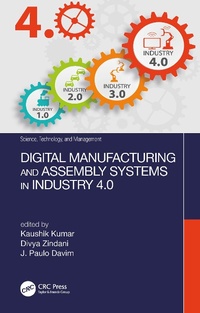
Digital Manufacturing and Assembly Systems in Industry 4.0
1st Edition
Published on 3. July 2019
176 pages
978-0-429-87660-8 (ISBN)
Description

Manufacturing, like other industries, is rising to the challenges imposed by aggressive consumer demands and the need for cost-effective processing that delivers quality in the fastest possible time. Fierce competition means that keeping abreast of new developments and applications in technology is essential if companies are to meet demands profitably and keep ahead of competitors. This book investigates the design and management of digital manufacturing and assembly systems for an efficient, flexible, and modular production of customized products using the I40 (industry 4.0)-enabling technologies. This book will also provide case studies covering modeling, simulation, and optimization.
eBook includes color figures.
Discusses how the advancement of data communication and storage through the Internet of Things (IoT) opens the possibilities of connecting sensors, robots, and devices
Sheds light on how the human role in industry is decreasing due to the development of connected manufacturing floors, allowing them to take more control over the manufacturing processes, decisions, and even maintenance
Covers the benefits from exploiting digital manufacturing, manufacturing enterprises, and what they expect to achieve
Explains the important roles that modeling, simulation, and optimization play
Investigates the design and management of digital manufacturing and assembly systems for an efficient, flexible, and modular production of customized products exploiting the I40 (industry 4.0)-enabling technologies
eBook includes color figures.
Discusses how the advancement of data communication and storage through the Internet of Things (IoT) opens the possibilities of connecting sensors, robots, and devices
Sheds light on how the human role in industry is decreasing due to the development of connected manufacturing floors, allowing them to take more control over the manufacturing processes, decisions, and even maintenance
Covers the benefits from exploiting digital manufacturing, manufacturing enterprises, and what they expect to achieve
Explains the important roles that modeling, simulation, and optimization play
Investigates the design and management of digital manufacturing and assembly systems for an efficient, flexible, and modular production of customized products exploiting the I40 (industry 4.0)-enabling technologies
More details
Series
Edition
1. Auflage
Language
English
Place of publication
London
United Kingdom
Publishing group
Taylor & Francis Ltd
Target group
College/higher education
Product notice
Reflowable
Illustrations
30 Tables, black and white; 64 Illustrations, black and white
ISBN-13
978-0-429-87660-8 (9780429876608)
Copyright in bibliographic data and cover images is held by Nielsen Book Services Limited or by the publishers or by their respective licensors: all rights reserved.
Schweitzer Classification
Other editions
Additional editions
Kaushik Kumar | Divya Zindani | J. Paulo Davim
Digital Manufacturing and Assembly Systems in Industry 4.0
Book
03/2021
1st Edition
CRC Press
€74.00
Shipment within 15-20 days
Kaushik Kumar | Divya Zindani | J. Paulo Davim
Digital Manufacturing and Assembly Systems in Industry 4.0
Book
08/2019
1st Edition
CRC Press
€245.12
Shipment within 10-20 days
Persons
Kaushik Kumar, B.Tech (Mechanical Engineering, REC (Now NIT), Warangal), MBA (Marketing, IGNOU) and PhD (Engineering, Jadavpur University), is presently an Associate Professor in the Department of Mechanical Engineering, Birla Institute of Technology, Mesra, Ranchi, India. He has 16 years of Teaching & Research and over 11 years of industrial experience in a manufacturing unit of Global repute. His areas of teaching and research interest are Conventional and Non-conventional Quality Management Systems, Optimization, Non-conventional machining, CAD / CAM, Rapid Prototyping and Composites. He has 9 Patents, 26 Book, 13 Edited Book, 42 Book Chapters, 136 international Journal publications, 21 International and 8 National Conference publications to his credit. He is on the editorial board and review panel of 7 International and 1 National Journals of repute. He has been felicitated with many awards and honours.
Divya Zindani, (BE, Mechanical Engineering, Rajasthan Technical University, Kota), M.E. (Design of Mechanical Equipment, BIT Mesra), presently pursuing PhD (National Institute of Technology, Silchar). He has over 2 years of Industrial experience. His areas of interests are Optimization, Product and Process Design, CAD/CAM/CAE, Rapid prototyping and Material Selection. He has 1 Patent, 4 Books, 6 Edited Books, 18 Book Chapters, 2 SCI journal, 7 Scopus Indexed international journal and 4 International Conference publications to his credit.
J. Paulo Davim received his PhD in mechanical engineering in 1997, M.Sc. in mechanical engineering (materials and manufacturing processes) in 1991, Licentiate degree (5 years) in mechanical engineering in 1986 from the University of Porto (FEUP), the Aggregate title from the University of Coimbra in 2005 and D.Sc. from London Metropolitan University in 2013. He is EUR ING by FEANI and senior chartered engineer by the Portuguese Institution of Engineers with MBA and specialist title in engineering and industrial management. Currently, he is professor at the Department of Mechanical Engineering of the University of Aveiro. He has more than 30 years of teaching and research experience in manufacturing, materials and mechanical engineering with special emphasis in machining and tribology. Recently, he has also interest in management/industrial engineering and higher education for sustainability/engineering education. He has received several scienti?c awards. He has worked as evaluator of projects for international research agencies as well as examiner of PhD thesis for many universities. He is the editor in chief of several international journals, guest editor of journals, editor of books, series editor of books and scienti?c advisor for many international journals and conferences. At present, he is an editorial board member of 25 international journals and acts as reviewer for more than 80 prestigious Web of Science journals. In addition, he has also published as editor (and co-editor) for more than 100 books and as author (and co-author) for more than 10 books, 80 book chapters and 400 articles in journals and conferences (more than 200 articles in journals indexed in Web of Science/h-index 45+ and SCOPUS/h-index 52+).
Divya Zindani, (BE, Mechanical Engineering, Rajasthan Technical University, Kota), M.E. (Design of Mechanical Equipment, BIT Mesra), presently pursuing PhD (National Institute of Technology, Silchar). He has over 2 years of Industrial experience. His areas of interests are Optimization, Product and Process Design, CAD/CAM/CAE, Rapid prototyping and Material Selection. He has 1 Patent, 4 Books, 6 Edited Books, 18 Book Chapters, 2 SCI journal, 7 Scopus Indexed international journal and 4 International Conference publications to his credit.
J. Paulo Davim received his PhD in mechanical engineering in 1997, M.Sc. in mechanical engineering (materials and manufacturing processes) in 1991, Licentiate degree (5 years) in mechanical engineering in 1986 from the University of Porto (FEUP), the Aggregate title from the University of Coimbra in 2005 and D.Sc. from London Metropolitan University in 2013. He is EUR ING by FEANI and senior chartered engineer by the Portuguese Institution of Engineers with MBA and specialist title in engineering and industrial management. Currently, he is professor at the Department of Mechanical Engineering of the University of Aveiro. He has more than 30 years of teaching and research experience in manufacturing, materials and mechanical engineering with special emphasis in machining and tribology. Recently, he has also interest in management/industrial engineering and higher education for sustainability/engineering education. He has received several scienti?c awards. He has worked as evaluator of projects for international research agencies as well as examiner of PhD thesis for many universities. He is the editor in chief of several international journals, guest editor of journals, editor of books, series editor of books and scienti?c advisor for many international journals and conferences. At present, he is an editorial board member of 25 international journals and acts as reviewer for more than 80 prestigious Web of Science journals. In addition, he has also published as editor (and co-editor) for more than 100 books and as author (and co-author) for more than 10 books, 80 book chapters and 400 articles in journals and conferences (more than 200 articles in journals indexed in Web of Science/h-index 45+ and SCOPUS/h-index 52+).
Content
Section I Overview 1. Intelligent Manufacturing Systems, Smart Factories and Industry 4.0: A General Overview 2. Industry 4.0: Opportunities and Challenges for Turkey 3. Industries of Future Section II Applications 4. Applying Theory of Constraints to a Complex Manufacturing Process 5. A Multi-objective Tool Path Optimization Methodology for Sculptured Surfaces Based on Experimental Data and Heuristic Search 6. A Computer Simulation Approach to Improve Productivity of Automobile Assembly Line: A Case Study
