

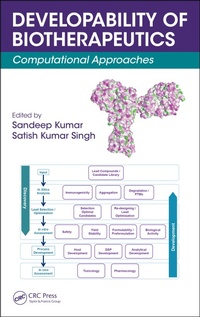
Developability of Biotherapeutics
Computational Approaches
Published on 18. November 2015
315 pages
978-1-4822-4615-5 (ISBN)
Description

Biopharmaceuticals are emerging as frontline medicines to combat several life-threatening and chronic diseases. However, such medicines are expensive to develop and produce on a commercial scale, contributing to rising healthcare costs. Developability of Biotherapeutics: Computational Approaches describes applications of computational and molecular
Reviews / Votes
'Developability of Biotherapeutics: Computational Approaches presents the most extensive and systematic overview to date, of modern computational approaches that are being used industrially to assess potential manufacturability and overall ease of development of biotherapeutics such as monoclonal antibodies. The book covers a wide array of topics, spanning from immunogenicity and pharmacokinetic/dynamic properties to key chemical and physical stability attributes. It is recommended as important reading for researchers from both academic and industrial perspectives, and will be of particular interest for graduate students seeking to gain an experienced perspective of the current state of the art and opportunities for high impact research in the future'.- Christopher J. Roberts, Professor of Chemical & Biomolecular Engineering, University of Delaware.
'Developability of Biotherapeutics: computational approaches presents a state-of-the art and modern overview on computational approaches for evaluating developability of biotherapeutics. Optimal molecule design and selection is a yet underappreciated and underutilized element of finding, developing, and finally commercializing the best molecule. The optimum molecule not only serves patient needs by ensuring efficacy and safety, but is also optimized from a technical drug product development perspective. This book is a must-read for industrial and academic researchers involved in discovering, identifying and optimizing molecules and transitioning from research to development and beyond.'
- Prof. Dr. Hanns-Christian Mahler, Head of Drug Product Services, Lonza AG.
'This book represents a compelling opening salvo to the field of computational methods applied to antibody developability. The chapters are... supported by extensive and timely literature citations: the average number of citations per chapter goes above 90, with over 50% of the references dating to 2009 or later. Developability of Biotherapeutics: Computational Approaches should be a good addition to the libraries of industrial and academic groups engaged in, or supporting, development of biopharmaceutical drugs.'
- Charlotte M. Deane & Maximiliano Vasquez (2016), mAbs, DOI: 10.1080/19420862.2016.1256723. 'Developability of Biotherapeutics: Computational Approaches presents the most extensive and systematic overview to date, of modern computational approaches that are being used industrially to assess potential manufacturability and overall ease of development of biotherapeutics such as monoclonal antibodies. The book covers a wide array of topics, spanning from immunogenicity and pharmacokinetic/dynamic properties to key chemical and physical stability attributes. It is recommended as important reading for researchers from both academic and industrial perspectives, and will be of particular interest for graduate students seeking to gain an experienced perspective of the current state of the art and opportunities for high impact research in the future'.
- Christopher J. Roberts, Professor of Chemical & Biomolecular Engineering, University of Delaware.
'Developability of Biotherapeutics: computational approaches" presents a state-of-the art and modern overview on computational approaches for evaluating developability of biotherapeutics. Optimal molecule design and selection is a yet underappreciated and underutilized element of finding, developing, and finally commercializing the best molecule. The optimum molecule not only serves patient needs by ensuring efficacy and safety, but is also optimized from a technical drug product development perspective. This book is a must-read for industrial and academic researchers involved in discovering, identifying and optimizing molecules and transitioning from research to development and beyond.'
- Prof. Dr. Hanns-Christian Mahler, Head of Drug Product Services, Lonza AG.
'This book represents a compelling opening salvo to the field of computational methods applied to antibody developability. The chapters are... supported by extensive and timely literature citations: the average number of citations per chapter goes above 90, with over 50% of the references dating to 2009 or later. Developability of Biotherapeutics: Computational Approaches should be a good addition to the libraries of industrial and academic groups engaged in, or supporting, development of biopharmaceutical drugs.'
- Charlotte M. Deane & Maximiliano Vasquez (2016), mAbs, DOI: 10.1080/19420862.2016.1256723.
More details
Language
English
Place of publication
London
United Kingdom
Publishing group
Taylor & Francis Ltd
Target group
College/higher education
Illustrations
78 s/w Abbildungen, 28 s/w Tabellen
78 b/w images, 28 tables and 19 lines of equations
File size
12,68 MB
ISBN-13
978-1-4822-4615-5 (9781482246155)
Copyright in bibliographic data and cover images is held by Nielsen Book Services Limited or by the publishers or by their respective licensors: all rights reserved.
Schweitzer Classification
Other editions
Additional editions
Book
06/2021
1st Edition
CRC Press
€83.13
Shipment within 10-20 days
Book
12/2015
1st Edition
CRC Press
€232.20
Article not available for order
Persons
Sandeep Kumar, PhD, is a senior principal scientist at Pfizer, Inc. in the Biotherapeutics Pharmaceutical Sciences group, working on computational modeling and developability risk assessments of a wide variety of biotherapeutic drug candidates, including monoclonal antibodies, antibody-based therapeutics, fusion proteins, vaccines, and antibody-drug conjugates. He earned his PhD in computational biophysics from the Molecular Biophysics Unit of the Indian Institute of Science, Bangalore, India, and performed postdoctoral research on proteins at the National Cancer Institute in Frederick, Maryland, a part of the National Institutes of Health. He has been an assistant professor (research-track) at Georgetown University Medical Center, Washington, DC; an assistant professor at the Indian Institute of Technology, Kanpur; and an associate research scientist at Johns Hopkins University, Baltimore, Maryland. He has more than 17 years of experience in computational protein sciences. He has contributed more than 60 research papers, review articles, and book chapters, has delivered more than 40 invited talks, and has chaired sessions of several conferences. He has won several fellowships and awards, including a Fogarty visiting scientist fellowship at NIH and the 2014 Ebert Prize from the American Pharmacists Association. He has also mentored several graduate students and postdoctoral scientists.
Satish Kumar Singh, PhD, is a research fellow at Pfizer, Inc. in the Biotherapeutics Pharmaceutical Sciences group, and an adjunct professor of the Department of Physical Pharmaceutical Chemistry at Uppsala University in Sweden. His responsibilities include leading formulation, product, and process development activities for biologics and therapeutic vaccines. He earned his PhD in chemical engineering from Kansas State University. He has more than 25 years of industrial experience and has published more than 50 peer-reviewed articles with emphasis on
Satish Kumar Singh, PhD, is a research fellow at Pfizer, Inc. in the Biotherapeutics Pharmaceutical Sciences group, and an adjunct professor of the Department of Physical Pharmaceutical Chemistry at Uppsala University in Sweden. His responsibilities include leading formulation, product, and process development activities for biologics and therapeutic vaccines. He earned his PhD in chemical engineering from Kansas State University. He has more than 25 years of industrial experience and has published more than 50 peer-reviewed articles with emphasis on
Content
PRINCIPLES OF BIOPHARMACEUTICAL INFORMATICS. Biopharmaceutical Informatics: Applications of Computation in Biologic Drug Development. Computational Methods in the Optimization of Biologic Modalities. Understanding, Predicting, and Mitigating the Impact of Posttranslational Physiochemical Modifications, Including Aggregation, on the Stability of Biopharmaceutical Drug Products. Preclinical Immunogenicity Risk Assessment of Biotherapeutics. Application of Mechanistic Pharmacokinetic-Pharmacodynamic Modeling toward the Development of Biologics. Challenges in High-Concentration Biopharmaceutical Drug Delivery: A Modeling Perspective. DEVELOPABILITY PRACTICES IN THE BIOPHARMACEUTICAL INDUSTRY. Best Practices in Assessment of Developability of Biopharmaceutical Candidates. Best Practices in Developability Assessments of Therapeutic Protein Candidates in the Biopharmaceutical Industry. Best Practices in Assessing the Developability of Biopharmaceutical Candidates. Developability Assessment Workflows to De-Risk Biopharmaceutical Development.
