

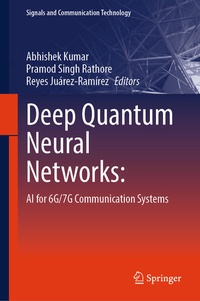
Deep Quantum Neural Networks:
Description

This book looks at how quantum computing, neural networks, and next-generation communication systems can work together in new and exciting ways. The book presents details about cutting edge techniques, such as Tensor Networks and the n-Sci framework, that make 6G and 7G networks faster, safer, and able to grow. It has in-depth discussion on quantum-assisted channel estimates, energy-efficient designs, and ultra-reliable low-latency communication (URLLC), which makes it an important tool for wireless communication scholars and engineers. Some of the unique features are- in-depth case studies, real-life examples in smart cities and autonomous systems, and the use of graphs and tables to make complicated ideas easy to understand. Readers will learn a lot about how future communication will work and how quantum neural networks can be used to change the development of global wireless standards.
More details
Other editions
Additional editions
Persons
Dr. Abhishek Kumar specializes in deep learning and neural networks, with numerous publications in top-tier journals and conferences. His research has significantly contributed to the development of generative models for medical image analysis, particularly in the early diagnosis of neurological disorders. He has been honored with multiple awards for his groundbreaking work in AI applications in healthcare.
Dr. Pramod is a leading expert in the application of computational models to medical problems and editors of many medical books. His research has pioneered the use of AI for early detection of diseases, with a strong focus on neurological conditions.
Dr. Reyes Juárez-Ramírez has two main areas of interest: software engineering and human-computer interaction. His current research focuses on adaptive interfaces for autistic users, affective aspects in intelligent tutors and videogames, and affective aspects of users in intelligent spaces.
Content
Quantum Neural Networks in 6G/7G Communication Systems.-Tensor Networks in Quantum Neural Network Architectures.- n-Sci: Bridging Science and Quantum Neural Networks.- Quantum-Assisted Channel Estimation for 6G/7G Networks.- n-Sci and Tensor Networks in Smart City and IoT Deployments.- Quantum Neural Networks in Satellite and Space-Based 7G Communications.- Enhancing URLLC in 6G/7G Using Quantum Neural Networks.- Energy-Efficient 7G Networks Using Tensor and Quantum Neural Networks.- Quantum Neural Networks for Security in 6G/7G.- New Paradigms in Edge Computing with Quantum Neural Networks.- Towards Standardization: Quantum Neural Networks in Global 7G Standards.- Quantum Neural Networks for Autonomous 7G Vehicle Communication.- Quantum Neural Networks in Healthcare and Critical Systems.- Tensor Networks and n-Sci: The Road to Beyond 7G.- Quantum Neural Networks in Post-7G Communication.
