

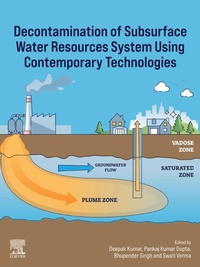
Decontamination of Subsurface Water Resources System using Contemporary Technologies
Published on 29. April 2025
250 pages
978-0-443-26640-9 (ISBN)
Description

Decontamination of Subsurface Water Resources System using Contemporary Technologies provides a comprehensive approach to addressing the decontamination of subsurface water resources. It covers field experimentations, modelling strategies, remote-sensing methods, and the application of artificial intelligence.This broad coverage ensures that readers gain a well-rounded understanding of the topic. Purchasing this book offers a unique opportunity to access up-to-date, comprehensive, and scientifically grounded insights into subsurface water decontamination. This book will inform the student, researcher, policymaker, or industry practitioner and contribute to positive change in the field of water resource management.
- Includes up-to-date assessment tools for water quality evaluation and advanced modelling techniques
- Contains unique resources on the restoration of surface water resources, with step-by-step analysis to guide students
- Covers theory and practice by offering global case studies with applications
- Offers thorough overview of Machine Learning (ML)/Artificial Intelligence (AI), GIS and remote sensing, and sensors application to achieve sustainable groundwater management
More details
Other editions
Additional editions
Deepak Kumar | Pankaj Kumar Gupta | Bhupender Singh
Decontamination of Subsurface Water Resources System using Contemporary Technologies
Book
06/2025
Elsevier
€124.50
Shipment within 15-20 days
Content
Section I: Emerging pollutants in subsurface water resource systems1. Fate and Transport of Emerging Contaminants in the Vadose Zone2. Emerging contaminants and their behaviour in aquifer systems3. Colloid-facilitated contaminant transport through sub-surface porous media4. Research on migration characteristics of CML colloid co-transported carcinogenic Cr(VI) in a two-phase porous medium incorporating probabilistic human health risk assessmentSection II: Remediation technologies for contaminated subsurface water resource systems5. Phytoremediation for extraction of heavy metal from contaminated soil6. Bioremediation Strategies for Vadose Zone Contaminant Cleanup7. An Overview on Cost Analysis of In-Situ Remediation Technologies for Sub Surface Management8. Electrocoagulation treatment of landfill leachate: influence of electrodes and characteristics9. Remediation strategies for soil heavy metal contamination in soil10. Field scale remediation technologies for vadose zone contaminated with chromium contaminantsSection III: Case study on Groundwater Assessment and Contaminant transport11. Soil-Water Contamination at COPR Sites and in Adjoining Agricultural lands: Remediation Strategies and Practices12. Estimation of surface and groundwater interaction by stable isotopic techniques - a case study on Chengalpattu district - IT corridor13. Assessment of groundwater vulnerability of the Rupnagar, Punjab, India using DRASTIC-LUH model and electrical resistivity tomography14. Subsurface investigation for groundwater resource assessment: A case study of Dehola village, Haryana, India.15. Identification of the best yield point for groundwater using the ERT method16. Fuzzy Logic Decision Support System for In-Situ Remediation of Contaminated Aquifer17. Response of groundwater to dry and wet rainfall spells in different climatic zones of India18. Geospatial assessment of groundwater quality using water quality index19. Water quality assessment of springshed of outer Himalaya's foothills: A case study from Uttarakhand20. Global collocation-based Meshfree simulation model for groundwater contaminant transportSection IV: Policies framework for subsurface water resource management21. Policy framework to control subsurface contamination22. Constitutional laws for subsurface water pollution23. Public participation to manage contaminated aquifer24. Aquifer management for achieving various objectives of sustainable development goal (SDG)
