

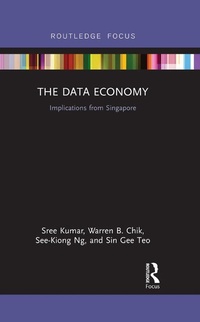
The Data Economy
Implications from Singapore
1st Edition
Published on 3. October 2018
126 pages
978-0-429-78264-0 (ISBN)
Description

"The data economy" is a term used by many, but properly understood by few. Even more so the concept of "big data". Both terms embody the notion of a digital world in which many transactions and data flows animate a virtual space. This is the unseen world in which technology has become the master, with the hand of the human less visible. In fact, however, it is human interaction in and around technology that makes data so pervasive and important - the ability of the human mind to extract, manipulate and shape data that gives meaning to it.
This book outlines the findings and conclusions of a multidisciplinary team of data scientists, lawyers, and economists tasked with studying both the possibilities of exploiting the rich data sets made available from many human-technology interactions and the practical and legal limitations of trying to do so. It revolves around a core case study of Singapore's public transport system, using data from both the private company operating the contactless payment system (EZ-Link) and the government agency responsible for public transport infrastructure (Land Transport Authority). In analysing both the possibilities and the limitations of these data sets, the authors propose policy recommendations in terms of both the uses of large data sets and the legislation necessary to enable these uses while protecting the privacy of users.
This book outlines the findings and conclusions of a multidisciplinary team of data scientists, lawyers, and economists tasked with studying both the possibilities of exploiting the rich data sets made available from many human-technology interactions and the practical and legal limitations of trying to do so. It revolves around a core case study of Singapore's public transport system, using data from both the private company operating the contactless payment system (EZ-Link) and the government agency responsible for public transport infrastructure (Land Transport Authority). In analysing both the possibilities and the limitations of these data sets, the authors propose policy recommendations in terms of both the uses of large data sets and the legislation necessary to enable these uses while protecting the privacy of users.
More details
Series
Edition
1. Auflage
Language
English
Place of publication
London
United Kingdom
Publishing group
Taylor & Francis Ltd
Target group
College/higher education
Illustrations
1 Tables, black and white; 13 Line drawings, black and white; 4 Halftones, black and white
File size
8,75 MB
ISBN-13
978-0-429-78264-0 (9780429782640)
Copyright in bibliographic data and cover images is held by Nielsen Book Services Limited or by the publishers or by their respective licensors: all rights reserved.
Schweitzer Classification
Other editions
Additional editions
Book
06/2020
1st Edition
Routledge
€28.46
Shipment within 15-20 days
Book
10/2018
1st Edition
Routledge
€84.30
Shipment within 10-20 days
Persons
Sree Kumar is a Director of Sreekumar Siddique & Co., a regional research and consulting firm based in Singapore. At the Lee Kuan Yew Centre for Innovative Cities, he is an Adjunct Senior Fellow. Mr Kumar holds degrees in law, economics, English, management, and engineering from universities in the United Kingdom and Singapore. He has been called to the Bar of England and Wales and has an interest in international tax and investment law. He is a Fellow of the Royal Statistical Society.
Warren B. Chik is an Associate Professor in the School of Law at Singapore Management University. He obtained his LLB from National Univeristy of Singapore Law School and his master's degrees from Tulane University and University College London. Associate Professor Chik has been called to the Bar of England and Wales, Singapore, and New York. He currently researches and writes in the areas of information and communications technology and the law, Internet intermediaries, data protection, cybersecurity, and the intersection between intellectual property and information technology law.
See-Kiong Ng is a Professor of Practice at the National University of Singapore's School of Computing and Director of Translational Research for the university's Institute of Data Science. He holds a PhD from Carnegie-Mellon University and is a practising data scientist with diverse and cross-disciplinary research interests. From using data mining to unravel the biology of the human body to applying machine learning to understand the "biology" of complex human cities, See-Kiong aims to push the boundary of data science through trans-disciplinary upstream research and to create impact by translating research outcomes into real-life applications.
Sin Gee Teo is a research scientist at the Institute for Infocomm Research (I2R) in Singapore. He holds a PhD in Computer Science from Monash University, Australia. Before joining I2R, he worked at the Lee Kuan Yew Centre for Innovative Cities, Singapore University of Technology and Design, as a research fellow. His research interests include data privacy, applied cryptography, deep learning, data mining, and cloud computing.
Warren B. Chik is an Associate Professor in the School of Law at Singapore Management University. He obtained his LLB from National Univeristy of Singapore Law School and his master's degrees from Tulane University and University College London. Associate Professor Chik has been called to the Bar of England and Wales, Singapore, and New York. He currently researches and writes in the areas of information and communications technology and the law, Internet intermediaries, data protection, cybersecurity, and the intersection between intellectual property and information technology law.
See-Kiong Ng is a Professor of Practice at the National University of Singapore's School of Computing and Director of Translational Research for the university's Institute of Data Science. He holds a PhD from Carnegie-Mellon University and is a practising data scientist with diverse and cross-disciplinary research interests. From using data mining to unravel the biology of the human body to applying machine learning to understand the "biology" of complex human cities, See-Kiong aims to push the boundary of data science through trans-disciplinary upstream research and to create impact by translating research outcomes into real-life applications.
Sin Gee Teo is a research scientist at the Institute for Infocomm Research (I2R) in Singapore. He holds a PhD in Computer Science from Monash University, Australia. Before joining I2R, he worked at the Lee Kuan Yew Centre for Innovative Cities, Singapore University of Technology and Design, as a research fellow. His research interests include data privacy, applied cryptography, deep learning, data mining, and cloud computing.
Content
Foreword
Acknowledgement
1. Introduction
2. An Outline of the Data Economy
3. The Search for Data
4. The Analysis of Data
5. The Legal Contours of the Data Economy
6. Redefining the Data Economy
7. Implications for the Future
Selected Bibliography
Index
Acknowledgement
1. Introduction
2. An Outline of the Data Economy
3. The Search for Data
4. The Analysis of Data
5. The Legal Contours of the Data Economy
6. Redefining the Data Economy
7. Implications for the Future
Selected Bibliography
Index
