

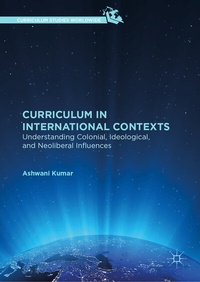
Curriculum in International Contexts
Description

This book is an exposition of how political, cultural, historical, and economic structures and processes shape the nature and character of curriculum landscapes globally. By developing theoretical connections and providing contextual background, Kumar explores how colonialism and imperialism, state-led ideological control, and the wave of neoliberalism and capitalism insidiously impact the process of curriculum development in different parts of the world. Kumar also underscores how intellectual movements such as Marxism and postmodernism have shaped curriculum theory in varied political and economic settings. By emphasizing the connections between and among diverse cultural and political conceptualizations of curriculum, this volume contributes to the internationalization of curriculum studies discourses.
Reviews / Votes
"As a key figure in the internationalization of curriculum studies, Ashwani Kumar questions colonialism and its legacies, including ideological control of curriculum and teaching, as well as the neoliberal obsession with measurement, comparison, and competition. In his meditative and contemplative manner, Kumar enacts what a rich, holistic, and transformative educational experience can be. Informed by his study of Krishnamurti, Macdonald, and Freire, Kumar maps the new political geography of contemporary curriculum studies." (William F. Pinar, Professor and Canada Research Chair, University of British Columbia, Canada)"Kumar demonstrates impressivecommand of a broad range of literatures as he examines key influences on curriculum across international contexts, including colonialism and neoliberalism. The distinguishing features of this book, and a key contribution of Kumar's scholarship, are the diverse, yet complimentary, responses to ideological control of the curriculum that he offers - Indigenous, critical, self-reflective, and meditative - pathways educators can follow as they construct more authentic curricula, no matter their contexts." (E. Wayne Ross, Professor, University of British Columbia, Canada)
More details
Other editions
Additional editions
Person
Ashwani Kumar is Associate Professor of Education at Mount Saint Vincent University, Canada. He is the author of Curriculum As Meditative Inquiry (2013).
Content
Chapter 1. Introduction.- Chapter 2. Curriculum Studies in South Africa: Colonialism, Constructivism, and Outcomes-Based Education.- Chapter 3. Curriculum Studies in Brazil: Marxism, Postmodernism, and Multiculturalism.- Chapter 4. Curriculum Studies in Mexico: Technical Rationality, Curriculum Communities, and Neoliberal Globalization.- Chapter 5. Curriculum As a Process of Conditioning in Asia: Ideology, Politics, and Religion.- Chapter 6. Indian Social Studies Curriculum in Transition: Effects of a Paradigm Shift in Curriculum Discourse.- Chapter 7. Postmodern Turn in North American Social Studies Education: Considering Identities, Contexts, and Discourses.- Chapter 8. The Menace of Neoliberal Education Reforms: Where Capitalism, Behaviorism, and Positivism Meet.
